
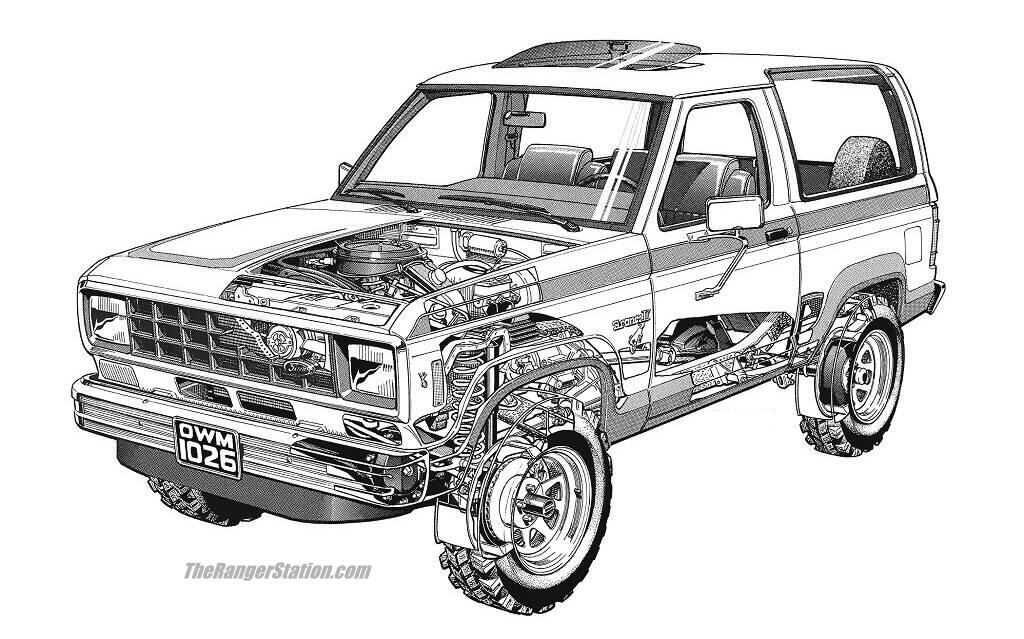
Ford Bronco II Specifications & Facts
The Ford Bronco II was produced from 1984 through 1990 as Ford’s compact, Ranger-based sport-utility vehicle. Although the basic Bronco II platform remained remarkably consistent throughout its seven-year production run, Ford made numerous changes to its engines, transmissions, transfer cases, axles, brakes, body components and available equipment.
Those changes can make it difficult to identify exactly which components belong on a particular Bronco II. Some changes occurred by model year, while others were running production changes that can be identified by the vehicle’s build date.
This page brings together the technical specifications and factual information needed to understand the different Bronco II configurations. Where a component changed during a model year or at a specific production date, that information is noted.
For the story of how the Bronco II developed from its introduction through the end of production, see Ford Bronco II History.
Ford Bronco II Quick Facts
| Specification | Information |
|---|---|
| Model years | 1984–1990 |
| Body style | Two-door SUV |
| Construction | Body-on-frame |
| Platform | Ford Ranger |
| Wheelbase | 94 inches |
| Drive configurations | 2WD and 4WD |
| Maximum seating | 4 |
| Assembly plant | Louisville Assembly Plant, Louisville, Kentucky |
| Production run | Seven model years |
| Rear axle | Ford 7.5-inch |
| Front 4WD axle | Dana 28 TTB / Dana 35 TTB |
| Fuel capacity | 23 gallons |
The Bronco II was always a two-door SUV. Unlike the later Ford Explorer, it was never offered with four doors.
Engines
Ford used three different engines in the Bronco II during its production run: the 2.8-liter Cologne V6, the 2.9-liter Cologne V6 and a rarely ordered 2.3-liter turbodiesel four-cylinder.
2.8-Liter Cologne V6 — 1984–1985
The 2.8-liter V6 powered the first Bronco IIs and remained in production through the 1985 model year.
| Specification | 2.8L V6 |
|---|---|
| Displacement | 171 cubic inches |
| Induction | 2-barrel carburetor |
| Horsepower | 115 hp @ 4,600 rpm |
| Torque | 150 lb-ft @ 2,600 rpm |
| Firing order | 1-4-2-5-3-6 |
| Distributor rotation | Clockwise |
The 2.8-liter was replaced for 1986 by the fuel-injected 2.9-liter V6.
2.9-Liter Cologne V6 — 1986–1990
Ford introduced the fuel-injected 2.9-liter V6 for the 1986 model year. It remained the standard gasoline V6 through the end of Bronco II production.
| Specification | 2.9L V6 |
|---|---|
| Displacement | 177 cubic inches |
| Induction | Electronic fuel injection |
| Horsepower | 140 hp @ 4,600 rpm |
| Torque | 170 lb-ft @ 2,600 rpm |
| Firing order | 1-4-2-5-3-6 |
| Distributor rotation | Clockwise |
The fuel-injection system changed during production. 1986–1987 models used bank injection, while 1988–1990 models used sequential injection.
1986–1987 Engine Details
The 1986–1987 2.9L engines also had several characteristics that are of particular interest to Bronco II enthusiasts:
- Larger 58 mm throttle body
- EGR system
- Factory H-pipe exhaust
The 58 mm throttle body and EGR configuration were limited to the 1986–1987 model years according to Bronco II-specific technical information.
2.3-Liter Turbodiesel
A 2.3-liter turbodiesel four-cylinder was available for the 1986 model year.
The turbodiesel was rarely ordered, making factory diesel Bronco IIs uncommon today.
The 1990 4.0L Mystery
Ford documentation has been reported to list an optional 4.0-liter V6 for the 1990 Bronco II.
The problem is that no production Bronco II equipped with a factory 4.0-liter V6 has ever been documented.
The 4.0-liter engine became available in the new Ford Explorer for 1991, making the 1990 Bronco II listing particularly interesting. Whether the listing represented a planned configuration that never reached production, an error in Ford documentation, or some other situation remains a Bronco II mystery.
Transmissions
The Bronco II was available with both manual and automatic transmissions throughout its production run.
Ford used five different manual transmissions during the seven-year production run. The 1984 model used a four-speed, while 1985–1990 models used five-speed manuals.
Manual Transmissions
| Model year | Transmission | Type | Code |
|---|---|---|---|
| 1984 | Toyo Koygo TK4 | 4-speed manual | X |
| 1985–1987 | Toyo Koygo TK5 | 5-speed manual | 5 |
| 1985–1987 | Mitsubishi FM145 | 5-speed manual | D |
| 1988–1990 | Mitsubishi FM146 | 5-speed manual | D |
| 1988–1990 | Mazda M5OD | 5-speed manual | M |
The different five-speed transmissions were used according to model year, engine and drivetrain configuration. A complete transmission identification guide is useful when determining what was originally installed in a particular Bronco II.
Automatic Transmissions
| Model year/build date | Transmission | Type | Code |
|---|---|---|---|
| 1984 | C5 | 3-speed automatic | W |
| 1985–1990 | A4LD | 4-speed automatic with overdrive | T |
The A4LD was introduced for the 1985 model year, with Bronco IIs built beginning in November 1984 receiving the new transmission. This is an important distinction when identifying early Bronco IIs because the model year and calendar build year do not always match.
The A4LD remained in use through the 1990 model year.
Transfer Cases
Four-wheel-drive Bronco IIs used Borg-Warner transfer cases.
| Application | Transfer case |
|---|---|
| 1984–1990 manual shift | Borg-Warner 1350 |
| 1986–1989 electronic shift | Borg-Warner 1350 |
| 1990 electronic shift | Borg-Warner 1354 |
The electronic system was Ford’s Touch-Drive system. On Bronco II models equipped with electronic shift, buttons in the overhead console allowed the driver to select the four-wheel-drive mode.
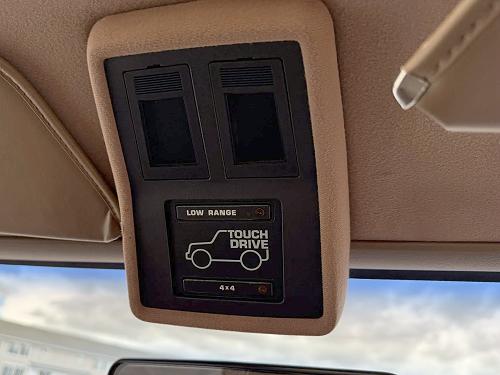
The electronic system allowed the transfer case to shift between 2WD and 4WD High while the vehicle was moving, under the appropriate conditions. Four-wheel-drive Low required the vehicle to be stopped or nearly stopped.
BW1359 ‘Dummy’ Transfer Case
From 1984-1990, Ford equipped 2WD models with a BorgWarner unit commonly identified as the BW1359. While it resembles a conventional 4WD transfer case externally, it is not a functional four-wheel-drive unit.
Instead, the BW1359 is best described as a “dummy” or pass-through transfer case, used almost entirely for manufacturing efficiency and assembly-line standardization.
For more information check out: BW1359 Dummy Transfer Case
In 1990, the final year of Bronco II production, Ford began transitioning some 2WD models away from the BW1359 entirely. Ford accomplished this by using an adapter that slid onto the output shaft of the 2WD transmission. This adapter featured a four-bolt flange, allowing the rear driveshaft to bolt directly to the transmission.
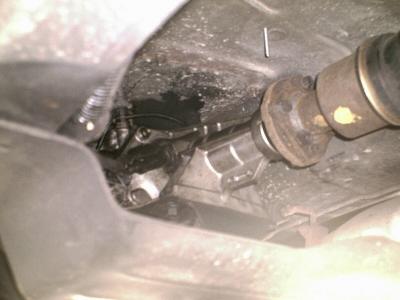
(Photo of flange adapter slid on to the output shaft of a Bronco II 2WD transmission)
Axles & Gear Ratios
Front Axle — 4WD
The Bronco II used Ford’s Twin Traction Beam front suspension with a Dana front differential.
| Production date | Front axle |
|---|---|
| 1984 through October 1990 | Dana 28 TTB |
| November 1990 and later | Dana 35 TTB |
The Dana 35 appeared during the final 1990 production run, making build date important when identifying the front axle in a 1990 Bronco II.
A 1990 model-year Bronco II does not automatically have a Dana 35.
Rear Axle
The Bronco II used a Ford 7.5-inch rear axle throughout production.
Available Gear Ratios
Factory gear ratios included:
- 3.45:1
- 3.73:1
- 4.10:1
The exact axle ratio depended on engine, transmission, drivetrain and vehicle configuration.
Suspension
The Bronco II used Ford’s Twin Traction Beam (TTB) front suspension, derived from the Ranger’s compact-truck architecture.
Front Suspension
- Twin Traction Beam
- Coil springs
- Radius arms
- Shock absorbers
- Dana 28 or Dana 35 differential depending on production date
The TTB system gave the Bronco II independent front-wheel movement while retaining the strength and ground clearance expected from a four-wheel-drive truck.
Rear Suspension
The rear suspension used:
- Leaf springs
- Shock absorbers
- Solid rear axle
Ford used overslung rear springs to provide additional ground clearance.
Brakes
The Bronco II used disc brakes at the front and drum brakes at the rear.
One significant change came for the 1987 model year when Ford added rear anti-lock brakes (RABS).
Rear Anti-Lock Brakes
RABS helped prevent the rear wheels from locking during hard braking, particularly on low-traction surfaces.
The system became part of the Bronco II’s evolution from a basic compact four-wheel-drive vehicle into a more refined passenger-oriented SUV.
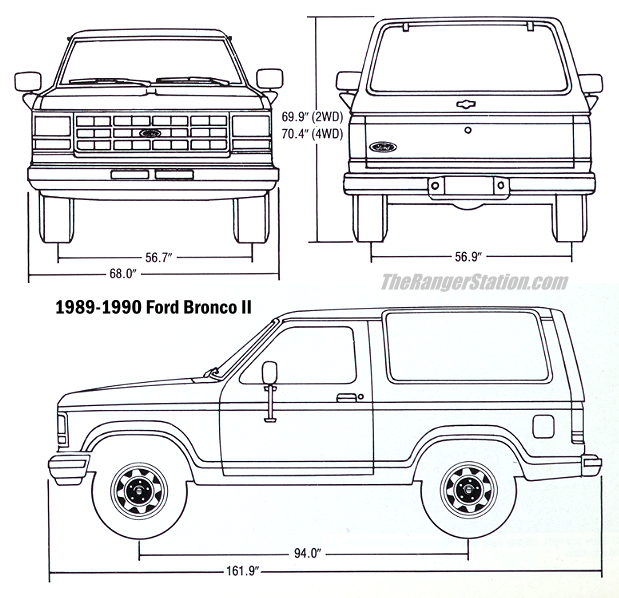
Exterior Dimensions
| Dimension | Measurement |
|---|---|
| Overall length | 161.8 inches |
| Overall width | 68 inches |
| Overall height | 70.4 inches |
| Wheelbase | 94 inches |
The 94-inch wheelbase was one of the defining characteristics of the Bronco II.
Its short wheelbase and compact overall dimensions contributed to its maneuverability on narrow trails and in tight off-road environments.
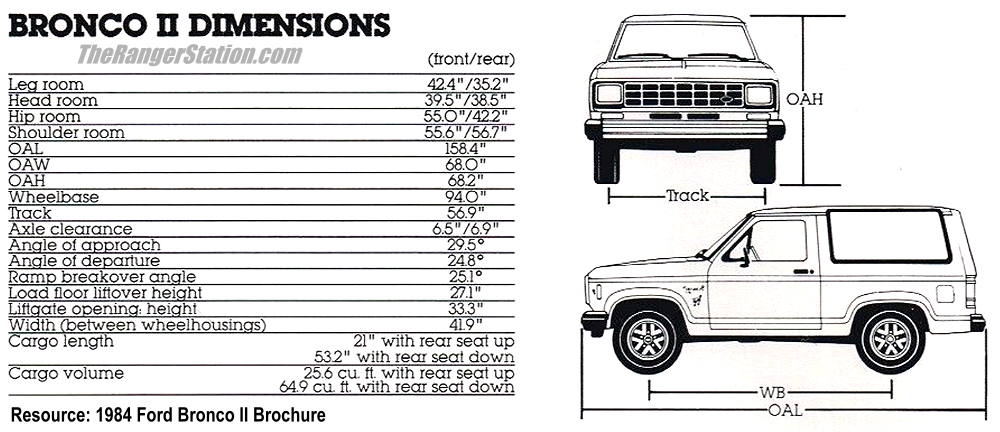
Interior Dimensions
| Dimension | Measurement |
|---|---|
| Front headroom | 39.5 inches |
| Front hip room | 52.7 inches |
| Front shoulder room | 54.6 inches |
| Front legroom | 43.9 inches |
| Rear headroom | 38.9 inches |
| Rear hip room | 42.3 inches |
| Rear shoulder room | 55.9 inches |
| Rear legroom | 35 inches |
Seating
Maximum seating capacity: 4
The Bronco II remained a two-door, four-passenger SUV throughout its production run.
Cargo Capacity
| Capacity | Measurement |
|---|---|
| Luggage capacity | 23.8 cubic feet |
| Maximum cargo capacity | 57 cubic feet |
The standard spare tire was mounted inside the rear cargo area.
An optional swing-out spare tire carrier was available from 1984 through 1990. The 1984–1985 swing-out carriers were aluminum.
Fuel Capacity
The Bronco II used a 23-gallon fuel tank.
The large tank was part of the Bronco II’s original design and gave the compact SUV useful range for highway travel and recreational use.
Body & Glass Facts
Some of the most interesting Bronco II identification clues involve the body glass.
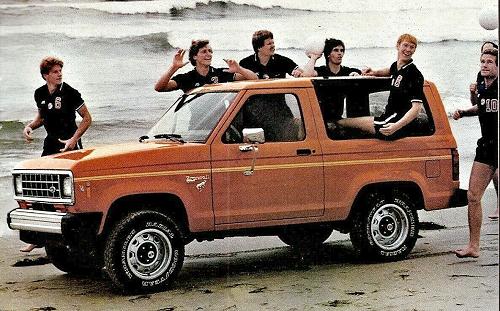
Quarter Flip Side Window
The earliest Bronco IIs, beginning with 1983.5 production, could be equipped with an optional Quarter Flip Side Window.
This removable pop-out rear side window was only used during the early part of production, making it an unusual feature on surviving Bronco IIs.
A dedicated page covers the Quarter Flip Side Window in greater detail.
Side Window Construction
Ford changed the way the rear side glass was installed during the early production run.
1984–early 1985:
- Metal side-window trim
- Glass urethaned/glued into place
Late 1985–1990:
- Rubber weatherstrip-style trim
- Glass bolted into place
This running change is another reason the build date can be useful when identifying an early Bronco II.
Door Vent Windows
Optional opening vent windows were available in the front doors from 1984 through 1988.
They disappeared with the 1989 redesign.
Opening Rear Hatch Glass
An optional opening rear hatch window was available on 1984–1985 Bronco IIs.
These early opening rear windows did not have a rear wiper or defroster.
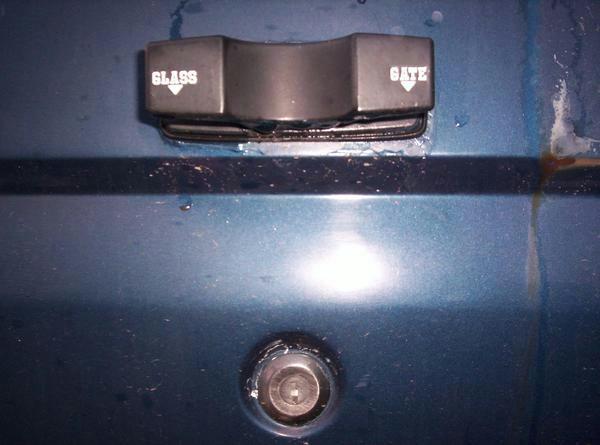
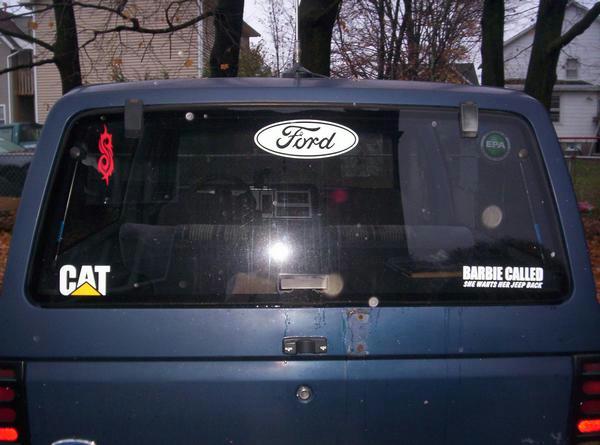
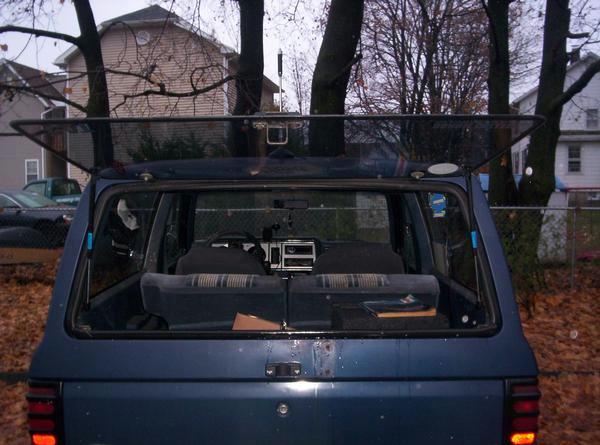
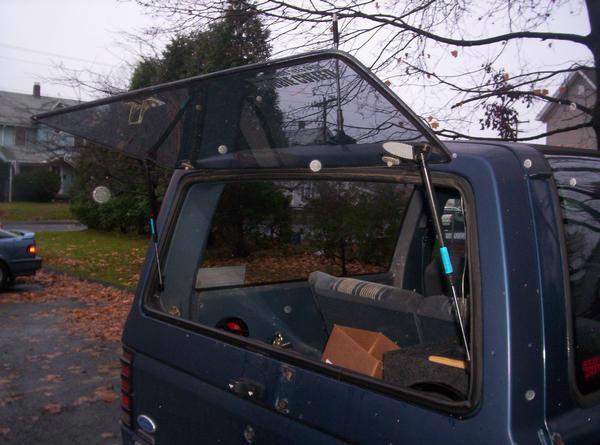
Photos of opening glass in rear hatch – Photos courtesy of ‘IamMonsterMan’
Interior & Equipment Facts
Rear Reclining Bucket Seats
The optional rear reclining bucket seats (instead of the standard 50/50 split-bench seat) were offered strictly during the early first-generation run for the 1984 and 1985 model years.
These rare, pivoting rear seats were restricted to specific high-tier setups:
- Eddie Bauer Edition: Introduced for the 1985 model year, this premium package offered the reclining rear buckets as a luxury standalone catalog option.
- XLS Sport Trim: Available during the 1984–1985 launch years, the sporty XLS package also allowed buyers to check the box for these rear reclining buckets.
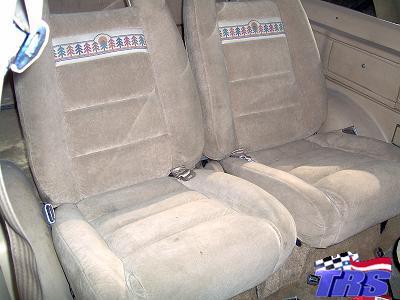
(Rear Reclining Buckets)
Power Windows & Door Locks
Ford introduced the Power Window/Lock Group for the 1985 model year.
The package included:
- Power windows
- Power door locks
Power windows and locks became standard equipment on the Eddie Bauer Edition and remained available on higher-level Bronco II models through the end of production.
XLS Trim
The XLS was offered for 1984–1985.
Its appearance included distinctive three-color XLS tape striping along the lower body sides and rocker-panel moldings.
Swing-Out Spare Tire Carrier
A swing-out spare tire carrier was available throughout the Bronco II’s production run.
The standard configuration mounted the spare tire inside the rear cargo area.
The 1984–1985 swing-out carriers were aluminum. The 1986-1990 tire carriers were tubular steel.
Engine & Exhaust Details
Several smaller technical changes are worth documenting because they are useful to Bronco II owners and builders.
1986–1987: 58 mm Throttle Body
The 1986–1987 2.9-liter V6 used a larger 58 mm throttle body.
1986–1987: EGR
The 1986–1987 Bronco II was equipped with an EGR system. These were the only Bronco II model years to use this configuration according to Bronco II-specific technical information.
1986–1987: Factory H-Pipe
The 1986–1987 2.9-liter V6 exhaust system used a factory H-pipe.
This is of particular interest to enthusiasts modifying the exhaust system because the factory configuration makes conversion to a true dual-exhaust system relatively straightforward.
Important Production-Date Changes
Not every Bronco II change can be described simply by model year.
Several components changed during the production run, making the vehicle build date important.
Major Running Changes
| Change | Production timing |
|---|---|
| Quarter Flip Side Window | Early 1983.5 production |
| Glued-in side glass | 1984–early 1985 |
| A4LD automatic | 1985 model year / 11-84 and later builds |
| Bolted-in side glass | Late 1985–1990 |
| Electronic Touch-Drive | Late 1986 |
| Dana 35 TTB | November 1990 and later |
This is especially important with the 1990 Bronco II. A 1990 model can have equipment that differs from another 1990 depending on its actual production date.
Bronco II Specifications by Year
The following provides a quick overview of the major mechanical changes during the seven-year production run.
| Specification | 1984 | 1985 | 1986 | 1987 | 1988 | 1989 | 1990 |
|---|---|---|---|---|---|---|---|
| Gasoline engine | 2.8L V6 | 2.8L V6 | 2.9L EFI V6 | 2.9L EFI V6 | 2.9L EFI V6 | 2.9L EFI V6 | 2.9L EFI V6 |
| Manual transmission | 4-speed | 5-speed | 5-speed | 5-speed | 5-speed | 5-speed | 5-speed |
| Automatic | C5 | A4LD | A4LD | A4LD | A4LD | A4LD | A4LD |
| 2WD available | No | No | Yes | Yes | Yes | Yes | Yes |
| Turbodiesel | No | No | Yes | No | No | No | No |
| Electronic 4WD | No | No | Late-year | Yes | Yes | Yes | Yes |
| RABS | No | No | No | Yes | Yes | Yes | Yes |
| Door vent windows | Yes | Yes | Yes | Yes | Yes | No | No |
| Dana 35 TTB | No | No | No | No | No | No | Late production |
This table is intended as a quick-reference summary. Individual equipment and drivetrain configurations can vary by production date and option package.
Rare Bronco II Conversions
The Bronco II also became the basis for several unusual factory/dealer or aftermarket conversions.
Two particularly rare examples are:
Sherrod Bronco II Convertible: The Sherrod conversion transformed the Bronco II into an open-air convertible. See the Sherrod Ford Bronco II convertible article for more information.
Bronco II Plus: The Bronco II Plus was another unusual conversion that modified the standard Bronco II body and configuration. See the Ford Bronco II Plus article and documents for more information.
These conversions are separate from Ford’s regular production Bronco II lineup and should not be confused with factory trim levels.
Related Articles
Bronco II Trim Levels & Packages
Ford Bronco II Production Numbers
Bronco II vs Bronco Dimensions
Ford Bronco II Fuel Economy Ratings
Ford Bronco II Sales Brochures
About The Author
Jim Oaks is the founder of TheRangerStation.com, the longest-running Ford Ranger resource online since 1999. With over 25 years of hands-on experience building and modifying Ford Rangers — including magazine-featured builds like Project Transformer — Jim has become one of the most trusted authorities in the Ford Ranger off-road and enthusiast space.
Since launching TheRangerStation.com, Jim has documented thousands of real-world Ranger builds, technical repairs, drivetrain swaps, suspension modifications, and off-road adventures contributed by owners worldwide. TheRangerStation.com has been referenced in print, video and online by enthusiasts, mechanics, and off-road builders looking for practical, and experience-based information.