

(1984 Ford Bronco II)
1984-1990 Ford Bronco II History
The Ford Bronco II was Ford’s answer to the growing market for compact sport-utility vehicles. Based on the new Ford Ranger compact pickup, the Bronco II combined Ranger-derived chassis and mechanical components with a short, enclosed two-door SUV body.
Introduced in March 1983 as a 1984 model, the Bronco II was considerably smaller and lighter than Ford’s full-size Bronco. Ford designed it to appeal not only to traditional four-wheel-drive buyers, but also to people looking for a versatile vehicle for recreation, camping, hunting, fishing and everyday transportation.
The Bronco II remained in production through the 1990 model year. Although its production run lasted only seven model years, it became an important step in Ford’s transition from traditional four-wheel-drive utility vehicles to the modern SUV.
The Bronco II also became an important part of Ford’s Ranger-based vehicle family. Its basic concept would eventually lead to the Ford Explorer, which transformed the compact SUV formula into one of America’s most popular vehicle segments.
The Birth of The Bronco II
Ford already had a successful full-size Bronco, but the market was beginning to move toward smaller sport-utility vehicles. Chevrolet had introduced the S-10 Blazer, GMC offered the S-15 Jimmy, and Jeep’s Cherokee provided another compact alternative.
Ford’s answer was closely tied to its new compact pickup.
The first-generation Ford Ranger was introduced for the 1983 model year, and Ford developed the Bronco II from the same basic platform. Rather than using the Ranger’s pickup bed, Ford created a short enclosed body with a fixed roof, rear cargo area and two side doors.
The Bronco II had a 94-inch wheelbase, more than 10 inches shorter than the full-size Bronco. Its compact dimensions and relatively light weight gave it a very different character from the larger Bronco, particularly when traveling on narrow trails or in tight spaces.
Ford introduced the Bronco II in March 1983, with production beginning in January 1983 at the Louisville Assembly Plant in Louisville, Kentucky. The plant was already producing the Ranger, making it a logical location for production of Ford’s new Ranger-based SUV. Ford’s original 1983 press material identified Louisville as the production location and described the standard four-speed manual transmission.
Early Bronco II Body Features
The earliest Bronco IIs had several features that would change during the first few years of production.
One particularly unusual option was the Quarter Flip Side Window. The removable, pop-out style rear side window was offered on very early Bronco IIs, identified as 1983.5 production, but it was discontinued after the first few months of production. This makes surviving examples equipped with the Quarter Flip Side Window especially interesting to collectors.
The side glass also changed during the early production run. 1984 and early 1985 Bronco IIs used metal side-window trim with the glass urethaned, or glued, into place. Beginning in late 1985, Ford changed to a rubber weatherstrip-style trim with the glass bolted into place.
The front doors also had optional opening vent windows. These remained available through the 1988 model year but disappeared when the Bronco II was redesigned for 1989.
Another early feature was the optional opening rear hatch glass. On 1984–1985 Bronco IIs, buyers could order rear glass that opened independently of the hatch. These early opening windows did not have a rear wiper or defroster.
These details are easy to overlook today, but they illustrate how much Ford’s compact SUV was evolving even during its first few years.
Where Was the Bronco II Built?
All Bronco IIs were built at Ford’s Louisville Assembly Plant in Louisville, Kentucky, alongside the Ford Ranger.
Production began in January 1983, before the Bronco II was introduced as a 1984 model. Production continued through 1990 as Ford prepared to replace the Bronco II with the new Explorer.
The connection between Louisville, the Ranger and the Bronco II was important to Ford’s development of its compact truck and SUV lineup. The Ranger provided the basic architecture, while the Bronco II demonstrated how that architecture could be adapted to a growing SUV market.

(Ford Bronco II XLS)
1984: The Bronco II Arrives
The 1984 Bronco II was introduced as a four-wheel-drive-only vehicle. Power came from Ford’s 2.8-liter Cologne V6.
A four-speed manual transmission was standard, while a C5 three-speed automatic was available as an option. The original Ford press material specifically described the four-speed manual as standard and the automatic as an available transmission.
The Bronco II was offered exclusively as a two-door SUV with a fixed roof. The short wheelbase, narrow body and relatively light weight made it considerably more maneuverable than a full-size four-wheel-drive vehicle.
Ford also recognized that buyers wanted more than a basic utility vehicle.
The XLS trim was available for 1984 and 1985, giving the Bronco II a sportier appearance with its distinctive three-color XLS tape striping along the lower body sides and rocker-panel molding spats.
Other options helped turn the Bronco II into a more versatile personal vehicle. Buyers could order a swing-out spare tire carrier rather than storing the spare inside the rear cargo area. The swing-out carriers used on 1984–1985 Bronco IIs were made of aluminum.
Ford also offered rear reclining bucket seats in place of the standard rear bench on 1984–1985 models. These seats are particularly interesting on early XLS Bronco IIs and vehicles equipped with the factory knob-style sunroof.
The Bronco II was therefore already more than simply a smaller version of the full-size Bronco. Ford was experimenting with ways to make the new compact SUV useful for recreation while also making it attractive as everyday transportation.

(Ford Bronco II Eddie Bauer)
The Eddie Bauer Bronco II
The Eddie Bauer Edition was available for the 1984 model year, giving Bronco II buyers a more upscale alternative to the standard models. The package combined distinctive two-tone exterior colors and trim with additional equipment, giving the compact SUV a more upscale appearance.
The Eddie Bauer concept reflected a larger change taking place in the truck and SUV market: buyers were increasingly purchasing these vehicles as personal and recreational transportation rather than strictly as work vehicles.
The factory Power Window/Lock Group became standard equipment on the Eddie Bauer Edition for 1985, helping distinguish it from more basic Bronco II models.
The Eddie Bauer name would eventually become closely associated with Ford SUVs, appearing on the Explorer and other Ford vehicles for years to come.
1985: New Transmissions and More Options
The 1985 model year continued the basic Bronco II design, but Ford was already expanding the vehicle’s equipment and making it more comfortable and appealing to a broader range of buyers.
The 2.8-liter V6 continued, but 1985 brought important transmission changes. The four-speed manual used in 1984 was replaced by a five-speed manual transmission, while the C5 automatic was replaced by the new A4LD four-speed automatic. The A4LD appeared in 1985 model-year Bronco IIs beginning with vehicles built in November 1984.
The change to five forward speeds gave Bronco II buyers an overdrive gear for highway driving while retaining the low gearing that made the manual transmission useful off-road.
The five-speed manual would remain a part of the Bronco II lineup through the rest of its production run. Ford used five different manual transmissions during the Bronco II’s seven-year production run: the 1984 four-speed and four different five-speed transmissions used from 1985 through 1990. The individual transmission models and their applications are covered in detail on the Bronco II Specifications & Facts page.
One of the most important additions for 1985 was the new Power Window/Lock Group. For the first time, buyers could order factory power windows and power door locks on the Bronco II. The Power Window/Lock Group became standard equipment on the Eddie Bauer Edition and remained available on higher-end Bronco IIs for the rest of the model’s production.
The 1985 model year also saw the running change from the early glued-in side glass to the later rubber-weatherstrip and bolted-in design. This was one of several subtle changes Ford made to the Bronco II without changing the overall appearance of the vehicle.
The Bronco II was becoming increasingly sophisticated for a compact truck-based SUV.
1986: A Major Mechanical Evolution
The 1986 model year brought some of the most important mechanical changes in Bronco II history.
Ford replaced the carbureted 2.8-liter V6 with a fuel-injected 2.9-liter Cologne V6. The new engine became the primary gasoline engine for the remainder of Bronco II production.
Ford also expanded the Bronco II’s potential market by introducing two-wheel drive for the first time. Until 1986, every Bronco II had been a four-wheel-drive vehicle.
A 2.3-liter turbodiesel was also available, although relatively few Bronco IIs were ordered with the diesel engine.
The Strange 2WD Bronco II
The introduction of the 2WD Bronco II produced one of the more unusual aspects of the vehicle’s drivetrain history.
Even though a Bronco II could now be ordered without four-wheel drive, many 2WD models continued to use a drivetrain based on the 4WD configuration. The Borg-Warner 1359 transfer case used in these vehicles was essentially a dummy transfer case. It had a permanent seal where the front driveshaft would normally connect because the vehicle had no front-drive capability.
In other words, some 2WD Bronco IIs effectively had a 4WD-style transmission and transfer-case arrangement even though they could only drive the rear wheels.
Why Ford chose this approach rather than simply using the conventional 2WD Ranger transmission arrangement is unclear. The Ranger and Bronco II shared much of their drivetrain architecture, making the difference particularly interesting.
By 1990, some 2WD Bronco IIs began appearing with a more conventional 2WD transmission. These vehicles used an adapter on the transmission output that provided a four-bolt flange for the driveshaft.
For an SUV that was supposed to be a simpler 2WD version, the drivetrain was anything but simple.
Touch-Drive Arrives
Another important 1986 development was Ford’s electronic four-wheel-drive system.
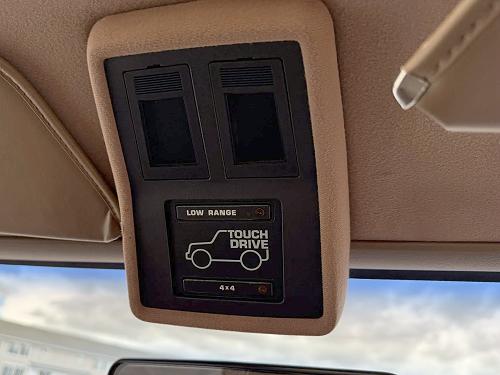
Late in the 1986 model year, the Bronco II became available with an electronic Touch-Drive transfer case. Instead of requiring the driver to manually shift the transfer case, four-wheel drive could be selected using buttons located in a small overhead console.
The system was an early example of the electronic four-wheel-drive controls that would become increasingly common on Ford trucks and SUVs.
The electronic shift-on-the-fly transfer case remained an option through the end of Bronco II production.
1987: More Refinement and Safety
The 1987 Bronco II continued with the fuel-injected 2.9-liter V6 and the expanding range of equipment introduced during the previous model years.
One important safety improvement was the addition of rear anti-lock brakes (RABS) as standard equipment.
Ford continued offering the Bronco II in a variety of configurations, allowing buyers to choose between basic transportation and more highly equipped models.
By this point, the Bronco II had become an established part of Ford’s light-truck lineup. It was no longer simply Ford’s answer to the S-10 Blazer and S-15 Jimmy; it was part of a rapidly growing SUV market in which appearance, comfort and convenience were becoming increasingly important.

(1988 Ford Bronco II XL Sport)
1988: The Bronco II Becomes a Lifestyle Vehicle
Ford continued expanding the Bronco II’s appearance and equipment offerings for 1988.
The XL Sport was introduced as a sportier alternative, giving the Bronco II a more aggressive appearance with special trim and equipment.
The Bronco II could now be configured in ways that would have been unusual for a basic compact utility vehicle only a few years earlier. Sport appearance packages, upgraded interiors, power accessories and other options allowed buyers to personalize the vehicle for recreation and everyday use.
The optional door vent windows were also still available through 1988, making the 1988 model the final Bronco II to offer them.
The market was changing rapidly. Compact SUVs were becoming lifestyle vehicles, and Ford was preparing to take the concept to the next level.

1989: A New Bronco II
The 1989 model year brought the most significant visual change in Bronco II history.
Ford redesigned the front end and updated the interior, bringing the Bronco II’s appearance more closely in line with the newly redesigned 1989 Ford Ranger. Although the Bronco II retained its basic Ranger-derived architecture, the updated styling made it look considerably more modern.
The redesign also eliminated the optional door vent windows that had been available since the early Bronco II years.
Ford continued expanding the model’s upscale and appearance-oriented offerings, including the XLT Plus and the popular Eddie Bauer Edition.
By 1989, the Bronco II was a very different vehicle from the one Ford had introduced six years earlier. The basic concept remained the same, but Ford had transformed the small Ranger-based 4×4 into a much more refined personal SUV.
The redesigned Bronco II represented the final major evolution of the model.
For a detailed look at the models, trim levels and appearance packages offered throughout the production run, see Bronco II Trim Levels & Packages.
Late-Production Changes
The Bronco II continued into the 1990 model year with relatively few major changes because Ford was preparing to replace it with the Explorer.
There were still some interesting running production changes.
One of the most significant for four-wheel-drive enthusiasts involved the front axle. Bronco IIs built before November 1990 used the Dana 28 TTB front axle, while Bronco IIs built from November 1990 onward received the Dana 35 TTB.
Because this was a production-date change rather than a simple model-year change, not every 1990 Bronco II has the same front axle.
The late-production 2WD drivetrain changes also made the final model year unusual. Some 2WD Bronco IIs continued using the earlier drivetrain arrangement while others began appearing with the more conventional 2WD transmission and driveshaft arrangement.
These details are easy to miss when looking only at model-year specifications, but they demonstrate how Ford continued making production changes right up to the end of the Bronco II’s life.
1990: The Final Bronco II
The 1990 model year was the final year for the Bronco II.
By this time, the compact SUV market had changed dramatically since the Bronco II was introduced. Buyers increasingly wanted more interior space, greater passenger capacity and easier access to the rear seating area.
The Bronco II had remained a two-door SUV throughout its entire production run.
Ford’s replacement would retain the basic concept of combining Ranger-related truck architecture with an enclosed SUV body, but it would offer something the Bronco II never did: a four-door configuration.
That vehicle was the Ford Explorer.
Bronco II production ended in 1990 as Ford transitioned to the new Explorer.
From Bronco II to Explorer
The Ford Explorer was not a complete departure from the Bronco II.
Instead, it represented the next stage in Ford’s development of the Ranger-based SUV concept.
The Explorer retained the basic idea of combining Ford’s compact truck architecture with an enclosed SUV body, but it was larger and offered both two- and four-door configurations. The additional space, passenger capacity and four-door accessibility allowed Ford to appeal to families and buyers who had outgrown the limitations of the Bronco II.
The transition from Bronco II to Explorer was therefore an important moment in Ford’s SUV history.
The Bronco II helped establish the concept. The Explorer would turn that concept into one of Ford’s most important vehicle lines.
The Bronco II Rollover Controversy
The Bronco II’s short wheelbase, narrow track and relatively high center of gravity contributed to handling characteristics that eventually became the subject of considerable controversy.
During the late 1980s and early 1990s, the Bronco II received significant attention from government agencies, safety organizations, the media and attorneys over rollover accidents.
The controversy became one of the most important—and controversial—aspects of the Bronco II’s history.
It is also important to understand the issue in the context of the era. The Bronco II was one of many short-wheelbase, body-on-frame four-wheel-drive vehicles being sold at a time when SUVs were evolving from specialized utility vehicles into mainstream passenger transportation.
The rollover controversy ultimately became part of the Bronco II’s legacy, but it represents only one part of the vehicle’s history.
Bronco II Production Numbers
The Bronco II enjoyed strong production throughout much of its seven-year run.
More than 100,000 Bronco IIs were produced in several individual model years, demonstrating the popularity of Ford’s compact SUV. Production declined significantly as the model approached the end of its production run and Ford prepared to introduce the Explorer.
For complete year-by-year production figures, including 4×4 and 4×2 production, see Ford Bronco II Production Numbers.
The Bronco II Legacy
Although production ended more than three decades ago, the Ford Bronco II has developed a loyal following among owners, collectors and off-road enthusiasts.
Its compact size, body-on-frame construction, Ranger-based mechanical components and four-wheel-drive capability make it an appealing platform for restoration, modification and off-road use.
Its small dimensions remain one of its greatest advantages. A Bronco II can fit into trails, campsites and other places where larger modern SUVs can be cumbersome. Its relatively simple construction also makes it attractive to enthusiasts who enjoy working on and modifying their own vehicles.
The Bronco II also occupies an important place in Ford history. It connected the compact Ranger pickup to the rapidly expanding SUV market and helped establish the formula that Ford would use for the Explorer.
But the Bronco II is more than simply a predecessor to the Explorer.
It was Ford’s first compact SUV, and during its seven-year production run it evolved from a relatively basic four-wheel-drive utility vehicle into a much more refined and lifestyle-oriented SUV. Along the way, Ford experimented with different body features, convenience equipment, drivetrain configurations and four-wheel-drive technology.
Those changes are part of what makes the Bronco II so interesting today.
For enthusiasts, the Bronco II remains a small, relatively simple, Ranger-based SUV that can be restored, modified and taken places that larger vehicles cannot easily reach.
Decades after the last one left the Louisville Assembly Plant, that combination of compact size, mechanical simplicity and off-road capability continues to give the Ford Bronco II a unique place in Ford truck and SUV history.
Related Articles / Links
1984-1990 Ford Bronco II Specs & Facts
Bronco II Trim Levels & Packages
Ford Bronco II Production Numbers
Ford Bronco II Fuel Economy Ratings
Ford Bronco II Sales Brochures
About The Author

Jim Oaks is the founder of TheRangerStation.com, the longest-running Ford Ranger resource online since 1999. With over 25 years of hands-on experience building and modifying Ford Rangers — including magazine-featured builds like Project Transformer — Jim has become one of the most trusted authorities in the Ford Ranger off-road and enthusiast space.
Since launching TheRangerStation.com, Jim has documented thousands of real-world Ranger builds, technical repairs, drivetrain swaps, suspension modifications, and off-road adventures contributed by owners worldwide. TheRangerStation.com has been referenced in print, video and online by enthusiasts, mechanics, and off-road builders looking for practical, and experience-based information.