
Ford Ranger & Bronco II Automatic Transmissions
The 1983-2011 Ford Ranger and 1984-1990 Ford Bronco II used a variety of automatic transmissions during their production runs. Many of the transmissions were shared between the two vehicles, particularly from 1984-1990.
If you’re trying to identify the automatic transmission in your Ranger or Bronco II, the easiest place to start is the Federal Safety Compliance Certification Label. The transmission identification code is listed in the TRANS box on the label.
Once you have the transmission code, use the chart below to determine which transmission your truck was equipped with. You can then go to that transmission’s section for specifications, identification information, applications, common problems, and additional technical information.
Finding Your Transmission Code
The easiest way to identify the transmission originally installed in your Ford Ranger or Bronco II is to look at the Federal Safety Compliance Certification Label, commonly called the door-jamb sticker.
The label is normally located on the driver’s side door or door jamb.
Identification
- Paint Code
- Wheelbase in Inches
- Transmission Code
- Rear axle code
- Tape (Striping)
Look for the box labeled TRANS. The letter or number shown in this box is the vehicle’s transmission identification code.
For example, if the TRANS box contains the letter T, use the transmission chart below to determine which transmission and application corresponds to that code.
For Manual Transmissions Visit:
Ford Ranger / Bronco II Manual Transmissions
Transmission Model / Trans Code Chart
| Model | Trans Code | Vehicle | Speed | Ratios |
| C3 | V | 1983-1984 2WD Ranger | 3-Speed | 1st: 2.47
2nd: 1.47 3rd: 1.00 |
| C5 | W | 1983-1984 4WD Ranger
1984 Ford Bronco II |
3-Speed | 1st: 2.46
2nd: 1.46 3rd: 1.00 |
| A4LD | T | 1985-1994 Ranger
1985–1990 Bronco II |
4-Speed | 1st: 2.47
2nd: 1.47 3rd: 1.00 4th: 0.75 Reverse: 2.10 |
| 4R44E | T | 1995-2000 4-Cylinder & 3.0L Rangers | 4-Speed | 1st: 2.47
2nd: 1.47 3rd: 1.00 4th: 0.75 |
| 4R55E | T | 1995-1997 4.0L Rangers | 4-Speed | 1st: 2.47
2nd: 1.47 3rd: 1.00 4th: 0.75 |
| 5R44E | D | 2001-2009 2.3L & 3.0L Ranger | 5-Speed | 1st: 2.47
2nd: 1.86 3rd: 1.47 4th: 1.00 5th: 0.75 Reverse: 2.10 |
| 5R55E | D | 1998-2011 4.0L Rangers | 5-Speed | 1st: 2.47
2nd: 1.87 3rd: 1.47 4th: 1.00 5th: 0.75 |
Transmission Descriptions
C3 Automatic
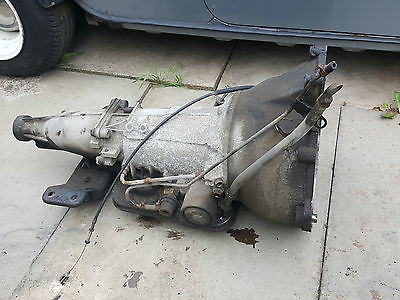
The Ford C3 is a light duty 3-speed automatic transmission that was available in the 1983-1984 2WD Ford Ranger. This transmission was replaced by the A4LD in 1985. The C3 is a weak transmission that was only intended for light duty 4-cylinder applications, and small V6’s. Because it’s light duty, it was not used in 4×4 applications. It was eventually replaced by the A4LD, which added a fourth, overdrive gear.
C5 Automatic
The C5 is a three-speed automatic transmission based on the Ford C4, but with a lockup clutch in the torque converter to improve highway fuel economy. It was used in the 1983–1984 Ford Ranger 4WD and the 1984 Ford Bronco II.
Unlike the later electronically controlled automatic transmissions used in the Ranger, the C5 was not computer controlled. It was the only automatic transmission used in the four-wheel-drive Ranger during this early period that did not require electronic control.
The C5 is generally considered a good, durable transmission for its intended applications.
Check Out: C5 Transmission Diagnosis
A4LD Automatic
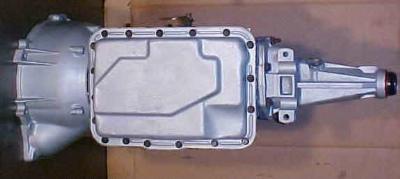
The C3 was modified into the A4LD 4-speed automatic by adding an overdrive gear, which the C3 lacked. This was the first Ford automatic to use an EEC-controlled torque converter lock-up clutch. Electronic shift control for the 3–4 shift was later added, another first, though other gears remained hydraulic.
The A4LD 4-speed automatic transmission went on to become the 4R44E, 4R55E, and finally the 5R55E. However, it had reliability issues from 1985-1987. Reliability began to improve in mid-1988 when Ford introduced the dual solenoid setup. Models from 1989 and later benefited from Ford’s broader engineering push to improve “Noise, Vibration, and Harshness” (NVH) and general durability, making them noticeably better than 1985–1987 models.
I generally recommend that people stay away from the 1985-1987 A4LD transmission. If you don’t want to replace it, you can extend its working lifespan using a few simple methods and modifications (this applies to the 1988-1990 models as well):
Place an aftermarket transmission cooler in the return line in addition to the factory cooler. It can help keep the transmission cool because too much heat buildup will destroy it. You should keep the temperature of the transmission below 200 degrees Fahrenheit maximum. Install a transmission temperature gauge to keep track of its temperature.
Add an A4LD valve body kit such as a Superior Shift Kit or a TransGo Shift Kit which adds pressure inside the valve assembly. When pressure increases, it keeps the clutch packs from separating, as well as keeping the clutches and associated bands from overheating.
Check Out: A4LD Automatic Transmission
4R44E / 4R55E Automatics
The 4R44E means 4 forward gears, rear-drive platform (or 4WD, with a different tail shaft housing), rated for 440 ft/lb. torque (after torque converter multiplication) and electronic shifting. 4R55E is the same but heavier duty and rated for 550 ft·lbs.
For the 1995 model year, the A4LD was upgraded to feature full electronic controls, resulting in a new transmission family. The two major versions of this new transmission were the 4R44E and 4R55E. The transmissions are fundamentally similar in design, varying only in the durability of key components based on the type of duty they were to be used for.
The 4R44E was a lighter-duty transmission used with 2.3L or 3.0L engines.
The 4R55E was a heavier-duty transmission used with the 4.0L V6 engines
The 4R55E was short-lived however as it was replaced in all instances where it was used with the newer 5R55E during the 1997 model year. The 4R44E continued on through the end of the 1990’s before being replaced by the 5R44E (5R55E’s relative).
Check Out:
Replacing A Ford 4R55E with a 5R55E
Ford 4R44E / 4R55E / 5R55E Valve Body Gasket
5R55E / 5R44E Automatics
The 5R55E, though mechanically identical to the 4-speed 4R55E, is a five-speed transmission. The ability to produce five forward gears is by improved software control. The 5R55E introduced adaptive shift control and sophisticated friction to friction shift ability. The 5R55E introduced Directional high energy frictions and eliminated all but one thrust washer with high-capacity thrust bearings. It was the first 5-speed electronically controlled transmission in an American vehicle.
The 5R44E was a lighter-duty transmission used with the 2.3L or 3.0L engines.
The 5R55E was a heavier-duty transmission used with the 4.0L OHV and 4.0L SOHC V6 engines.
Check Out: Ford 4R44E / 4R55E / 5R55E Valve Body Gasket
Bellhousing Information
The SOHC and OHV use very similar bolt patterns. The only difference is the top right bolt (as viewed from the rear) was moved down and to the right by about 2-inches. The rest of the bolts line up. This bolt was moved for clearance for one of the SOHC timing chains. Looking into the transmission, it would be the top left bolt being moved down and to the left. A 5R55E automatic transmission bellhousing has the holes to mount to both the 4.0 OHV and 4.0 SOHC.

The 4r (4R44E / 4R55E / A4LD) transmission bellhousings have a larger starter pocket than the 5R transmissions (see photo above).
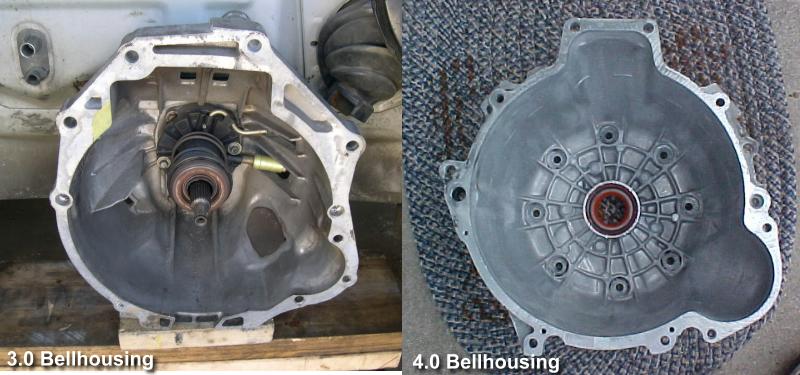
The 3.0L Bellhousing has a wider bolt spacing at the top and is angled. It also uses a 3-bolt starter. The 4.0L bellhousing has a narrower bolt pattern at the top and uses a 2-bolt starter.
The 4.0L & 3.0L engines have the starter mounted on the driver’s side. The 2.0L, 2.3L, and 2.5L engines have the starter mounted on the passenger side.
The Ford 2.8L, 2.9L, and 4.0L Cologne engines share the same ‘Taunus’ bellhousing bolt pattern.
The Ford 3.0L uses a different ‘Vulcan’ V6 bellhousing bolt pattern.
The Ford 2.0L, 2.3L and 2.5L Lima engines use the ‘Lima’ bellhousing bolt pattern.
The Ford 2.3L Duratec uses a ‘Duratec’ bellhousing bolt pattern.
Visual Identification (Pan Bolts)

Visual Identification (Photos)
C3 Automatic Transmission
(Click the photos to enlarge)
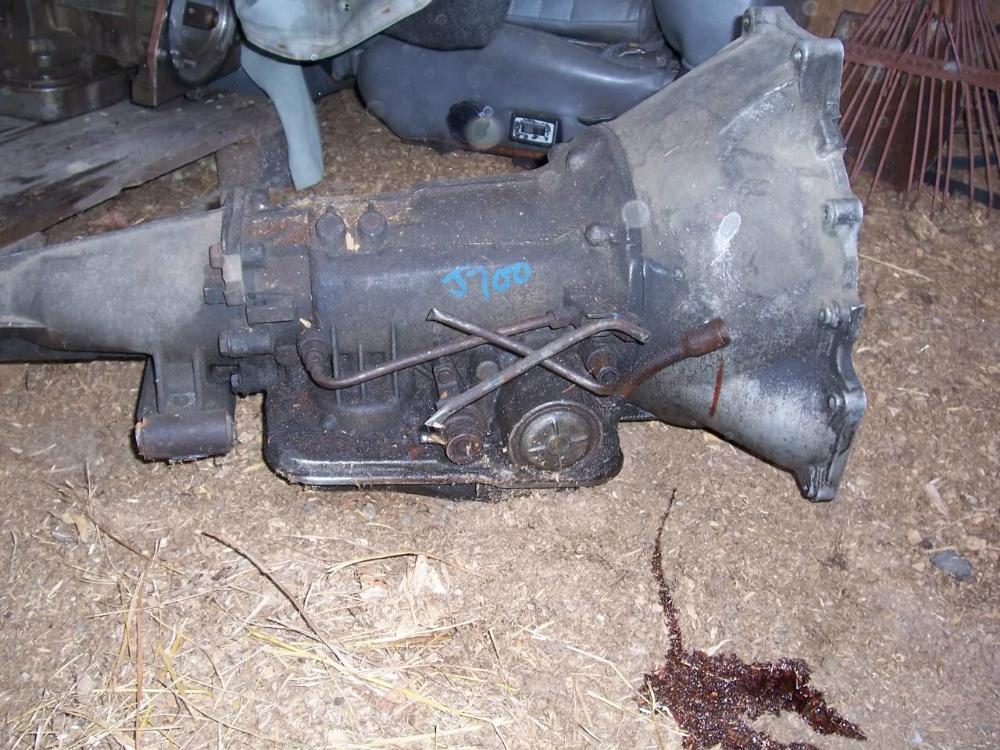
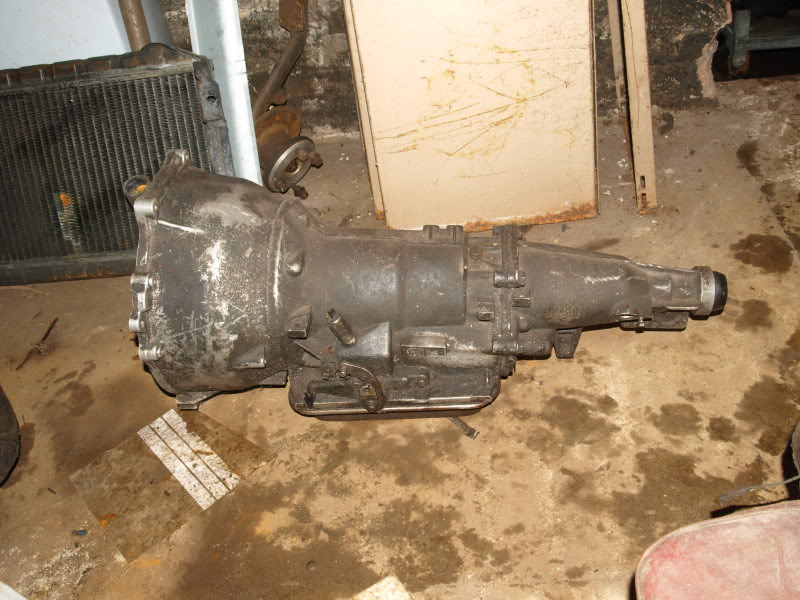
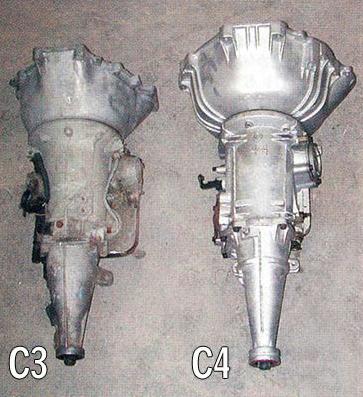

C5 Automatic Transmission
(Click the photos to enlarge)
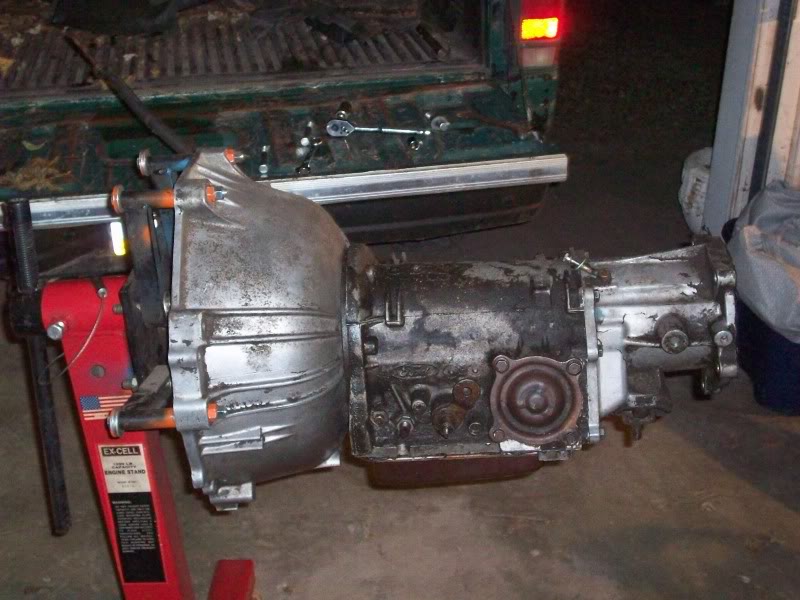


The C5 automatic will have a hump in the bottom of the transmission pan. Note how the one shown has a smoother bellhousing than the one on the engine stand. The C5 on the engine stand has a V8 bellhousing. You can see it’s ribbed for more support. The other photo is of a C5 from a Ford Ranger that someone added a transfer case doubler to.
A4LD Automatic Transmission
(Click the photos to enlarge)

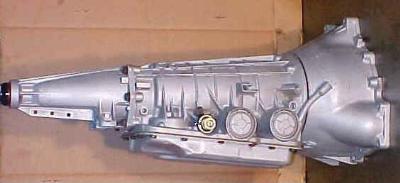
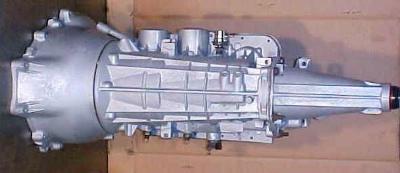


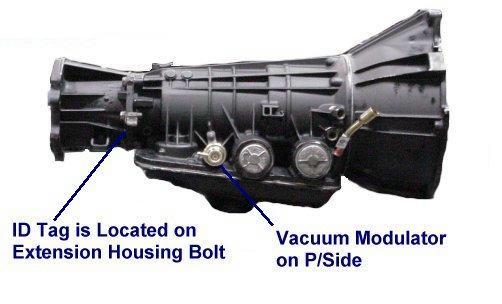
4R44E / 4R55E Automatic Transmission
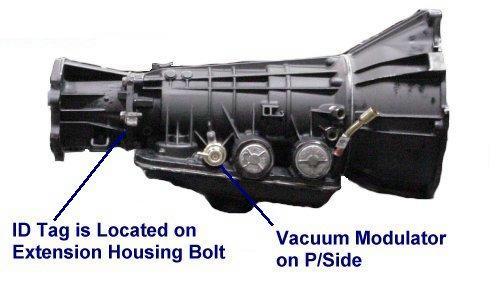
The 4R44E and 4R55E transmission main aluminum gear cases, 16-bolt oil pans, and external dimensions are completely identical making these transmissions look very similar. The best way to differentiate a Ford 4R44E transmission from a 4R55E is by looking at the bellhousing bolt pattern, which is uniquely shaped to match specific engine blocks. A 4R55E will always feature the distinct Ford 4.0L Cologne V6 bolt pattern, which includes an extra structural reinforcement bolt hole near the top, whereas a 4R44E will feature a completely different shape designed to match either a 3.0L Vulcan V6 or a 2.3L 4-cylinder engine.Additionally, if the torque converters are still resting inside the bellhousings, the heavier-duty 4R55E features a visibly larger diameter converter with a wider flexplate bolt circle compared to the more compact unit found in the 4R44E.
(Click the photos to enlarge)
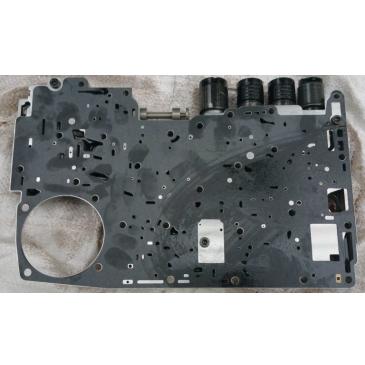

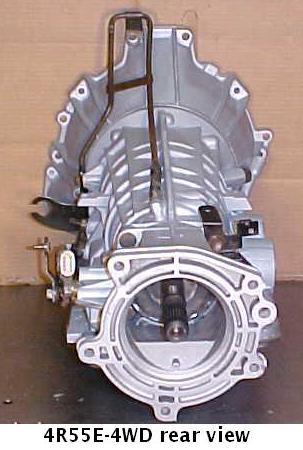


5R44E / 5R55E Automatic Transmission
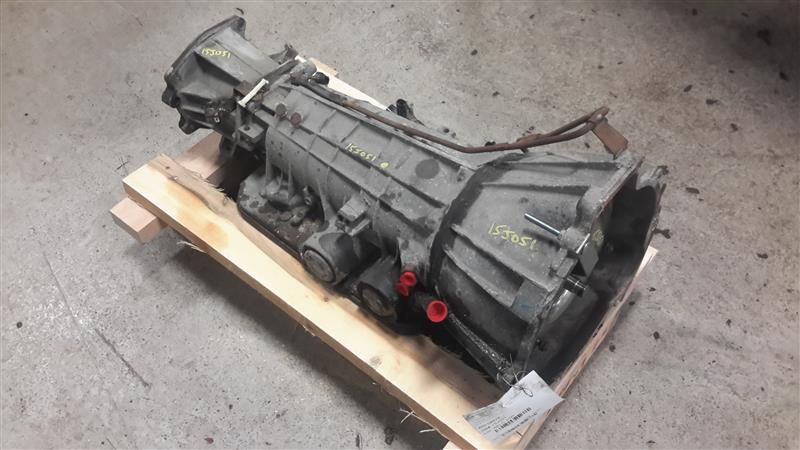
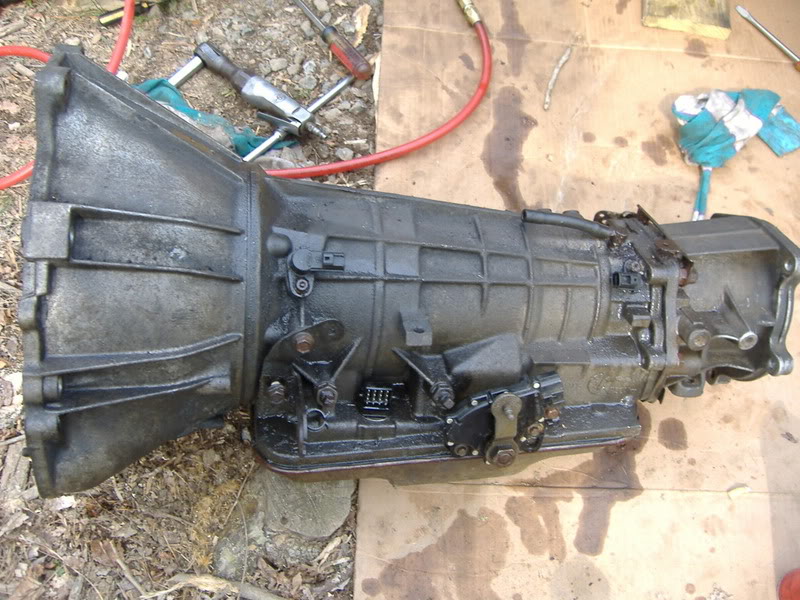
The 5R44E & 5R55E main aluminum gear cases, 16-bolt oil pans, and electrical connectors are identical making these transmissions look almost identical. The best way to differentiate a Ford 5R44E transmission from a 5R55E is by looking at the bellhousing. A 5R55E will always feature the distinct Ford 4.0L Cologne V6 bolt pattern, complete with an extra structural reinforcement bolt hole, while a 5R44E will feature a completely different shape designed to match either a 3.0L Vulcan V6 or a 2.3L Duratec 4-cylinder engine. Additionally, if the torque converters are still installed, the 5R55E features a visibly larger diameter converter with a wider bolt circle compared to the more compact unit found in the 5R44E.
(Click the photos to enlarge)



Related Articles
Ford Ranger Fluids & Capacities
Ford 4R44E / 4R55E / 5R55E Valve Body Gasket
Replacing A Ford 4R55E with a 5R55E
7-Common Problems With The Ford 4R55E Transmission
Automatic Transmission Fluid Change
Put A GM 700R4 Behind Your Ford 4.0L V6
Installing a Torque Converter lock up switch
Adjust / Repair Instrument Cluster Gear Indicator
A4LD Pressure Switch For Lock Up Torque Converter
AllanD’s Transmission & Transfer Case Guide
Automatic Transmission Troubleshooting
Last Updated:
About The Author
Jim Oaks is the founder of TheRangerStation.com, the longest-running Ford Ranger resource online since 1999. With over 25 years of hands-on experience building and modifying Ford Rangers — including magazine-featured builds like Project Transformer — Jim has become one of the most trusted authorities in the Ford Ranger off-road and enthusiast space.
Since launching TheRangerStation.com, Jim has documented thousands of real-world Ranger builds, technical repairs, drivetrain swaps, suspension modifications, and off-road adventures contributed by owners worldwide. TheRangerStation.com has been referenced in print, video and online by enthusiasts, mechanics, and off-road builders looking for practical, and experience-based information.