
Ford Ranger & Bronco II Manual Transmissions
The 1983-2011 Ford Ranger and 1984-1990 Ford Bronco II used a variety of manual transmissions during their production runs. Many of the transmissions were shared between the two vehicles, particularly from 1984-1990.
If you’re trying to identify the manual transmission in your Ranger or Bronco II, the easiest place to start is the Federal Safety Compliance Certification Label. The transmission identification code is listed in the TRANS box on the label.
Once you have the transmission code, use the chart below to determine which transmission your truck was equipped with. You can then go to that transmission’s section for specifications, identification information, applications, common problems, and additional technical information.
Finding Your Transmission Code
The easiest way to identify the transmission originally installed in your Ford Ranger or Bronco II is to look at the Federal Safety Compliance Certification Label, commonly called the door-jamb sticker.
The label is normally located on the driver’s side door or door jamb.
Identification
- Paint Code
- Wheelbase in Inches
- Transmission Code
- Rear axle code
- Tape (Striping)
Look for the box labeled TRANS. The letter or number shown in this box is the vehicle’s transmission identification code.
For example, if the TRANS box contains the letter X, use the transmission chart below to determine which transmission and application corresponds to that code.
For Automatic Transmissions Visit:
Ford Ranger / Bronco II Automatic Transmissions
Transmission Model / Trans Code Chart
| Model | Trans Code |
Vehicle | Speed | Ratios |
| Toyo Kogyo TK4 | X | 1983-1984 Ranger 4X4
1984 Bronco II |
4-Speed | 1st: 3.96
2nd: 2.08 3rd: 1.39 4th: 1.00 |
| Toyo Kogyo TK5 | 5 | 1983-1987 Ranger 2WD
1984-1987 Ranger 4X4 1985-1987 Bronco II |
5-Speed | 1st: 3.96
2nd: 2.07 3rd: 1.39 4th: 1.00 5th: 0.84 |
| Mitsubishi FM132 | D | 1988-1992 2.9L 2WD | 5-Speed | 1st: 3.769
2nd: 2.210 3rd: 1.516 4th: 1.000 5th: 0.812 Reverse: 3.400 |
| Mitsubishi FM145 | D | 1985-1987 Ranger 4X4
1985-1987 Bronco II |
5-Speed | 1st: 3.769
2nd: 2.210 3rd: 1.516 4th: 1.000 5th: 0.812 Reverse: 3.400 |
| Mitsubishi FM146 | D | 1988-1992 2.9L Ranger 4X4
1988-1990 Bronco II |
5-Speed | 1st: 3.769
2nd: 2.210 3rd: 1.516 4th: 1.000 5th: 0.812 Reverse: 3.400 |
| Mazda M5OD-R1 | M | 1988-2011 4-Cylinder Rangers
1988-1992 2.9L 2WD Rangers 1991-2008 3.0L Ranger 1988-1990 Bronco II |
5-Speed | 1st: 3.72
2nd: 2.20 3rd: 1.50 4th: 1.00 5th: 0.79 Reverse: 3.40 |
| Mazda M5OD-R1 | M | 1990-2000 4.0L Ranger
(Different gear ratios for the 4.0L) |
5-Speed | 1st: 3.40
2nd: 2.05 3rd: 1.31 4th: 1.00 5th: 0.79 Reverse: 3.40 |
| Mazda M5OD-R1HD | J | 2001-2011 4.0L SOHC Ranger | 5-Speed | 1st: 3.40
2nd: 2.05 3rd: 1.31 4th: 1.00 5th: 0.79 |
Transmission Descriptions
Toyo Kogyo TK 4 (4-Speed Manual)
Years Used: 1983–1984
Drivetrain Configuration: Available in 4×4 models
Engine Pairings: 2.0L 4-Cylinder, 2.3L Lima 4-Cylinder, and early 2.8L Cologne V6
Overall 4×4 Length: 25.937-Inches
Adapter length is 5.5-Inches long
Key Characteristics:
The TK4 was a four-speed manual transmission used in early Ranger 4×4 applications. Manufactured by Mazda’s Toyo Kogyo industrial division, it is a fully synchronized unit that does not include an overdrive gear. The transmission case is built with an integrated, non-removable aluminum bellhousing. It is physically distinguished by a cast, ribbed 14-bolt pan on the bottom of the case and a top cover where the shifter mechanism mounts. Unlike the heavy gear oils used in early 4×4 transmissions, the TK4 uses Mercon or Type F Automatic Transmission Fluid (ATF). Because finding surviving versions of this 4-speed configuration is difficult today, it is considered quite rare.
Toyo Kogyo TK 5 (5-Speed Manual)
Ford Part Number: E57A-7003-DA
Years Used: 1983–1987
Drivetrain Configuration: Available in both 2WD and 4×4 models
Engine Pairings: 2.0L 4-Cylinder, 2.3L Lima 4-Cylinder, 2.8L Cologne V6, and 2.9L Cologne V6
Overall 4WD Length: 25.937-Inches
Key Characteristics:
The TK 5 was a step-up option from the TK 4, utilizing the exact same foundational 4-speed core casting but adding an overdrive 5th gear assembly bolted directly to the rear section of the main case. It can be identified externally by its more rounded aluminum housing architecture compared to contemporary Mitsubishi boxes, a 14-bolt bottom pan, and a main case that tapers noticeably toward the tail housing. To operate smoothly, the TK 5 requires Mercon Automatic Transmission Fluid (ATF) rather than standard gear oil. Early production models (1983–1984) feature an externally mounted hydraulic slave cylinder on the left side of the transmission housing, whereas late-model versions (1985–1987) transitioned to a more modern internal slave cylinder that slips directly over the input shaft.
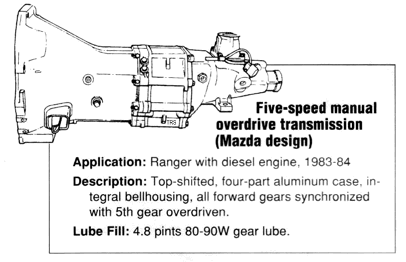
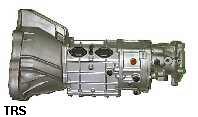
Mitsubishi FM132 (5-Speed Manual)
Years Used: 1988–1992
Drivetrain Configuration: 2WD (Rear-Wheel Drive)
Engine Pairings: 2.9L Cologne V6
Assembled Length – 28.687-Inches
Key Characteristics:
The FM132 was engineered strictly for light-duty 2WD trucks and is distinguished by its distinct multi-piece case architecture featuring a removable aluminum bellhousing. It uses a top-shifting design and requires heavy standard gear oil rather than the automatic transmission fluid found in later Ranger manual gearboxes. Mechanics and builders quickly identify it by looking at the underside of the main case, which features a prominent 12-bolt stamped steel oil pan.
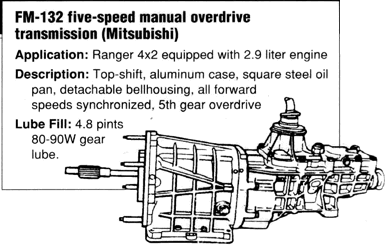
Mitsubishi FM145 (5-Speed Manual)
Ford Part Number: E67A-7003-FA
Years Used: 1985–1987
Drivetrain Configuration: 4×4 (Four-Wheel Drive)
Engine Pairings: 2.8L Cologne V6 (1985), 2.9L Cologne V6 (1986–1987), and 2.3L Mitsubishi 4D55 Turbo Diesel
Assembled 4WD Length – 28.687-Inches
Key Characteristics:
The FM145 was one of the earliest Mitsubishi manual transmissions used in the Ranger and was designed for 4WD applications. It features a removable bellhousing and a tail housing designed to mate directly with the BorgWarner transfer case. Like the FM132, it features a 12-bolt stamped steel bottom pan. However, it can be physically differentiated from its later sibling, the FM146, by measuring the length of the transmission case; the FM145 case is roughly an inch shorter than the FM146 unit.
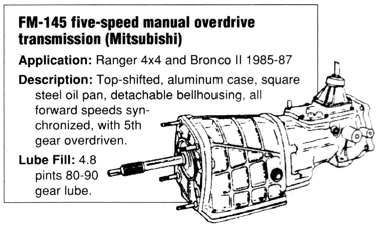
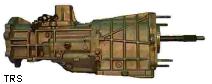
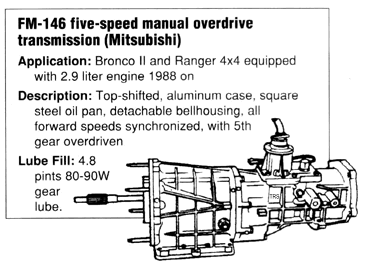
Mitsubishi FM146 (5-Speed Manual)
Years Used: 1988–1992
Drivetrain Configuration: 4×4 (Four-Wheel Drive)
Engine Pairings: 2.9L Cologne V6
Assembled 4WD Length – 28.687-Inches
Key Characteristics:
The FM146 was introduced in 1988 as a revised, stronger replacement for the FM145 to handle four-wheel-drive applications paired with the fuel-injected 2.9L V6. It retains the signature removable bellhousing and the 12-bolt bottom steel pan characteristic of the Mitsubishi FM family. To increase internal component strength and torque handling, the case casting was lengthened by approximately one inch compared to the FM145. Because of this length difference, the FM145 and FM146 do not directly interchange without modifying the driveshaft lengths and transfer case linkages.
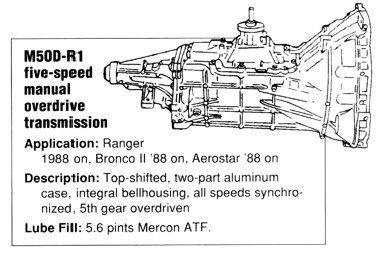
Mazda M5OD-R1 (5-Speed Manual)
Years Used: 1988–2011
Drivetrain Configuration: Available in both 2WD and 4×4 models, depending on engine and model year
Engine Pairings: 2.3L/2.5L Lima 4-Cylinder (1988–2001), 2.3L Duratec DOHC 4-Cylinder (2001–2011), 3.0L Vulcan V6 (1991–2008), and 4.0L Cologne OHV V6 (1990–2000).
Assembled 4WD Length – 29.250-Inches
Key Characteristics:
The M5OD-R1 (often abbreviated as the M5R1) was the ubiquitous, long-running manual transmission that defined the second and third generations of the Ford Ranger. Built by Mazda, it is a “top-loader” style, all-aluminum design featuring an integrated bellhousing cast directly into the transmission case. Because the bellhousing cannot be unbolted, Ford utilized several different outer case castings tailored strictly to the bolt patterns of specific engine families.
The M5OD relies entirely on a hydraulic internal slave cylinder that sits inside the bellhousing over the input shaft. Unlike early truck transmissions that require heavy gear oil, the M5OD-R1 was engineered to run exclusively on Mercon Automatic Transmission Fluid (ATF). Standard gear sets utilized relatively deep ratios (3.72 1st, 2.20 2nd, 1.50 3rd, 1.00 4th, and 0.79 5th/OD) to help smaller displacement four-cylinder and mid-sized V6 engines stay in their powerbands.
The M5OD is known for leaking oil from the rubber plugs in the top cover. You should replace the rubber plug with a steel Dorman cup plug P/N 555-108 or Dana P/N 219-3052. You will need 3 plugs. Leaking shift-rail plugs can allow transmission fluid to escape. If the leakage is severe or goes unnoticed, low fluid level can result in transmission damage.
Many owners have gone with synthetic transmission fluid hoping to extend the life of the transmission. Synthetic fluid handles high temperatures and pressures better than conventional fluids.
The hydraulic clutch system is another common area to pay attention to. Over time, the slave cylinder fails to release the clutch completely. If you are having trouble shifting into 1st and reverse while stationary or if your truck creeps forward with the clutch pedal depressed the slave cylinder / throw out bearing is probably at fault. Unfortunately, there is no easy fix here as the transmission must be removed to replace the combination slave cylinder and throw out bearing.
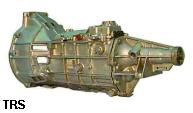
Mazda M5OD-R1HD (5-Speed Heavy-Duty)
Years of Production: 2001–2011
Drivetrain Configuration: Available in both 2WD and 4×4 models
Engine Pairings: 4.0L Cologne SOHC V6
Assembled 4WD Length – 29.250-Inches
Key Characteristics:
The M5OD-R1HD was introduced in 2001 as a structural upgrade explicitly designed to handle the vastly improved output of the 210-horsepower 4.0L SOHC V6 engine. While it looks nearly identical to the standard R1 from the outside and shares the same all-aluminum casting layout, it features key evolutionary improvements to survive higher torque loads.
Internally, the “Heavy-Duty” version utilizes redesigned, upgraded synchronizer blocking rings for first and second gears. The first-gear ring features a larger outer and inner diameter, while the second-gear ring is built with beefier construction to withstand aggressive shifting under load. To complement the power delivery of the SOHC V6, the R1HD was outfitted with a taller, closer-ratio gear set (3.40 1st, 2.05 2nd, 1.31 3rd, 1.00 4th, and 0.79 5th/OD). This allowed the truck to maximize the SOHC engine’s broad torque curve on the highway.
Because of its specialized SOHC bellhousing pattern and distinct internal components, it does not directly interchange with standard R1 units meant for 4-cylinder or 3.0L V6 platforms. However, the R1HD uses the 4.0L bellhousing pattern and can be bolted to the earlier 4.0L OHV engine because of the additional bolt hole.
Mercon ATF is the lubricant fill specified.
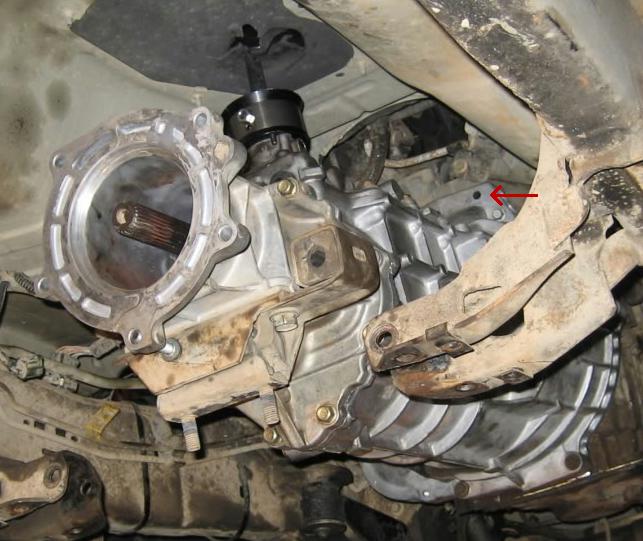
Bolting A Mazda M5OD-R1HD To A 4.0 OHV
The M5OD-R1HD can also be bolted to the earlier 4.0L OHV V6. The additional bellhousing bolt hole (shown by the red arrow) allows the transmission to bolt to either the SOHC or OHV 4.0L.
Visual Identification – Photos
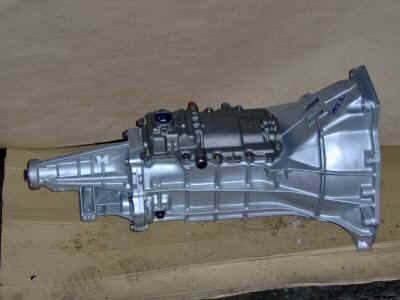
M5OD-R1 2WD Transmission
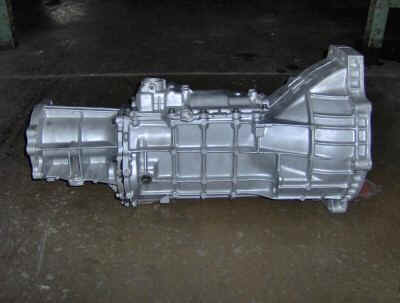
M5OD-R1 4WD Transmission
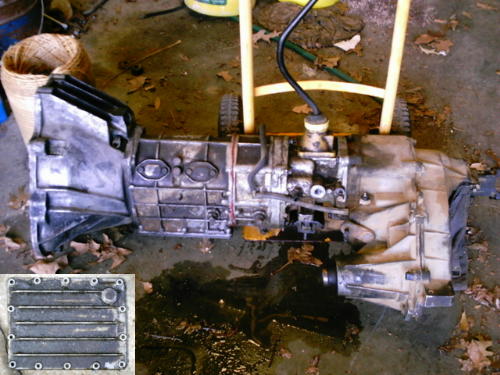
Photo of TK-5 with photo of pan bottom inserted in lower left corner of photo.
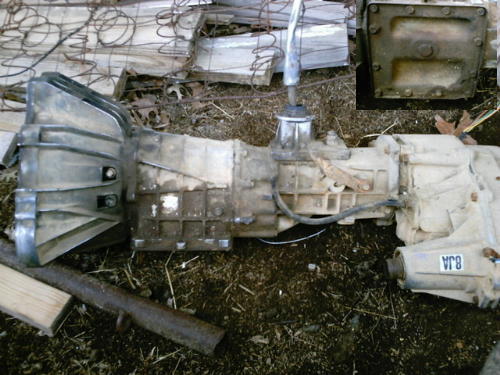
Photo of FM146 with photo of pan bottom inserted in upper right corner of photo.
(Above 2 photos submitted by Jorley)
Related Articles:
FM146 to M5OD and Complete Clutch Upgrade
How to replace a M5OD-R1 with a M5OD-R1HD
Mazda Transmission Disassembly Under Field Conditions
Last Updated:
About The Author

Jim Oaks is the founder of TheRangerStation.com, the longest-running Ford Ranger resource online since 1999. With over 25 years of hands-on experience building and modifying Ford Rangers — including magazine-featured builds like Project Transformer — Jim has become one of the most trusted authorities in the Ford Ranger off-road and enthusiast space.
Since launching TheRangerStation.com, Jim has documented thousands of real-world Ranger builds, technical repairs, drivetrain swaps, suspension modifications, and off-road adventures contributed by owners worldwide. TheRangerStation.com has been referenced in print, video and online by enthusiasts, mechanics, and off-road builders looking for practical, and experience-based information.