
Introduction
As the owner and creator of The Ranger Station, I’ve not only built my own off-road Ford Rangers, but I’ve had the chance to hit the trails with numerous other Ford Ranger owners, look at their setups, and see what works. I’ve also featured any off-road builds here at The Ranger Station.
This guide will help you plan, build, and optimize a 1983–2011 Ford Ranger 4×4 for off-road use. It is geared more toward the beginner and intermediate builders and is not an all-inclusive step-by-step guide.
What Are You Going to Use Your Ranger For?
This may seem like a stupid question, and you may think that ‘off-road’ covers everything but being realistic about how you plan to use the truck will help to ensure that you’re making the proper modifications and choosing the right parts.
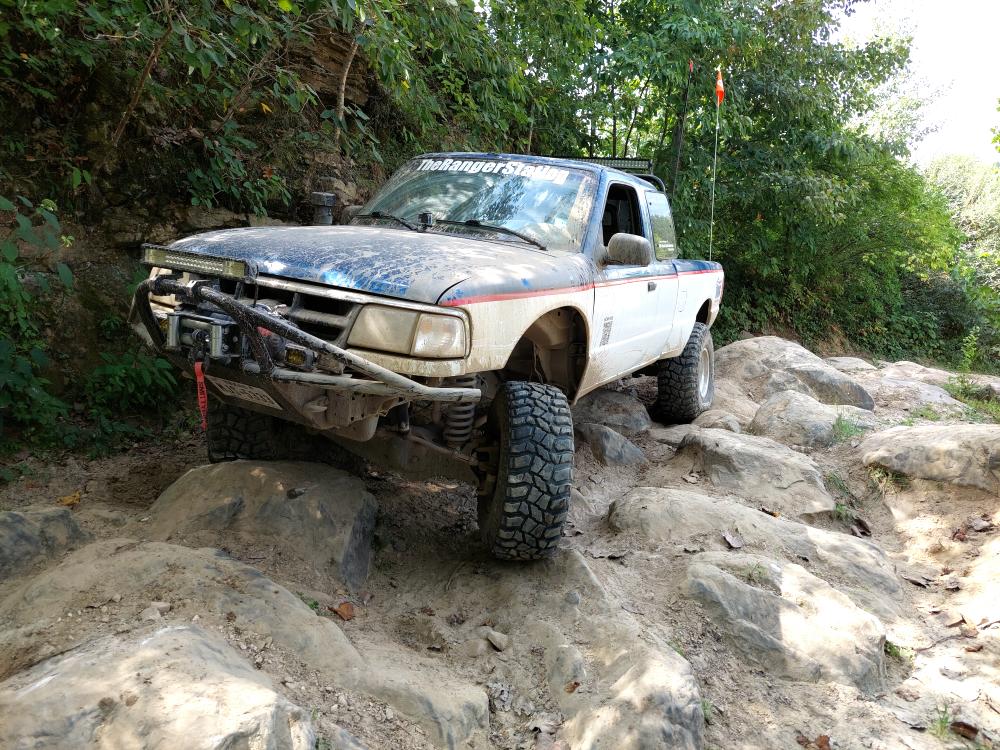
I’ll use the photo of my 1996 Ford Ranger above as an example. That Ranger has been able to take me anywhere I could want to go off-road. But it’s not a serious rock crawler. The 33″ tire size limits the size of the rocks I could crawl, and the tire size that I would need would require larger axles, along with a completely different suspension setup. And while it could take me anywhere I could want to go if I was overlanding, the bed cage, spare tire, tool box, and bed mounted batteries pretty much render the bed useless. There would be no room for a fridge, roof top tent (or camper shell), and camping gear.
So, with that in mind, is your Ranger going to be used for:
- Camping / overlanding
- Hunting
- Trail use
- Daily driver / weekend off-roader
- Dedicated trail truck
- Mud truck
- Sand dunes
- Pre-runner
- Rock crawler
Decide on how you plan to use the truck before you start building it. Know what type and size of tire is going to best suit your needs. A significant increase in tire size will require a change in the front and rear axle gear ratio’s to return the stock performance. You’ll want to use a good tire size to axle ratio combination. You can find out more on that below under Tire Size vs Gear Ratio.
Suspensions Lifts, Body Lifts, and Fender Flares
A suspension lift increases ground clearance; a body lift adds tire clearance cheaply; cutting or flaring fenders makes room for big tires with less lift. Some hardcore builds use a combination of all three.
Identify Your Suspension
1983–1997 Ford Rangers use a Twin-Traction Beam (TTB) front suspension, while 1998–2011 Ranger’s use a Short/Long Arm (SLA) torsion-bar setup. These two systems require completely different methods for lifting the suspension, alignment solutions, and have different off-road limits and benefits. For more information on the Ford Ranger 4WD suspension check out:
Ford Ranger Front Suspension Types Explained (TTB vs IFS)
Suspension Lifts
A suspension lift will not only make room for larger tires, but it also moves the frame and drivetrain higher to improve ground clearance. A suspension lift can also improve approach, breakover, and departure angles. Only tire size will affect how much room is between the axles and the ground.
Lifting your truck will affect its center of gravity. Ideally, you always want to keep your center of gravity as low as possible. A higher center of gravity will have a negative effect on how your truck handles and increase the chance of a rollover when you’re navigating steep angles.
Modifying Your Suspension
There’s way too much information to share on modifying your Rangers suspension. please check out the appropriate guide below:
1983–1997 Ford Ranger TTB Suspension Modification Guide
1998–2011 Ford Ranger IFS (SLA) Suspension Modification Guide
IMPORTANT: Lift kits and suspension advice are not interchangeable between these two systems. Always follow the guide that matches your model year.
Body Lift
A body lift is a 2-inch or 3-inch spacer (3-inch is most common) that is bolted between the frame, and the body mounts. This will lift the body and make room for larger tires. It’s much cheaper than a suspension lift and doesn’t increase your center of gravity as much as a suspension lift would, since the frame and drivetrain have not been raised. It also doesn’t increase ground clearance.
Cut Fenders / Fender Flares
Another method of increasing tire size is by cutting the fenders and increasing the size of the wheel openings. Some people use Bushwacker Cut-Out fender flares designed to cover the cut-out openings (and cover the wider tires you’ll be adding), and some use Pacer Flexy Flares along the edges of the cut metal to clean up the look and protect from the sharp edges. Some cut the fenders and don’t use a flare at all.
Some people use a combination of suspension lift, body lift, AND cut fenders.
The 1983-1992 Ford Ranger has a smaller wheel opening than the 1993-2011 Ford Ranger and it’s common to have to cut the fenders to fit a 33″ tire.
TIP: Fiberwerx and McNeil Racing make off-road fiberglass bedsides and front fender with significantly larger wheel openings for larger tires.
Check out:
Tire Sizes & Gear Ratios
Tire size affects gearing, axle stress, steering, braking, and overall reliability. Most Ford Rangers perform best off-road with 33″- 35″ tires. 36″ and larger tires will exceed the physical capabilities of your stock axles.
Keep in mind that larger tires are going to require more power to turn them. If you make a major increase in tire size, you’ll need numerically higher gears to compensate to return the stock performance.
- 31″ Tires: Is a great tire size for mild off-roading and doesn’t significantly decrease the Rangers performance.
- 33″ Tires: This is a good tire size for a daily driver and moderate trail rig.
- 35″ Tires: This is about the biggest tire your stock axles can handle.
- 36″ & Larger Tires: A 31-spline Ford 8.8 could handle 36″ – 37″ tires, but you should swap out your front axle for a Dana 44. You should do a full front and rear Dana 60 swap for anything over 37″ tires.
For a general guide on how much lift you need for a specific tire size check out:
1983-2011 Ford Ranger Tire Fitment Guide
Choosing the Right Tire Tread
When upgrading your Ranger for off-road use, tire size is just one piece of the puzzle. The tread type you choose plays a huge role in traction, durability, and overall performance on trails, mud, and rocky terrain.
- All-Terrain (AT): Balanced for both highway and light off-road use. Provides good traction on dirt, gravel, and light mud without sacrificing comfort or longevity on pavement.
- Rugged-Terrain (RT): A hybrid designed for more aggressive off-road conditions while still maintaining decent highway manners. Offers deeper lugs and stronger sidewalls for mixed terrain adventures.
- Mud-Terrain (MT): Extreme off-road focus. Aggressive tread pattern and reinforced sidewalls maximize grip in mud, sand, and rocks, but may be noisy and wear faster on pavement.
For a deeper dive into choosing the perfect tire for your off-road build—including detailed comparisons, traction insights, and tips for each tread type—check out our dedicated guide: Choosing An Off-Road Tire For Your Ranger.
Tire Size vs Gear Ratio
Larger tires reduce your effective gear ratio, causing sluggish acceleration, poor crawl control, and increased drivetrain stress. Re-gearing restores drivability and off-road performance by matching axle ratios to tire size and engine power.
The best way to figure out what gear ratio you need when adding a larger tire is to use our Ford Ranger Gear & Crawl Ratio Calculators. The Gear Ratio Calculator will take your stock tire size, factory gear ratio and new tire size and calculate the gear ratio needed to compensate for the larger tires.
As a basic guideline, here are the common ratios used for 31″, 33″, and 35″ tires:
- 31″ Tire: 3.73 – 4.10 Gears
- 33″ Tire: 4.56 – 4.88 Gears
- 35″ Tire: 4.88 – 5.13 Gears
This is for the Ford 4.0L V6. If you have a 2.8L or 2.9L you should choose the higher of the two numbers.
Axle Strength & Limits
Front Axles
Dana 28 TTB (1983-1989)
The smaller Dana 28 front axle in the older 1983-1989 Ford Ranger is best suited for 31-inch tires. Don’t be surprised if you break a locking hub or break an axle shaft at the u-joint running 33-inch or larger tires. They can handle 33-inch tires with moderate off-roading, but If you’re serious about off-roading, upgrade to a Dana 35 axle from a 1990-1997 Ford Ranger, or 1990-1994 Ford Explorer. For more information check out:
Ford Ranger 4×4 Front Axles 1983-1997
Dana 35/28 TTB Hybrid
The Ford Dana 35 TTB Hybrid, used in 1993-1997 Ford Rangers, combines a Dana 35 TTB front axle beam with Dana 28 TTB differential internals. While the outer axle shafts, brakes, and hubs match a standard Dana 35 TTB, the hybrid uses smaller 6.625″ Dana 28 gears, a smooth carrier housing, and 23-spline axle shafts. It can be identified by the front fill plug inspection, BOM part numbers, and its slightly longer driveshaft.
The Dana 35/28 TTB Hybrid was used in these Ford Rangers:
- 1993-1997 Ford Ranger 3.0L Automatic
- 1993-1997 Ford Ranger 2.3L
For more information and specifications check out:
Dana 35 TTB (1990-1997)
The Dana 35 TTB front axle can handle 33-inch and 35-inch tires. The weak link in the Dana 35 TTB is the flange style locking hubs. The 465XP Extreme Duty Locking Hub is stronger than the stock or Warn manual locking hubs. The Dana 35 TTB will bolt in place of the weaker Dana 28 TTB. The only real modification you’ll need to make is to shorten your Dana 28 driveshaft or get one for a Dana 35 TTB. Check out:
465XP Extreme Duty Locking Hub
Ford Ranger 4×4 Front Axles 1983-1997
Dana 35 / Dana 44 Hybrid
The weak link in the Dana 35 TTB is generally in the flange style locking hubs. However, the Dana 35 TTB actually shares similar axle shaft diameters and the same U-joints as the Dana 44 TTB. It is possible to swap out the Dana 35 steering knuckles, spindles, hubs, and stub shafts with Dana 44 components. For more information check out:
Dana 44 Knuckle Swap on Dana 35
Beefing Up The Ford Dana 35 TTB
Should You Replace A Dana 35 TTB With A Dana 44?
Ford Ranger 4×4 Front Axles 1983-1997
Dana 35 SLA (1998-2011)
The Dana 35 SLA isn’t quite as strong as the Dana 35 TTB but can still handle a 33″ – 35″ tire. A 35″ tire may be better suited for a moderate trail or overlanding rig. If you want to do any hardcore off-roading, you may find yourself wanting to swap to a Dana 44. One of biggest issues with the Dana 35 SLA is that the 1998-2000 Ford Ranger came with PVH hubs which can fail. Fortunately, you can swap them out for manual hubs.
The other issue is that the 2001-2011 Dana 35 SLA is a live axle which means that the axles always turn, even in 2WD. With a live front axle, the locker will try to force both front wheels to turn at the same speed. When turning, the inner and outer wheels need to spin at different speeds. A locked differential prevents this, causing the vehicle to want to push straight ahead. This can lead to erratic and difficult-to-control handling, as well as increased tire wear. On wet or icy pavement, a front traction device can cause the vehicle to “plow” straight ahead during a turn (understeer) because the wheels cannot easily differentiate their speeds.
For more information check out:
1998-2000 Ford Ranger Manual Locking Hubs
Convert Ford Ranger Live Axles To Manual Hubs
1998-2011 Ford Ranger 4×4 Dana 35 SLA Front Axle
Rear Axles
Ford 7.5-Inch Axle
The Ford 7.5-inch rear is best up to 33″ tires, although I’ve seen them running 35’s. If you’re serious about building an off-road capable Ford Ranger, you should swap out the Ford 7.5 rear axle for a 31-spline 8.8-inch axle. For more information check out:
Ford 7.5-Inch Rear Axle History & Specs
Ford 8.8-Inch Axle
The 28-spline 8.8-inch axle is better suited for the 33″ to 35″ tire sizes. The Ford Explorer and Ford Ranger FX4 31-spline 8.8-inch axle could easily handle 35″ and even 37″ tires.
The 31-spline 8.8 axle is about 30% stronger than the 28-spline 8.8 axle. Swapping out a 28-spline 8.8 for a 31-spline 8.8 is a judgement call. I’ve replaced a 28-spline 8.8 with a 31-spline 8.8 with disc brakes from a Ford Explorer. Since there was a good amount of money being spent one a Detroit Locker and 4.56 gears, it just made more personal sense to invest the money in a 31-spline setup. The differential cover is made from 1/4″ steel plate and I have since added an axle truss.
For more information on the Ford 8.8-Inch axle check out:
Ford 8.8-Inch Rear Axle History & Specs
Ford Explorer 8.8-Inch Rear Axle – Swap
Choosing Limited Slips & Lockers
As you become more serious about your off-roading, and you continue to modify your truck, you’ll most likely start thinking about your trucks differentials and how you can get more traction off-road. There are a variety of differentials available for the Ford Ranger, depending on what axle you’re working with.
Your Ford Ranger came with either an open differential, or a limited slip differential in the rear axle. The main difference between them lies in how power is distributed when one wheel loses traction. While an open differential sends power to the wheel with the least resistance, a limited-slip differential (LSD) redirects it to the wheel with the most grip.
NOTE: The Ford Ranger did not come with a front limited slip differential.
To better understand how limited slips and lockers work, the units available for your Ranger, and which one is best for you, check out:
Picking A Differential For Your Ford Ranger
Dana 44 Solid Axle Swaps (SAS)
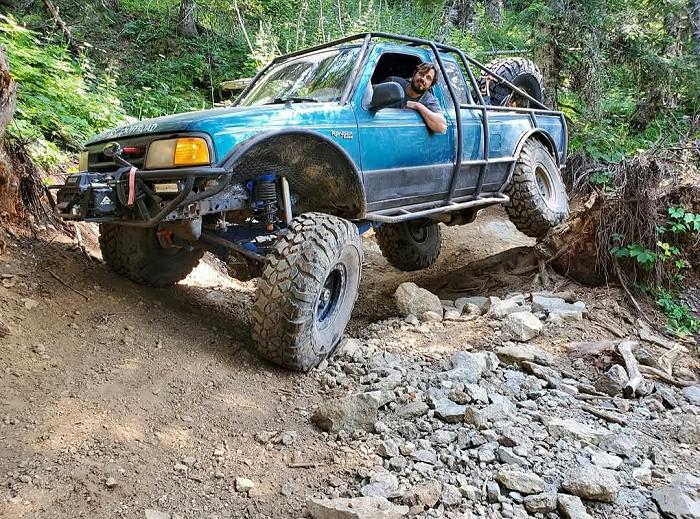
Many off-road enthusiasts assume that a solid front axle—like a Dana 44 or larger—is required for a capable Ranger build. From my experience, that’s not always true. A Solid Axle Swap (SAS) only becomes necessary for extreme builds, usually when you’re running 36″ tires or bigger, or seriously focused on rock crawling. For beginner and intermediate builds, your stock TTB (1983–1997) or SLA (1998–2011) front suspension is more than enough.
Whether you’re swapping the Dana 44 spindles and hubs onto your Dana 35 or considering a full Dana 44 Solid Axle Swap, be sure to check out our:
Dana 44 Guide For Ford Rangers
1990–1997 Dana 35 TTB Considerations
- The Dana 35 TTB has been a reliable choice in off-road racing thanks to its long wheel travel and durability.
- Stock Dana 35 shafts are strong enough for most builds, though the flange-style locking hubs and narrow wheel bearing spacing are the weak points.
- Upgrading to Dana 44 knuckles and stub shafts lets you use stronger 1/2-ton Dana 44 spindles (better wheel bearing spacing) and manual locking hubs without swapping the whole axle.
For more info on hybrid Dana 35/Dana 44 knuckle swaps, check out:
Dana 44 Knuckle – Locking Hub Conversion
Beefing Up The Ford Ranger Dana 35 TTB
People have even found a way to mount the Dana 44 spindle and hub on the Dana 35 TTB knuckle. Check out:
Dana 44 Spindle & Hub Conversion On Dana 35 TTB
The Mappyjack Dana 44 Spindle & Hub Conversion
1998–2011 SLA Front Suspension Considerations
- SLA front suspensions have limited wheel travel and almost no options for front lockers.
- If you’re planning on 35″ tires or bigger, a Dana 44 SAS is worth considering for these Rangers.
- You can do a SAS on these Rangers, but you’ll have to add steel plate to the side of the frame rail first.
Tire Rule of Thumb
- 33″ Tires: Stock Dana 35 (TTB) or SLA front is fine.
- 35″ Tires: Consider a Dana 44 knuckle swap on Dana 35 TTB
- 37″+ Tires: I would go with a Dana 44 for a 37″ tire and Dana 60 for anything larger.
Keep in mind that a full Dana 44 swap—or even using Dana 44 knuckles—requires:
- Wheels with a 5×5.5 bolt pattern
- An adapter on the rear axle to convert the wheel bolt pattern to 5×5.5
Bottom Line: The stock Ranger axles are maxed out with 35″ tires. A Dana 35 TTB running 35″ tires can benefit from Dana 44 spindles and hubs. If you want to rock crawl with 35″ tires, then I would suggest a Dana 44 swap. I would definitely do a Dana 44 solid axle swap if you plan to run 37″ tires and a Dana 60 for anything over 37″.
Transmissions: Why First Gear Matters Off-Road
Ford Ranger automatic transmissions use a 2.47:1 first gear, while manual transmissions range from 3.40:1 to 3.96:1. The deeper first gear in manuals provides more torque off the line, which becomes increasingly important when running larger tires or navigating slow, technical terrain.
Manual Transmission First Gear Ratios
| Model Years / Transmission | First Gear Ratio |
|---|---|
| 1983–1984 TK4 | 3.960 |
| 1983–1987 TK5 | 3.960 |
| 1985–1987 FM145 | 3.769 |
| 1988–1992 FM146 | 3.769 |
| 1991–2008 M5OD (3.0) | 3.762 |
| 1990–2011 M50D (4.0) | 3.400 |
It can be challenging to work the clutch and brake when climbing obstacles. Some people like it but it can be nerve wracking. The benefit to a manual is the use of transmission breaking (using a lower gear) when going downhill and they’re not a susceptible to heat as an automatic.
For more information on manual transmissions check out:
Ford Ranger Manual Transmissions
Automatic Transmission First Gear Ratios
| Transmission Type | First Gear Ratio |
|---|---|
| 4-Speed Automatic (A4LD / 4R44E / 4R55E) | 2.47 |
| 5-Speed Automatic (5R44E / 5R55E) | 2.47 |
The A4LD 4-speed automatic transmission went on to become the 4R44E, 4R55E, and finally the 5R55E. However, it had reliability issues from 1985-1987. Reliability began to improve in mid-1988 when Ford introduced the dual solenoid setup. Models from 1989 and later benefited from Ford’s broader engineering push to improve “Noise, Vibration, and Harshness” (NVH) and general durability, making them noticeably better than 1985–1987 models.
I generally recommend that people stay away from the 1985-1987 A4LD transmission. If you don’t want to replace it, you can extend its working lifespan using a few simple methods and modifications (this applies to the 1988-1990 models as well):
Excessive heat is an enemy to a Ford Ranger automatic transmission. Especially the A4LD. If you’re doing a lot of slow speed climbing it can put a lot of strain on the transmission and the slow speed doesn’t create enough airflow to help keep it cool. You should consider adding an auxiliary transmission cooler to the transmission coolants return line (between the radiator and transmission) to help keep it from overheating. Install a transmission temperature gauge to keep track of its temperature and keep the temperature below 200 degrees Fahrenheit maximum.
Add an A4LD valve body kit such as a Superior Shift Kit or a TransGo Shift Kit which adds pressure inside the valve assembly. When pressure increases, it keeps the clutch packs from separating, as well as keeping the clutches and associated bands from overheating.
For more information on automatic transmissions check out:
Ford Ranger Automatic Transmissions
Engines, Power, and Drivetrain Considerations
The stock 4.0L V6 provides adequate power for most off-road Ranger builds when properly geared. Larger tires increase strain on the engine and reduce the effective size of the axle gear ratio, making re-gearing more important than raw horsepower.
Stock Horsepower & Torque Ratings
- 1983-1985 2.8L V6 came with 115 HP / 150 FT LB of Torque
- 1986-1992 2.9L V6 came with 140 HP / 170 FT LB of Torque
- 1991-2009 3.0L V6 came with 145-150 HP / 165-190 FT LB of Torque
- 1990-2000 4.0L OHV V6 came with 160 HP / 220 FT LB of Torque
- 2001-2011 4.0L SOHC V6 came with 207 HP / 238 FT LB of Torque
Common Engine Swaps
1996-2001 Ford Explorer 5.0L (210 HP / 280 FT LB of Torque)
Recommendation
The 4.0L OHV and 4.0L SOHC are great engines, and many find the 4.0L OHV to be more reliable and easier to maintain. The 4.0L OHV is a common upgrade from the 2.8L and 2.9L engine. Heat will be the enemy of those that seek to do a 5.0L engine swap. Unless you plan to exceed a 35″ tire, a properly geared 4.0L will take you everywhere you want to go.
Winches & Recovery Kits
If you’re building your Ford Ranger for off-road, then you need to take recovery into consideration. You don’t have to be on an actual ‘off-road’ trip to find yourself stuck. A simple camping trip or driving across a field to do some work can result in you getting stuck. How will you get out? Do you have the proper recovery gear? Do you have the proper recovery points on your vehicle to attach to? Do you have a winch? Is your winch the right size for your Ford Ranger? Will it handle the weight of your truck and all of the stuff you’re carrying in it? For a guide on choosing a winch, recovery gear, and recovery points check out:
Choosing A Winch, Recovery Gear, and Recovery Points
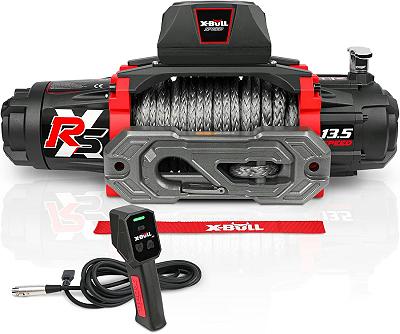
(X-Bull 13,500 WInch With Synthetic Rope)
Off-Road Lighting
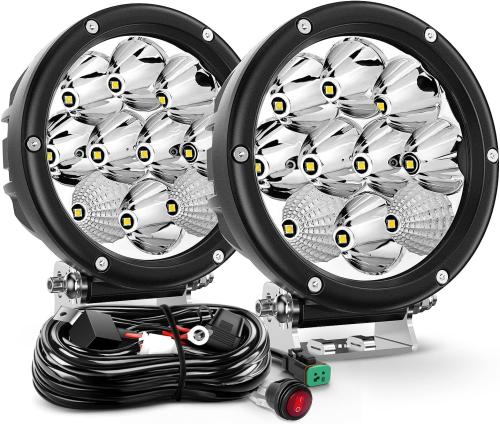
I have long switched from halogen off-road lights to LED off-road lights. LED gives me a brighter light while using a fraction of the power that a 100-Watt off-road light uses. There was a time when my Ford Ranger had a pair of 100-Watt halogen off-road lights on the front bumper and four 100-watt off-road lights up on the bed cage. That’s 600-Watts! Today I use these Nilight 7-Inch LED Off-Road Lights that puts out 6,500 lumens and uses half the power of a halogen light.
For more information on off-road lights, check out:
How To Choose An Off-Road Light
Communications
If you plan to do any off-roading or overlanding with other people, trail communications are a vital tool.
CB Radio use to be the go-to radio for communications off-road. Today GMRS (General Mobile Radio Service) and 2-Meter ham radios have become extremely popular. You’ll need a license to operate a ham radio which requires that you pass a test. GMRS requires a license but it’s only a fee, there’s no test. Another nice thing about GMRS is that you can get portable radios (walkie-talkies) at a pretty reasonable cost that makes communicating with spotters and other people outside of the vehicle much easier. Check out:
GMRS Dash Install 2019-2023 Ford Ranger
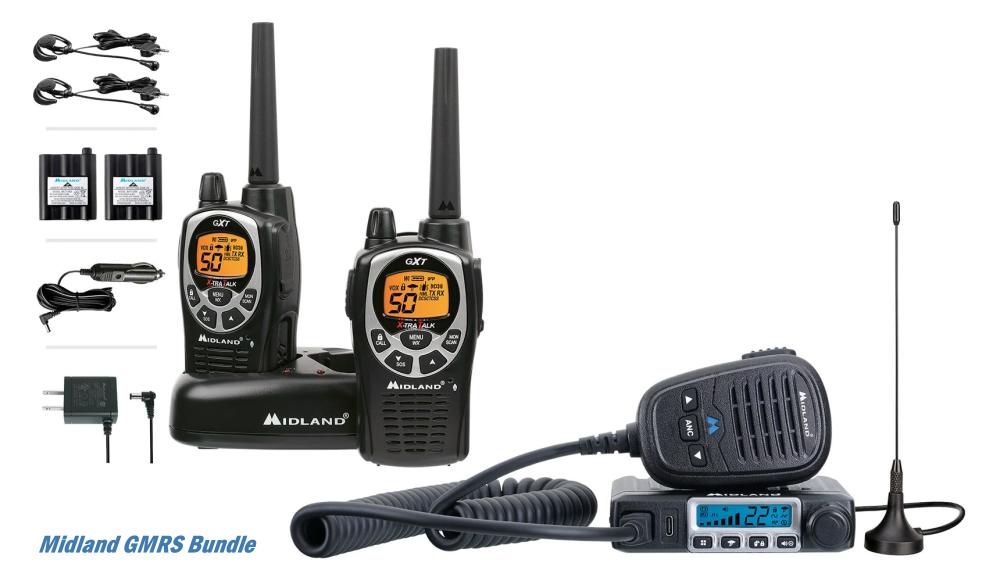
GMRS Mobile and Handheld Radios
Example Setups Based on Model Years
Still trying to figure out the right setup? Here are some personal recommendations based on the various model years and the options that were available:
1983-1989 Ford Ranger: These Ford Rangers came with a Dana 28 front axle, and a weak A4LD automatic transmission. I would look for a 2.8L or 2.9L V6 model with a 5-speed manual transmission. The early automatics in these trucks don’t survive very long off-road and benefit from an auxiliary transmission cooler. If you buy a Ranger that still has automatic locking hubs, do a Manual Hub Conversion.
Low Buck Build: Look for a standard cab short bed model with 3.73 gears. If you find one with an open rear differential, you could easily add a Lock-Right locker. Make room for 31-inch tires by either using a 4-inch suspension lift, 3-inch body lift, and / or cutting the fenders to make room.
Moderate Build: Replace the stock Dana 28 front axle with a Dana 35 from a 1990-1997 4.0L powered Ranger or 1990-1994 Ford Explorer. You’ll have to have your front driveshaft shortened or possibly use the one from the donor vehicle. Have 4.56 gears installed in your axles, along with a 6-inch lift and 33-inch tires. You’ll have to do some fender trimming to get them to fit. There’s a good possibility that you’ll end up with an open front differential and a limited slip rear. Add a Lock-Right or Aussie locker to the front differential, and a locker to the Ford 7.5 rear if it’s open as well. A limited slip will work fairly well in moderate off-roading, but you may want to replace it with a true locker.
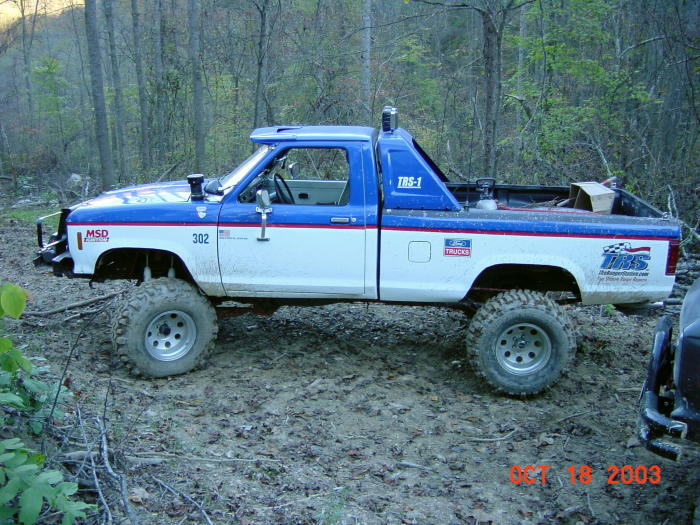
1983 Ford Ranger 4×4 with a 4-inch lift, 3-inch body lift, cut fenders and 33″ tires
1990-1997 Ford Ranger: The 4.0L and 3.0L models came with the larger Dana 35 front axle, along with a 28-spline 8.8-inch rear axle. The weakest link in these Ford Rangers is the A4LD automatic transmission that Ford used up through 1994. Reliability began to improve in mid-1988 when Ford introduced the dual solenoid setup. Models from 1989 and later benefited from Ford’s broader engineering push to improve “Noise, Vibration, and Harshness” (NVH) and general durability, making them noticeably better than 1985–1987 models. Starting in 1995, Ford began using the 4R44E automatic behind the 4-cylinder and 3.0L engines, and the 4R55E behind the 4.0L V6 engine. These automatics were revised versions of the A4LD. I personally prefer the 4R55E over the A4LD, but they’re all susceptible to excessive heat and benefit from an auxiliary transmission cooler. If you buy a Ranger that still has automatic locking hubs, do a Manual Locking Hub Conversion. I would specifically look for a set of 465XP Extreme Duty Locking Hubs.
Low Buck Build: Any V6 model with a manual, or a 1995-1997 model with an automatic. Bolt on a 4-inch lift with 33-inch tires (may need to do some fender trimming) and consider adding a locker to the open differentials if they’re not limited slips. You’ll get more torque to turn the larger tires with a manual transmission thanks to its 3.40 (4.0L models) or 3.72 (all other models) 1st gear versus the automatics 2.47 1st gear ratio.
Moderate Build: I would build a 1995-1997 Ford Ranger with the 4.0L and 4R55E combination combined with a 6-inch suspension lift, 33-inch tires, 4.56 gears, and lockers in the front and rear axles. If you wanted to go with a larger tire, I would cut out the fenders to fit 35-inch tires and use 4.88 gears and lockers. Get a set of Skyjacker extended radius arms to allow more wheel travel from the front suspension.
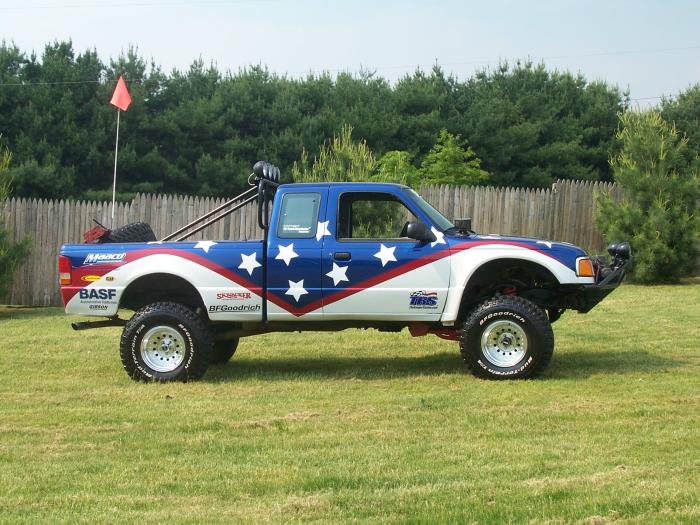
1996 Ford Ranger with 6-Inch lift, fiberglass front fenders, and 33″ tires
1998-2011 Ford Ranger: Starting in 1998, the Ford Ranger used a Short arm / Long Arm (SLA) front axle setup instead of the original Twin Traction Beam (TTB). The 1998-2000 Ford Ranger used a Pulse Vacuum Hub (PVH) front locking hub. These have proven to be problematic. While some people try to avoid these Rangers, they actually have two benefits:
- You can upgrade to Manual Locking Hubs.
- If you install a front locker, you can unlock the front axles so they’re not turning when you’re on the street.
In 2001, Ford switched to a live axle setup which means that the front axle is turning all the time and can’t be disconnected. The downfall to that is that you can’t run a true locker in the 2001-2011 front axle, because there’s no way to disconnect the front axle shafts when you’re on pavement. It is possible to Convert Your Live Axles To Manual Hubs. This would allow you to install an Aussie locker, Powertrax Lock-Right Locker, or Powertrax No-Slip limited slip differential and still be able to drive on the street. If you 2001-2011 Ford Ranger 4×4 is going to spend most of its tie off-road, this isn’t as much of an issue.
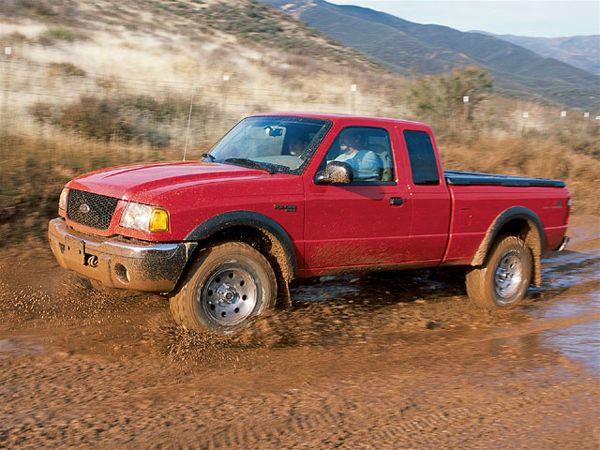
(Ford Ranger FX4)
It’s important to note that Ford offered a FX4 model of the Ranger from 2002-2009. These trucks were specifically built with off-road in mind. I would search for a 2002 FX4, or a 2003-2007 FX4 Level II model to ensure that you’re getting the 31-spline 8.8-inch rear axle, 4.10 gears and Torsen differential. For more information on the Ford Ranger FX4, click HERE.
Mild Build: Build a 2002 FX4, or a 2003-2007 FX4 Level II with a 3-inch body lift and 33-inch tires. Another option would be a 1998-2000 Ford Ranger with a 3-inch body lift, 33-inch tires, and a manual locking hub swap. I don’t really like cranking the torsion bars because you’ll lose downward wheel travel, but you could crank the front torsion bars and add a 1.5-inch lift block to the rear and easily run 33-inch tires (see my 2001 Ford Ranger below).
Moderate Build #1: Any 1998-20011 Ford Ranger 4×4 with a 3-inch body lift, mild torsion bar crank, 33-inch tires, and a rear locker. Install a Powertrax No-Slip differential in the front, or a Lock-Right locker if you have a 1998-2000 with a manual hub swap. Upgrade to 4.56 gears for 33-inch tires, or 4.88’s if you want to run 35-inch tires. Cut the fenders and add cut-out fender flares to make room for the 35-inch tires.
Moderate Build #2: Any 1998-20011 Ford Ranger 4×4 with a Rough Country 5-inch suspension lift, 33-inch tires, and a rear locker. Install a Powertrax No-Slip differential in the front, or a Lock-Right locker if you have a 1998-2000 with a manual hub swap. Either install a 3-inch body lift or cut the fenders and add cut-out fender flares to make room for the 35-inch tires. Upgrade to 4.56 gears for the 33-inch tires, or 4.88’s if you want to run 35-inch tires.
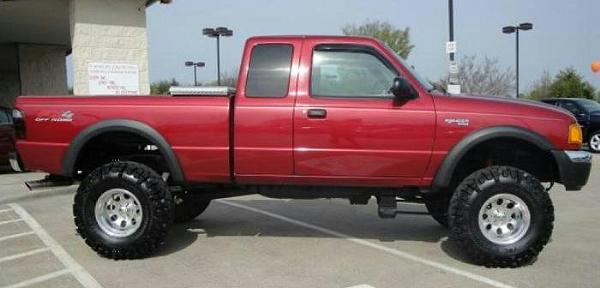
2002 Ford Ranger with 4-Inch suspension lift, 3-inch body lift, and 35″ tires
Below is my 2001 Ford Ranger. It has a 3.0L automatic with an open 28-spline 8.8-inch rear axle and factory 4.10 gears. The previous owner cranked the torsion bars to lift the front, added a 2-inch lift block under the rear springs, and installed 265/75/16 (31-inch) tires. You can see from the photos that the truck could fit 33-inch (285/75/16) tires but may require a little trimming of the front plastic valance behind the bumper to prevent rubbing. Since it has an open differential, I could easily add a Lock-Rite locker to the rear axle. If I added a set of cut out fender flares with 33-inch tires, this would make an inexpensive daily driver, and weekend trail truck.
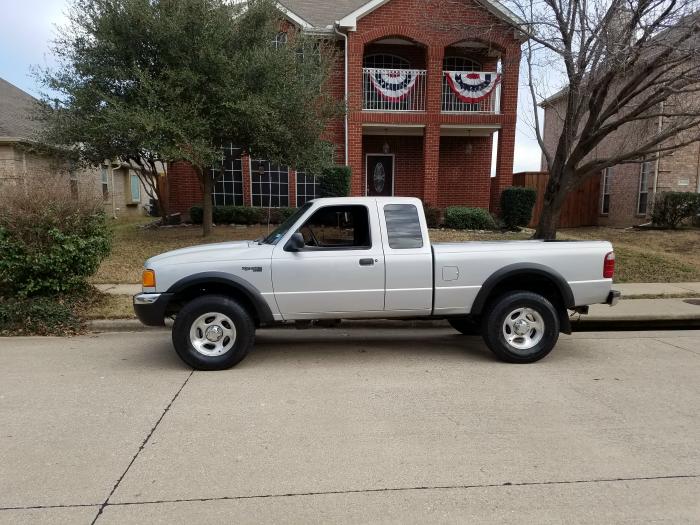
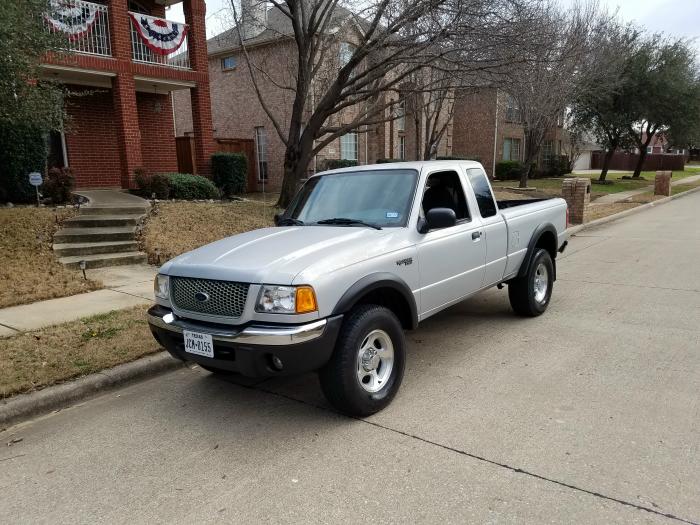
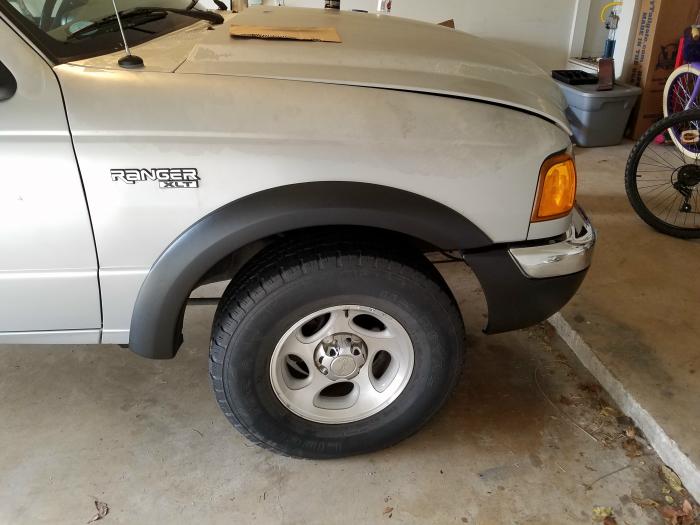
Quick Build Breakdowns
1998-2011 Rangers
Budget Off-Road Build:
- 33″ tires + 3″ body lift
- Crank torsion bars + rear blocks
True Off-Road Build:
- Rough Country 5-Inch Suspension Lift
- Rough Country CV Driveshaft
- 33″ tires & 4.56 gears
- or 35″ tires & 4.88/5.13 gears & cutout fender flares
- Selectable rear locker
Why I recommend this:
Cranking your torsion bars will raise the front of your Ranger but give you a harsh ride and body lifts have become scarce. I recommend the Rough Country 5-inch lift and their CV driveshaft. The driveshaft angle from the 5-inch lift will quickly wear out the Rzeppa joint in your front driveshaft.
1990-1997 Ford Ranger
Note: The 1990-1992 4-cylinder Ranger came with a Ford 7.5-inch and Dana 28 axle and should follow the build suggestions for the 1983-1989 Ford Ranger.
Budget Off-Road Build:
- Skyjacker 4-inch suspension lift
- 33″ tires with fender trimming or 3″ body lift
True Off-Road Build:
- Skyjacker 6-Inch Class II Suspension (Comes with extended radius arms)
- 33″ tires & 4.56 gears
- or 35″ tires & 4.88/5.13 gears and cutout fender flares
- AVM Extreme manual locking hubs
- Selectable locker in the rear (and front if you can afford it)
Serious Off-Road Build:
- Skyjacker 6-Inch Class II Suspension (Comes with extended radius arms)
- Dana 35 TTB converted with Dana 44 TTB steering knuckles, spindles, and locking hubs
- 31-spline Ford 8.8-inch axle
- 35″ tires & 4.88/5.13 gears and cutout fender flares (or off-road fiberglass)
- Selectable locker in the front & rear
Why I recommend this:
The True Off-Road Build is the setup that I currently use, and it works exceptionally well. The Skyjacker comes with beefy suspension brackets and are the only company that makes a complete upgraded replacement bracket that mounts the passenger side beam. All other companies just include a drop plate. The extended radius arm will give your suspension more wheel travel to keep the tires in contact with the ground. A selectable locker is more ideal for the street and slick road conditions because you can control its engagement. The Dana 35 TTB with the Dana 44 TTB knuckles, spindles, and hubs essentially increases your Dana 35 TTB to the strength of a Dana 44. This gives you the axle strength to do some serious off-roading with 35″ tires.
1983-1989 Ford Ranger
Budget Off-Road Build
- 4-inch suspension lift
- 31″ tires
True Off-Road Build
- 6-inch Skyjacker Suspension
- 33″ tires and some fender trimming
- 4.88 gears
- Lock-Right locker in rear open diff
Serious Off-Road Build
- 6-Inch Skyjacker Class II Suspension
- Dana 35 TTB axle swap
- AVM Extreme manual locking hubs
- Ford 8.8-inch 31-spline axle swap
- Trimmed fenders
- 33″ tires & 4.88 gears
- or 35″ tires & 5.13 gears and serious fender trimming
- Selectable locker in the rear (and front if you can afford it)
Why I recommend this:
These Ranger’s came with a 2.8L or 2.9L V6, so I’m recommending the 4.88 gears vs 4.56 gears to make up for their lack of power compared to a 4.0L. I love the look of these original Ford Ranger’s, but their stock axles get maxed out with 33″ tires. But with that said, I’ve seen a 2.9L Ranger with a 4-inch lift, rear locker, and 31-inch tires that seemed to be able to go anywhere. They really are fun trucks. The stronger Dana 35 TTB and Ford 8.8 is a better option for a 33-inch tire setup.
Looking for More Ranger Build Inspiration?
If you want to see how other off-road enthusiasts are building their Ford Rangers, check out this community thread on The Ranger Station forums. Owners share their setups, lessons learned, and what they’d do differently if they started over — a great place to spark ideas for your own build:
Show Me Your Off-Road Ranger – TRS Forum Thread
You can also find inspiration checking out the Ford Rangers featured on our home page and the various featured categories:
The Ranger Station – Home Page
Whether you’re planning a beginner-friendly setup or dreaming of a serious rock crawler, seeing real-world examples can help you visualize possibilities and get motivated for your own build.
Last Updated:
About The Author
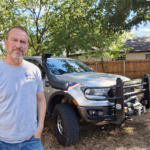
Jim Oaks is the founder of TheRangerStation.com, the longest-running Ford Ranger resource online since 1999. With over 25 years of hands-on experience building and modifying Ford Rangers — including magazine-featured builds like Project Transformer — Jim has become one of the most trusted authorities in the Ford Ranger off-road and enthusiast space.
Since launching TheRangerStation.com, Jim has documented thousands of real-world Ranger builds, technical repairs, drivetrain swaps, suspension modifications, and off-road adventures contributed by owners worldwide. TheRangerStation.com has been referenced in print, video and online by enthusiasts, mechanics, and off-road builders looking for practical, and experience-based information.