2010 Off-Road Truck of the Year: Gwaii’s 1986 Ford Ranger
Every once in a while, a truck comes along that makes you stop and look twice. Tom Lilley’s 1986 Ford Ranger is one of those trucks.
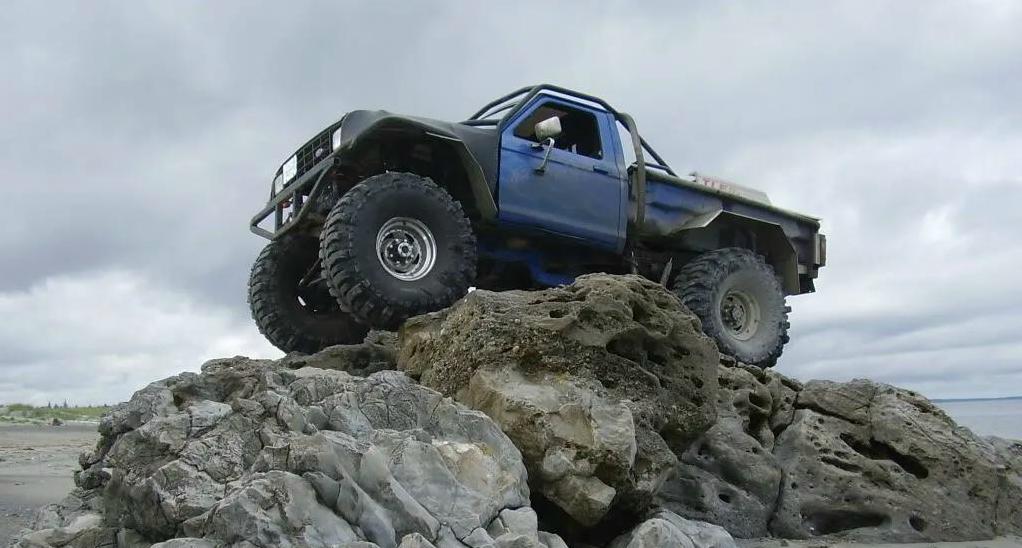
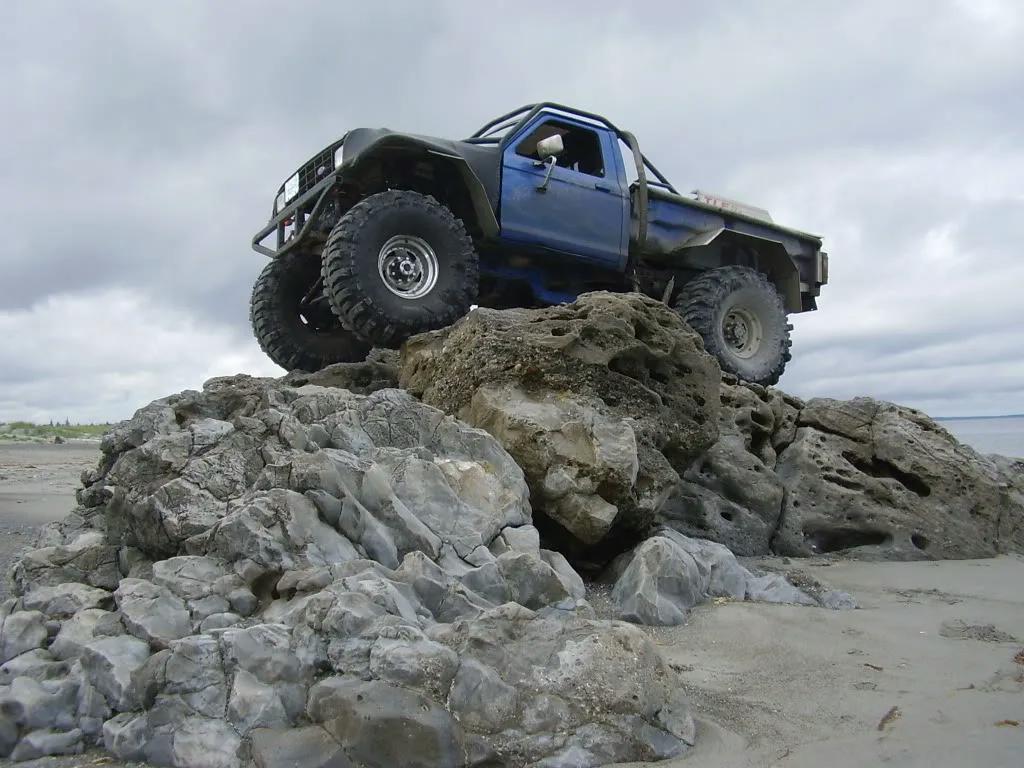
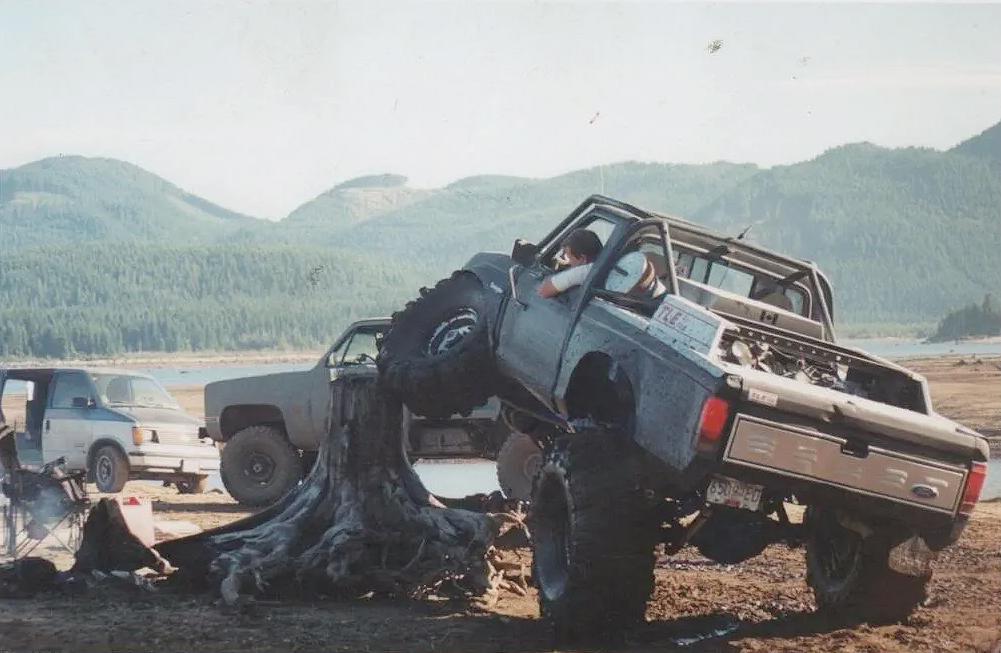
By the time it became The Ranger Station’s 2010 Off-Road Truck of the Year, there wasn’t much left of the original $500 pickup beyond the basic Ranger structure. The truck had a rear-mounted 460 V8, multiple transmissions and transfer cases, a custom solid front axle, a heavily modified rear axle, 44-inch Boggers, and a suspension unlike anything Ford ever put under a Ranger.
The interesting part, however, isn’t simply the list of parts. There is a reason behind nearly everything Tom did. The truck wasn’t designed on paper from the beginning and then built according to a master plan. It evolved as Tom found problems, came up with solutions, and decided that if something wasn’t strong enough or capable enough, he’d simply build something different.
Tom summed it up himself: the truck wasn’t really built—it evolved.
A $500 Ranger
Tom originally wanted a simple, economical wheeling machine that he could use for exploring and camping. It needed to be tough enough to beat on off road and still be capable of driving home afterward. It also had to be a Ranger. He wasn’t particularly concerned with what was under the hood, what axles it had, or what type of suspension it used. As long as the body and frame were sound, he figured he could change everything else.
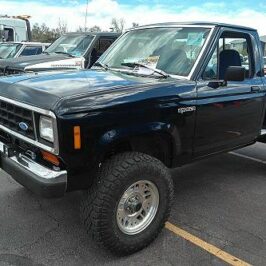
He found exactly what he was looking for in a 1986 Ford Ranger 2WD with a four-cylinder engine and five-speed transmission. The truck cost him $500 and had been sitting around as a lawn ornament for a couple of years. It needed a little attention before it would run, but Tom got it going and drove it home.
The exhaust system had rusted away, so one of the first jobs was installing a new exhaust. He then took the truck through emissions testing with relatively low expectations. To his surprise, it passed.
The Ranger was already painted flat black, which Tom liked, so there was no reason to spend money making it pretty. In fact, one of the early upgrades consisted of spending about five dollars on more flat-black paint for the doors.
That didn’t last long, though. By the second day, Tom had already decided that two-wheel drive wasn’t going to work for what he had in mind.
From 2WD to 4WD
The Ranger’s 2WD front crossmember wasn’t designed to accommodate a front differential, so converting it to four-wheel drive required some serious cutting and welding. Fortunately, Tom had already been collecting parts with a Ranger project in mind. He had a Dana 44 that had been cut, turned and narrowed, along with a four-wheel-drive transmission and transfer case.
Out back, he had a narrowed Ford 9-inch. The rear axle went under the Ranger with four-inch lift blocks and new U-bolts, and Tom trimmed the fenders to make room for the tires.
By the third day, the $500 two-wheel-drive Ranger had become a four-wheel-drive truck with a Dana 44 front axle, Ford 9-inch rear axle and a brush guard.
A local tire shop supplied a set of 33-inch tires for $150 mounted. The front and rear tires weren’t even the same brand, but Tom wasn’t building a show truck. He wanted something he could wheel.
He added a Warn 9000 winch, mounted between the frame rails, and converted the truck from manual steering to power steering.
The drivetrain was functional, but there was already a problem. The axles had 3.50:1 gears, which were acceptable on the street but much too tall for the little four-cylinder engine when the truck was crawling off road. Traction wasn’t the issue—the front had limited slip and the rear was welded. The problem was getting enough gear reduction.
Tom couldn’t afford new axle gears or an expensive aftermarket transfer case, so he went back to an idea he’d been considering for years: putting transmissions in series.

The First Compound Transmission
Tom had an early Bronco three-speed transmission and transfer case. His idea was to use the second transmission as an additional range box.
This required considerably more than simply bolting one transmission to another. Tom turned down the input gear of the additional transmission until it became a stub, modified the Ranger transfer-case input shaft, and machined the splined section until the pieces were a press fit. He specified about three thousandths of an inch interference and TIG-welded the assembly with chrome-moly rod.
He then fabricated an adapter plate from 3/4-inch aluminum and a 1-1/4-inch aluminum centering and sealing plate. The original tailshaft housing provided the pattern for the machining. Once the pieces were assembled, Tom fabricated the necessary shifters.
The resulting unit bolted onto the back of the Ranger transmission.
The modification required shortening the rear driveshaft, lengthening the front driveshaft, relocating the transmission crossmember and moving the fuel tank into the bed because the transfer case occupied the space where the tank had originally been.
What Tom gained was effectively another set of ranges. Instead of having only the normal transmission gears and transfer-case high and low, he could use the additional transmission to multiply the available reductions. The Ranger transmission could be used as the main gearbox, or the auxiliary transmission could become the primary gearbox while the other remained in a selected range.
The early system even had an unusual trick. The three-speed’s shift arrangement allowed Tom to select two gears simultaneously. With the driveline effectively locked, the truck could be left in gear as a sort of mechanical parking brake and theft deterrent.
It looked like a cobbled-together monstrosity, but it worked. More importantly, it proved reliable enough that Tom eventually removed it when the V8 era began, and the system went on to serve in two other trucks without giving him problems.
For the Dana 44, Tom built custom radius arms specifically for the Ranger. Rather than using conventional drop brackets to create lift, he incorporated approximately four inches of lift directly into the radius-arm design.
The Ranger was becoming a serious wheeling machine, but the evolution was just getting started.

More Axle, More Suspension
The original four-cylinder engine eventually met its end in the mud. During a deep mud run, the engine was over-revved and the radiator became plugged with mud. It overheated badly enough to warp the cylinder head.
Tom replaced the head and kept going, but eventually the engine swallowed a large gulp of mud that caused enough damage to finish it off.
A 2.9-liter V6 replaced it. Tom promptly beat on that engine until it died, then installed another 2.9. That one lasted only a few weeks.
At that point, Tom decided he had had enough of small engines.
Before going to the V8, however, he continued developing the rest of the truck.
At a dump, he found a Ford 10.25 rear axle and Dana 50 front axle for $25 total. The 10.25 had bad gears and bearings, but the outer components were usable. Tom wanted a full-floating rear axle but already had a good gearset in his 9-inch, so he devised another unconventional solution.
He took the side gears from the Sterling differential, machined them down to fit the 9-inch carrier, and welded them into place to create a 35-spline spool arrangement.
The Dana 50 received similar attention. Tom wanted to retain the Ranger-style coil-spring arrangement rather than converting the front to leaf springs. The lower ball-joint arrangement was the major difference, so he modified the arms using a jig based on the Ranger’s TTB components.
He also built new radius arms from 3/16-inch abrasion-resistant plate. The arms were completely boxed and constructed from overlapping C-shaped sections, producing roughly 3/8-inch material thickness across the top and bottom. They were heavy, but Tom wasn’t interested in building anything that would bend the first time the truck hit something hard.
At this stage, the truck had a 2.9-liter V6, compound transmissions, a transfer case, a custom Dana 50-based front axle and a full-floating 9-inch rear. The tires eventually grew to 35 inches, an exoskeleton cage was added, and aluminum caps were installed along the bed rails.
The fuel tank had been moved into the front portion of the bed and covered with aluminum.
Tom was also learning something important about the Ranger’s suspension: flex was going to become a problem.

The V8 Era
The next engine was a 302 taken from a 1987 F-150.
Tom had an overdrive gear splitter available, but with the 3.50 axle gears and 35-inch tires, what he really needed was the opposite of overdrive. He had a T18 two-wheel-drive four-speed, an NP435 four-wheel-drive four-speed and an NP205, and the idea of combining them was already taking shape.
The Ranger’s engine compartment created another problem. The bay tapered toward the front, and the intake arrangement he wanted wouldn’t clear. Rather than perform major surgery on the crossmember and engine compartment, Tom used a four-barrel intake and carburetor.
The 302 didn’t have an easy life.
The first engine failed when the number-one rod bearing went away in a mud hole. It knocked badly, but Tom managed to get the truck home. He rebuilt another engine with a turned crank, bored cylinders, high-volume oil pump and a different camshaft.
That engine didn’t survive either.
Tom eventually admitted that he had been asking a lot from it. He was over-revving it, running it hot, keeping his foot in it, and even hitting the nitrous button. His attitude was basically that if the engine couldn’t survive that treatment, it wasn’t tough enough.
During one mud run, the conversation turned to building a mid-engine truck. Somebody told Tom that you couldn’t do it.
His response pretty much sums up the philosophy behind the entire Ranger:
“No, YOU can’t do that. I can do whatever I want to do.”
And that’s when the Ranger took another dramatic turn.
Turning the Ranger Around
Tom had a 4.6-liter engine and 4R70W transmission sitting around from another project. Instead of letting them collect dust, he decided to use them.
And he got out the Sawzall.
Tom didn’t want to simply turn an engine around and reverse the differentials. He knew the NP205 was strong enough to transmit power through its front output, so he came up with a much more unusual arrangement.
The basic concept was to use one NP205 to send power forward into another NP205 that was oriented in the opposite direction. The second transfer case could then send power toward the rear while the other output continued driving the front axle.
Because he already had another transmission and transfer-case combination available, he incorporated that into the system as well.
The result was a compound driveline with multiple gearboxes and transfer cases arranged longitudinally through the truck.
This wasn’t simply about having a ridiculous number of gears. The extra transmissions served as range boxes. In normal driving, Tom could use the primary transmission much like any other manual transmission. When he needed extremely low gearing, the additional transmissions could be selected into lower gears and multiplied together.
The unusual arrangement also meant that the second transmission was physically oriented differently from the first. That created thrust-loading concerns because the transmission was being asked to deal with forces in directions it wasn’t originally designed for. Tom eventually modified the bearing arrangements in the NP435s to handle those loads. The NP205s were considerably less concerned about the unusual orientation.
The shifters presented another problem. With one transmission located underneath the driver’s seat and the other farther back in the truck, conventional floor shifters weren’t practical. Tom connected the shift levers directly to the transmission shift rails and fabricated remote controls so he could operate them from the driver’s position.
The fuel tank moved again, this time toward the rear of the bed, while the radiator was relocated above the transmission and fitted with electric fans.
At this point, the Ranger had officially stopped resembling anything Ford ever intended to build.
The Front End Gets Serious
The mid-engine conversion wasn’t the only major change happening at this stage.
Tom entered an RTI ramp competition and discovered that the Twin Traction Beam design was limiting the truck’s articulation. He didn’t have the money for a Dana 60, and he already had a functioning Dana 50, so he decided to make the Dana 50 work.
The front axle was converted into a solid-axle arrangement, with custom brackets tying the structure together and a track bar controlling lateral movement. The axle was also moved six inches forward, improving the approach angle.
The first version allowed more articulation, but it created another problem. At full droop, the coil springs could fall out of their seats. Competition officials had a rule that a truck with a loose spring was disqualified.
Tom’s solution was to move the springs inboard of the frame. With no engine occupying the front of the Ranger, there was plenty of room to do it.
The front spring rate then became an issue. The radius arms also created an alignment problem. When one side of the axle moved upward while the other moved downward, the two radius arms could twist the front assembly enough to change the alignment.
Tom solved that by bringing the radius arms together and welding a pivot at their junction.
He then built a massive crossmember from 1/4-inch steel, completely boxing it to handle the fore-and-aft loads from the front axle while also stiffening the Ranger’s frame. Tubes from the roll cage were tied into the front frame structure as well.
The result was a much stronger and more controlled front suspension.

Enter the 44s
At some point, even 35-inch tires weren’t enough.
Tom obtained a set of 44-inch Boggers from a customer who couldn’t pay his bill. The tires fit the Ranger, technically speaking.
The body wasn’t nearly as enthusiastic about the idea.
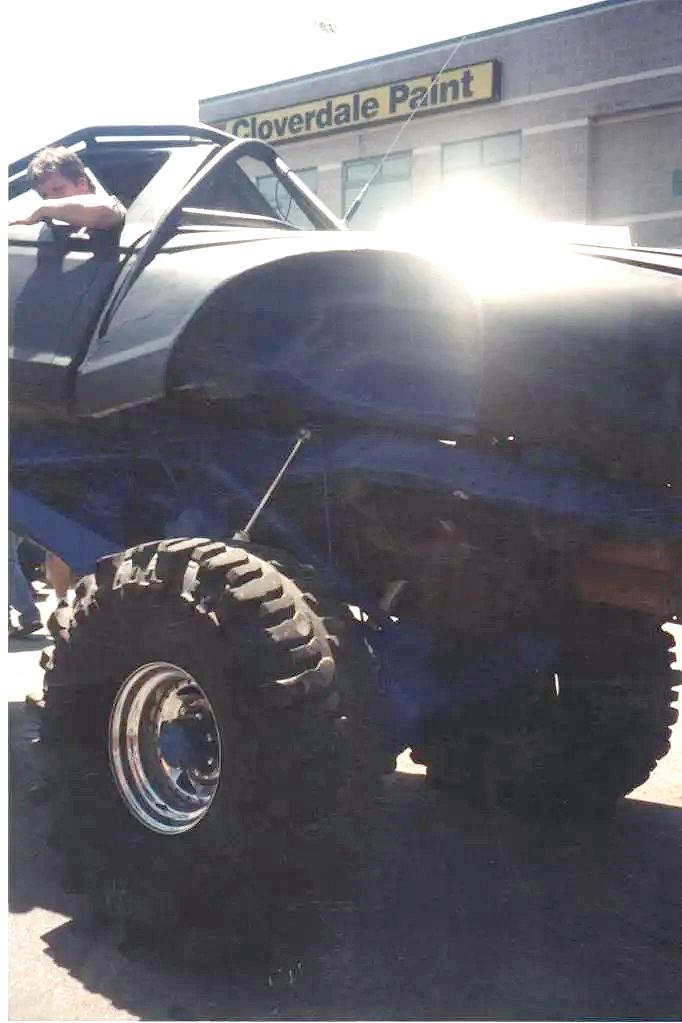
The front fenders were being eaten by the tires, and the same thing was happening in the rear. Eventually Tom removed the fenders and fabricated steel framework that would allow aluminum panels to be installed around the tires.
The aluminum panels never made it onto the truck.
The 44s created another problem: gearing.
The truck still had relatively tall axle gears, and the additional weight and rolling resistance of the Boggers made the small V8 struggle in the mud. Tom eventually found a 10.25 rear axle with 4.10 gears and installed it.
Rather than replace the Dana 50’s entire center section, he found a Dana 44 center section with the desired 4.10 gears. It was a direct fit for the Dana 50 components, allowing him to retain the Dana 50 shafts and outer ends.
That combination gave the truck 4.10 gearing while retaining the strength and hardware Tom had already built into the front axle.
The 44s were still hard on the drivetrain, though. In deep mud, the tires could absorb tremendous amounts of power.
Tom’s answer was simple:
More engine.

The 460
Tom eventually put a 460 cubic-inch Ford V8 in the back of the Ranger.
The 4.6-liter had actually worked well, and Tom removed it while it was still running. One of the things he liked about the 4.6 was its electronic protection strategy. When it was over-revved, the limiter protected it, and when it overheated, the engine could shut down cylinders in groups and cycle them to reduce temperature.
The 4R70W transmission had never given him trouble either.
But the 460 was the engine that finally made the truck’s combination of weight, gearing and 44-inch tires make sense.
A C6 automatic was used behind the big-block, followed by an NP205. Behind that was the pair of NP435 four-speeds and another NP205, creating the complicated drivetrain that became one of the truck’s trademarks.
With the 460 making considerably more torque, the Ranger could finally make serious use of the 44-inch tires in the mud.
Of course, fitting all of this into a Ranger required considerably more fabrication.
The exhaust was custom-built, including headers that Tom wanted to wrap over the valve covers before exiting toward the rear of the engine. Conventional catalog headers didn’t provide the configuration he needed. The custom exhaust was also important because the stock-style exhaust manifolds had a tendency to blow their gaskets when the engine was subjected to nitrous.
The steering system received custom steel lines as well. Tom used 5/16-inch tubing for the pressure side and 3/8-inch tubing for the return, double-flaring the ends and connecting the lines to the steering box and flexible sections at the pump.
The heater hoses were treated similarly, with steel tubing running from the rear-mounted engine to the heater box and short rubber sections used where flexibility was required.

The Final Suspension
The suspension eventually went through perhaps as much evolution as the drivetrain.
The truck originally used coil springs in front and leaf springs in the rear. Tom eventually replaced that arrangement with a transverse-leaf suspension at both ends, combined with custom links.
The basic idea is easier to understand if you separate two jobs that a conventional leaf spring performs.
A conventional leaf spring both supports the vehicle’s weight and locates the axle. Tom’s arrangement separated those functions. The links controlled the location and movement of the axle, while the transverse leaf spring primarily supported the vehicle’s weight.
At the rear, the suspension effectively functioned as a three-link arrangement. A large upper A-arm located the differential from above, with its wide end pivoting on the frame and its single inner pivot located at the differential. Heavy lower arms attached near the ends of the axle tubes.
The lower links used radius-arm-style bushings at their frame mounts. The other ends were bushed so the suspension could move through its range without binding.
The transverse leaf spring was mounted across the truck rather than longitudinally. The spring extended from one side of the truck to the other, with its ends supporting the axle much like the lower portions of conventional coil springs.
The important point is that the spring wasn’t responsible for locating the axle. The links did that job.

At full articulation, the differential could move away from one spring perch while the suspension geometry kept the opposite side properly supported. The links controlled the axle’s movement while the springs provided the weight-carrying force.
The front used a similar philosophy, although the geometry was different. The front suspension was essentially a two-link arrangement using a large triangular arm, with a panhard/track bar controlling lateral movement.
Tom deliberately avoided relying on rod ends for the main pivots. Instead, he used one-inch Grade 8 bolts with nylon bushings on the compression side and rubber bushings on the extension side.
After years of use, the nylon bushings showed some wear, but Tom considered the overall design extremely successful.
He also used the shocks as articulation limiters. They prevented the suspension from twisting beyond a controlled range, while the link geometry itself limited further movement. Even without the shocks, the suspension couldn’t simply continue twisting indefinitely.
The spring-support crossmembers were built from 3/16-inch abrasion-resistant plate, fully boxed and overlapped to produce roughly 3/8-inch effective thickness. Tom built them strong enough to support a truck weighing approximately 6,800 pounds.
The springs themselves were F-250 leaf packs trimmed to the required length. Tom could alter the spring rate by changing individual leaves or adding and removing shims.
He considered the transverse-leaf conversion one of the best changes he’d made to the truck. It provided a combination of articulation, stability and controlled street manners that would have been difficult to achieve with the original suspension arrangement.

A Gearbox Inside a Gearbox Inside a Gearbox
By this point, the drivetrain was so complicated that it deserves a little explanation.
Tom wasn’t actually driving around and shifting three transmissions every time he changed gears. The multiple gearboxes served primarily as additional ranges.
Think of a transfer case’s low range. You can drive in first gear with the transfer case in high, then select low range and suddenly first gear becomes much lower.
Tom essentially had additional versions of that concept.
The NP435 has a very low first gear—approximately 6.69:1. The NP205 provides another 1.96:1 reduction in low range. With multiple transmissions and transfer cases available, Tom could combine these reductions to create extraordinarily low overall gearing.
He calculated one combination using a ZF five-speed, two NP435s, two NP205s and 4.10 axle gears at approximately 4,032:1 overall reduction. When the transmissions were used in reverse as part of the unusual arrangement, he calculated a theoretical ratio of approximately 6,146:1.
At a 750-RPM idle, that could reduce wheel speed to roughly one tire revolution every eight minutes.
That’s approximately 0.0165 MPH.
At that speed, the Ranger wasn’t exactly going anywhere quickly—but it could crawl.
And that’s the point. Tom wasn’t trying to create hundreds of useful driving gears. In normal operation, he could simply use the primary transmission normally. The additional gearboxes provided selectable ranges when the terrain demanded them.
The complicated drivetrain also allowed Tom to distribute the mechanical reduction across several strong, readily available Ford components rather than relying on a single exotic aftermarket transmission or transfer case.
It was an unconventional solution, but unconventional solutions were becoming something of a theme with this Ranger.

Built to Explore
Eventually Tom moved to Haida Gwaii, where the Ranger’s original mission—exploring and camping—became more important than ever.
The truck had another problem to solve: legality.
With so much of the body removed or modified, Tom needed to provide appropriate fender coverage. He stretched EPDM rubber roofing material over the front cage to provide coverage around the front tires and fabricated simple aluminum rear fenders.
Fuel was always something to think about with a 460-powered truck running 44-inch tires. The straps on the back of the truck were used to carry two additional jerry cans.
Haida Gwaii provided plenty of logging roads, beaches and remote areas to explore, giving the Ranger exactly the kind of environment Tom had envisioned when he bought that $500 pickup.
It had certainly come a long way from the lawn ornament he drove home.
The 2010 Off-Road Truck of the Year
The finished Ranger is difficult to describe with a simple list of modifications because the list doesn’t explain what makes the truck interesting.
It wasn’t a professionally engineered vehicle that was designed from scratch. It wasn’t a catalog build. It wasn’t even the truck Tom originally set out to build.
It was a series of solutions.
The four-cylinder needed more gearing, so Tom stacked transmissions. The engines kept failing, so he installed a V8. The V8 wasn’t enough for the 44s, so he installed a 460. The front suspension limited articulation, so he built a solid axle. The radius arms created alignment problems, so he redesigned them. The conventional suspension wasn’t doing what he wanted, so he developed the transverse-leaf/link arrangement.
Every time the truck presented Tom with a problem, he built his way around it.
That’s why the final Ranger is so fascinating. When you look at photographs of a rear-engine Ranger with multiple transmissions, enormous tires and a suspension that looks like nothing Ford ever imagined, you’re not looking at a collection of random crazy ideas.
You’re looking at the history of a truck that evolved one problem at a time.
And in 2010, that evolution earned Tom Lilley’s 1986 Ford Ranger the title of The Ranger Station’s Off-Road Truck of the Year.

Final Specifications
- Owner: Tom Lilley — “gwaii”
- Vehicle: 1986 Ford Ranger
- Original configuration: 2WD, 4-cylinder, 5-speed
- Final engine: Ford 460 V8, rear-mounted
- Transmission: Ford C6 automatic
- Auxiliary transmissions: Two NP435 four-speed transmissions
- Transfer cases: Two NP205 transfer cases
- Front axle: Custom solid axle using Dana 50 components with a Dana 44 center section and 4.10 gears
- Rear axle: Ford 10.25-inch, 4.10 gears
- Differentials: Spools
- Front suspension: Custom linked/transverse-leaf suspension with track bar
- Rear suspension: Custom 3-link/transverse-leaf suspension
- Tires: 44-inch Boggers
- Steering: Power steering
- Winch: Warn 9000
- Cage: Custom exoskeleton
- Fuel: Relocated Ranger fuel tank with additional jerry cans
- Cooling: Rear-mounted radiator with electric fans
- Estimated weight: Approximately 6,800 pounds
Editor’s note: The truck’s drivetrain continued to evolve after some of the earlier stages described in the build thread. The specification above reflects the configuration associated with the Ranger’s 2010 Off-Road Truck of the Year feature, rather than treating every later modification as part of the 2010 truck.
Links
Gwaii – Ranger Retrofit / Rebuild
Photo Gallery





About The Author
Jim Oaks is the founder of TheRangerStation.com, the longest-running Ford Ranger resource online since 1999. With over 25 years of hands-on experience building and modifying Ford Rangers — including magazine-featured builds like Project Transformer — Jim has become one of the most trusted authorities in the Ford Ranger off-road and enthusiast space.
Since launching TheRangerStation.com, Jim has documented thousands of real-world Ranger builds, technical repairs, drivetrain swaps, suspension modifications, and off-road adventures contributed by owners worldwide. TheRangerStation.com has been referenced in print, video and online by enthusiasts, mechanics, and off-road builders looking for practical, and experience-based information.