
How to Phase Dana 35 and Dana 44 TTB Axle Shafts
The Ford Ranger, Bronco II, and early Ford Explorer used Dana 28 and Dana 35 Twin-Traction Beam (TTB) front axles. When rebuilding the passenger-side axle shaft on a Dana 35, there’s an important detail you need to pay attention to: U-joint phasing.
The passenger-side axle shaft uses two U-joints connected by a slip yoke. The rotational alignment of the yokes matters because the two U-joints need to work together correctly. Unlike the Dana 28, which uses a master spline or ‘keyed spline’ to ensure the shaft sections fit together in only one rotational position, the Dana 35 allows the slip-yoke connection to be assembled in different positions. This makes it possible to put the shaft together incorrectly even though everything fits.
The same phasing principle applies to the Dana 44 TTB axle shaft, which uses the same basic arrangement. Although the Dana 44 was not a factory option in the Ranger, Bronco II, or Explorer, the information is relevant to people working with that axle as well.
What Is U-Joint Phasing?
Phasing refers to the rotational alignment of the yokes on a shaft assembly that uses two universal joints. The yokes need to be positioned in relation to each other so the joints work together as intended.
A conventional U-joint operating at an angle does not transmit rotation at a perfectly constant speed. As the joint turns, the output speeds up and slows down twice per revolution. When two U-joints are correctly phased and their operating angles are compatible, the speed fluctuations from one joint can cancel those from the other.
When the yokes are incorrectly phased, those fluctuations may not cancel properly. The result can be unwanted cyclic motion and stress in the assembly, and depending on the operating conditions, vibration or binding.
The same basic principle applies to axle shafts that use two U-joints.
This video demonstrates the effect U-joint phasing has on shaft rotation and helps explain why the rotational relationship between the yokes matters.
How to Phase the Passenger-Side Axle Shaft
When assembling the passenger-side axle shaft on a Dana 35 or Dana 44 TTB front axle, the yoke ears on the intermediate shaft and slip yoke need to line up with each other. The yokes at the two ends of the assembly will then be perpendicular to the intermediate yokes, as shown in the illustration below.
Because the splines allow the shaft sections to fit together in different rotational positions, pay attention to how the yoke ears line up before completing the assembly. Simply getting the splines engaged does not guarantee that the U-joints are properly phased.
A general U-joint phasing illustration can help show the concept:
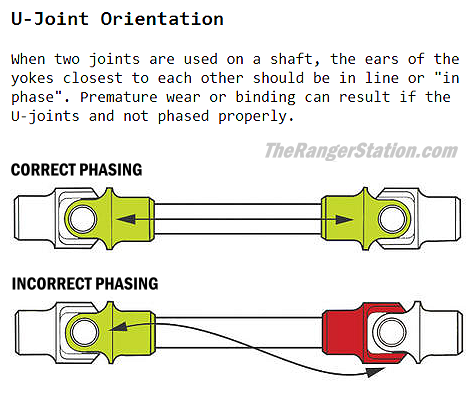
Use this image as a general illustration of yoke alignment, not as a diagram of the Ford TTB axle shaft assembly.
Once you have established the correct orientation, assemble the slip yoke and shaft sections without changing their rotational relationship. Complete the rest of the axle assembly according to the appropriate service procedure.
What If the Axle Shafts Are Out of Phase?
An out-of-phase shaft assembly can still fit together and appear to be assembled correctly. The problem is that the U-joints may no longer work together as intended.
Depending on the geometry and operating conditions, incorrect phasing can contribute to cyclic movement, vibration, or binding. The exact symptoms and severity can vary, so the absence of an obvious vibration does not prove the shafts are correctly phased.
If you have disassembled the passenger-side axle shaft on a Dana 35 or Dana 44 TTB axle, take the time to verify the yoke orientation before putting everything back together. It is much easier to correct the alignment while the shaft is on the bench than after the axle has been reassembled.
Related Discussion
D35 u-joints “in phase”? Applicable to other TTB axles as well
Related Articles
Ford Ranger 4×4 Front Axles 1983-1997
Dana 28 and Dana 35 Repair and Rebuild
About The Author
Jim Oaks is the founder of TheRangerStation.com, the longest-running Ford Ranger resource online since 1999. With over 25 years of hands-on experience building and modifying Ford Rangers — including magazine-featured builds like Project Transformer — Jim has become one of the most trusted authorities in the Ford Ranger off-road and enthusiast space.
Since launching TheRangerStation.com, Jim has documented thousands of real-world Ranger builds, technical repairs, drivetrain swaps, suspension modifications, and off-road adventures contributed by owners worldwide. TheRangerStation.com has been referenced in print, video and online by enthusiasts, mechanics, and off-road builders looking for practical, and experience-based information.