
1984-1990 Ford Bronco II Trim Levels & Packages
The Ford Bronco II was offered in several different trim levels and factory equipment packages during its seven-year production run from 1984 through 1990. While the basic Bronco II formula remained the same, Ford changed the available trims, standard equipment, appearance treatments and equipment packages as the vehicle evolved.
The earliest Bronco IIs were offered in Standard, XLS, XLT and Eddie Bauer configurations. The XLS was discontinued after 1985, while the XLT continued throughout the Bronco II’s production run. Ford later added the XL Sport and XLT Plus, while the Eddie Bauer remained the most distinctive and recognizable Bronco II.
It is important to remember that a Bronco II’s trim designation did not necessarily determine every feature on the vehicle. Ford offered multiple factory equipment packages within some trim levels, and the equipment included with those packages changed from year to year. As a result, two Bronco IIs with the same trim designation can have different equipment.
Bronco II Trim Levels by Model Year
| Model Year | Standard / XL | XLS | XLT | XL Sport | XLT Plus | Eddie Bauer |
|---|---|---|---|---|---|---|
| 1984 | ✓ | ✓ | ✓ | — | — | ✓ |
| 1985 | ✓ | ✓ | ✓ | — | — | ✓ |
| 1986 | ✓ | — | ✓ | — | — | ✓ |
| 1987 | ✓ | — | ✓ | — | — | ✓ |
| 1988 | ✓ | — | ✓ | ✓ | — | ✓ |
| 1989 | ✓ | — | ✓ | ✓ | ✓ | ✓ |
| 1990 | ✓ | — | ✓ | ✓ | ✓ | ✓ |
Trim names, equipment and package availability changed during the production run. This table provides a general overview; see the original Ford brochure for the specific model year when determining exact factory equipment.
Note About Trim Packages
Ford sometimes offered the same Bronco II trim with more than one factory equipment package. The trim designation identified the model, while the equipment package determined much of the equipment installed on that particular vehicle.
For example, Ford offered multiple equipment packages within the XLT trim. Depending on the model year and package, an XLT could have air conditioning, power windows, power door locks, power mirrors, cruise control, tilt steering, upgraded audio equipment and other features. Ford identified these packages with specific codes in its ordering literature, and the contents of the packages changed as the Bronco II evolved.
Dealers generally favored the better-equipped packages when ordering vehicles for their showroom inventory because those vehicles offered the features customers were most likely to expect from the trim level. Consequently, a Bronco II with a particular trim designation may have considerably more equipment than another vehicle carrying the same trim name.
The trim tells you what the Bronco II is; the factory equipment package helps explain how it was equipped.
Important Model-Year Equipment Changes
Power windows and power door locks: Factory power windows and power door locks were not available on the 1984 Bronco II. Ford introduced the Power Window/Lock Group for the 1985 model year.
Flip-up rear glass: The optional flip-up rear window glass in the rear hatch was available from 1984 through 1988. When Ford redesigned the Bronco II for 1989, the flip-up glass option was eliminated. All 1989 and 1990 Bronco IIs used the one-piece solid-glass rear hatch window.
Touch-Drive: Ford introduced the optional Touch-Drive electric-shift transfer case for 1986. On 1986–1988 Bronco IIs, the push-button controls were located in an overhead console. Ford redesigned the instrument panel for 1989 and moved the Touch-Drive controls into the dash.
These changes are useful when evaluating a Bronco II for sale because some equipment was only available during certain model years. The equipment on an individual vehicle should always be verified rather than assumed from the trim badge alone.
Standard / XL Trim
The Standard was the entry-level Bronco II, providing a straightforward combination of utility and basic equipment. Ford later adopted the XL designation as part of the company’s broader truck-line naming system.
- Exterior: Early Standard models used a simple appearance with black grille and bumper treatments, black exterior mirrors and basic steel wheels or wheel covers. Exterior equipment and styling changed during the production run.
- Interior: The basic interior featured reclining bucket seats, knitted-vinyl upholstery, a simple steering wheel and practical trim. Equipment such as carpeting and upgraded interior appointments changed from year to year.
- Instrumentation: The basic instrument cluster provided the primary vehicle and engine gauges. Some later equipment packages added upgraded instrumentation, including a tachometer.
- Equipment: Depending on the year and factory equipment package, Standard/XL models could be equipped with air conditioning, upgraded audio equipment, cruise control, tilt steering, power windows and power door locks. These were not universal features of every Standard or XL.
The Standard/XL was therefore not necessarily a stripped-down truck. Ford offered equipment packages that could make an XL considerably better equipped than the basic version of the trim.
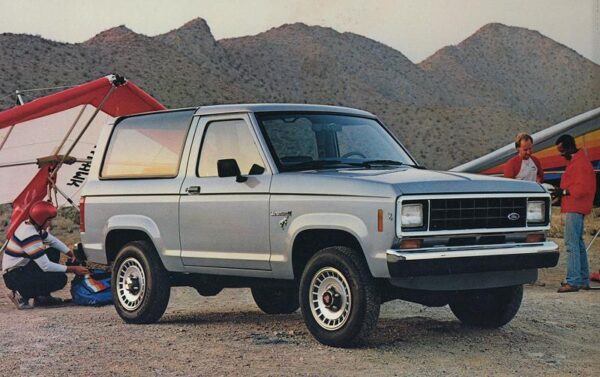
(Ford Bronco II Standard / XL Trim)
XLS Trim
The XLS was Ford’s sporty Bronco II during the 1984 and 1985 model years. Rather than concentrating on the chrome and luxury-oriented appearance of the XLT, the XLS emphasized a sportier appearance and special interior trim.
- Exterior: The XLS featured a blacked-out appearance, including a dark grille, black bumpers and flat-black window trim. Distinctive XLS tri-color lower-body graphics identified the model.
- Interior: The XLS received a black, thick-wrapped sport A-frame steering wheel, cloth door trim panels with integrated map pockets and color-keyed instrument-panel trim.
- Equipment: Ford offered the XLS with additional equipment beyond its basic trim, with the exact combination depending on the model year and factory equipment package.
The XLS was discontinued after the 1985 model year.
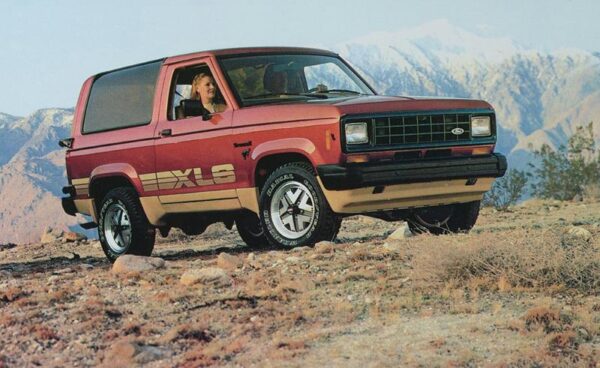
(Ford Bronco II XLS Trim)
XLT Trim
The XLT was the Bronco II’s mainstream luxury-oriented trim, focusing on passenger comfort, upgraded interior appointments and a more upscale exterior appearance.
- Exterior: The XLT featured a chrome grille, chrome bumpers and chrome wheel-lip moldings, along with deep-tinted rear quarter windows.
- Interior: XLT models received premium cloth-and-vinyl upholstery, fully carpeted floors and full vinyl door trim panels.
- Storage: The rear quarter panels incorporated three storage compartments, including one lockable compartment.
- Equipment: Depending on the model year and factory equipment package, XLTs were equipped with features such as air conditioning, power windows, power door locks, power mirrors, cruise control, tilt steering, upgraded AM/FM audio equipment, interval windshield wipers and upgraded instrumentation.
- Four-wheel drive: The optional Touch-Drive electric-shift transfer case was introduced for 1986. On 1986–1988 Bronco IIs, the push-button controls were located in the overhead console. For 1989, Ford redesigned the instrument panel and moved the Touch-Drive controls into the dash.
Because Ford offered multiple equipment packages within the XLT trim, the equipment found on an XLT can vary considerably depending on its model year and factory package.

(Ford Bronco II XLT Trim)
XL Sport Trim
Ford introduced the XL Sport for 1988, giving buyers a sport-oriented version of the XL without moving into the XLT or Eddie Bauer models.
The XL Sport was more than an XL with a name on the fender. Ford gave it a specific group of exterior appearance equipment intended to make it immediately recognizable.
- Exterior: The XL Sport featured a brush grille guard, fog lamps, black tubular rear bumper, black front bumper, front fascia and body spats.
- Appearance: Sport-oriented wheels, tires and graphics further distinguished the XL Sport from the standard XL.
- Interior: The XL Sport retained the basic XL interior but could be ordered with Ford’s available equipment packages.
- Equipment: The available XL Sport equipment packages could add features including air conditioning, electronic AM/FM stereo, tachometer, cast-aluminum wheels, privacy glass, power windows and door locks, cruise control and tilt steering, rear window defroster, rear window wiper/washer and a flip-open rear window, depending on the package selected.
The XL Sport identified the trim and appearance package, while the factory equipment package determined how much additional equipment the particular truck received.

(Ford Bronco II XL Sport Trim)
XLT Plus Trim
The XLT Plus appeared for the 1989 and 1990 model years. Rather than being a completely separate trim in the same sense as the XLT or Eddie Bauer, XLT Plus was Ford’s designation for a specific, highly equipped XLT factory package.
- Exterior: The package included additional equipment such as deluxe two-tone paint, a luggage rack and an outside spare-tire carrier, along with upgraded wheel and appearance equipment.
- Interior: The XLT Plus package included air conditioning, power windows, power door locks, power mirrors, cruise control and tilt steering.
- Convenience: Additional equipment was bundled into the package rather than requiring the buyer to select each item individually.
- Four-wheel drive: On 1989–1990 Bronco IIs equipped with the optional Touch-Drive electric-shift transfer case, the push-button controls were located on the redesigned instrument panel. Ford had placed the Touch-Drive controls in the overhead console on the 1986–1988 models.
The XLT Plus is therefore best understood as an XLT with a particular factory equipment package, rather than simply a separate trim level that was above every other XLT.
Eddie Bauer Trim
The Eddie Bauer was the Bronco II’s distinctive upscale configuration, created through Ford’s relationship with the Eddie Bauer outdoor brand. It combined upgraded equipment with a unique exterior color scheme and dedicated interior.
- Exterior: Eddie Bauer models featured distinctive two-tone paint, with a tan or earth-tone accent on the lower body and wheel openings. Eddie Bauer identification and a color-keyed spare-tire cover further distinguished the model.
- Interior: The Eddie Bauer received a dedicated tan interior with special upholstery and trim. Early models featured outdoor-themed seat designs, including stitched pine-tree motifs, while later models received updated Eddie Bauer graphics and upholstery.
- Seating: Eddie Bauer models featured upgraded seating with distinctive cloth inserts. Early models also included inflatable air-pump lumbar support.
- Equipment: Eddie Bauer models were generally sold with substantial amounts of additional equipment, although the exact equipment changed from year to year and could vary according to the factory equipment package.
- Eddie Bauer luggage: Early Bronco II Eddie Bauer models were offered with matching Eddie Bauer luggage/garment bags.
The Eddie Bauer remained one of the most recognizable Bronco II configurations throughout the vehicle’s production run.

(Ford Bronco II Eddie Bauer Trim)
Ford Brochures: The Original Source
The best way to understand the Bronco II’s trim levels and equipment is to look at Ford’s own sales literature. The Ranger Station has preserved Ford sales brochures for 1984, 1985, 1986, 1987, 1988, 1989 and 1990, along with additional Ford marketing material. These brochures document the model names, equipment packages, colors and changes Ford offered during the Bronco II’s production run.
See the Bronco II Sales Brochure Library for the original Ford documentation.
Related Articles
Ford Bronco II Sales Brochures
Bronco II Specifications & Facts
Ford Bronco II Production Numbers
About The Author

Jim Oaks is the founder of TheRangerStation.com, the longest-running Ford Ranger resource online since 1999. With over 25 years of hands-on experience building and modifying Ford Rangers — including magazine-featured builds like Project Transformer — Jim has become one of the most trusted authorities in the Ford Ranger off-road and enthusiast space.
Since launching TheRangerStation.com, Jim has documented thousands of real-world Ranger builds, technical repairs, drivetrain swaps, suspension modifications, and off-road adventures contributed by owners worldwide. TheRangerStation.com has been referenced in print, video and online by enthusiasts, mechanics, and off-road builders looking for practical, and experience-based information.