
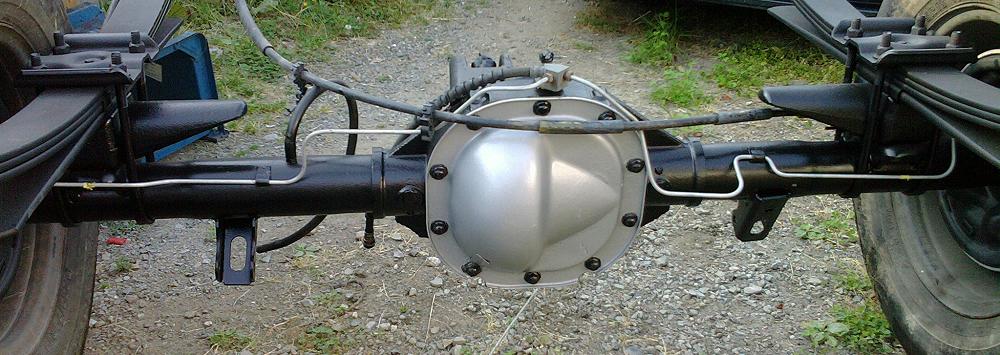
Ford 7.5-Inch Rear Axle History & Specifications
The Ford 7.5-Inch rear axle is a reliable and serviceable axle used in Ford Rangers, Bronco IIs, Aerostars, and Mustangs for decades. Favored by off-road enthusiasts and DIY mechanics, this axle provides a solid balance of strength, maintenance ease, and compatibility. This guide covers its history, specifications, axle codes, and how to identify your axle for 1983–2011 Ford vehicles.
Contents
- Ford 7.5-Inch Axle Usage
- Axle Shaft and Width Differences
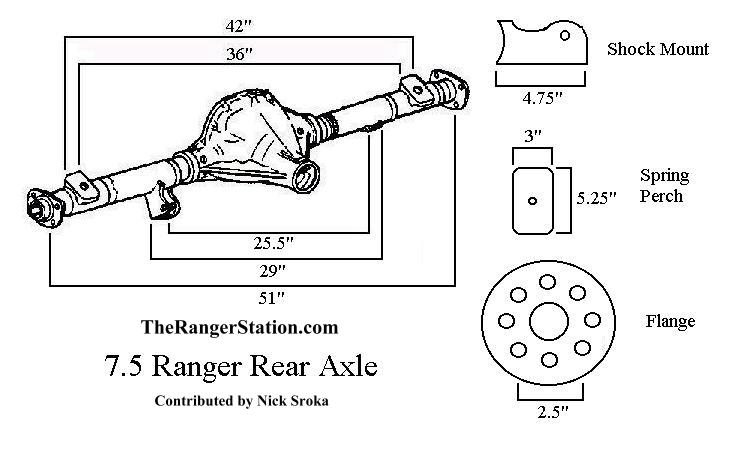
- Ford 7.5-Inch Rear Axle Specifications
- Rear Axle Codes
- How to Identify Your Axle
Ford 7.5-Inch Axle Usage
The Ford 7.5-Inch axle was installed in several vehicles including:
- Ford Aerostar (1985-1997)
- Ford Bronco II (1984-1990)
- Ford Mustang (1979-2011)
- Ford Ranger (1983-2011)
For this guide, we will focus on the Ford Ranger and Bronco II.
All Bronco II trucks (1984-1990) came with a 7.5-Inch rear axle.
Ford Rangers used the 7.5-Inch axle from 1983-1989. From 1990-2011, 4.0L Rangers received the 8.8-Inch rear axle. Non-4.0L Rangers (1990-2011) retained the 7.5-Inch axle, except 1998-2011 SuperCab 4×4 models, which used the 8.8-Inch axle regardless of engine size.
Drum Brakes
The Ford Ranger 7.5-Inch axle came with a 9-inch drum brake.
Ford Ranger SuperCabs with a 7.5-Inch came with a 10-Inch brake drum.
Payload Package: Ford Ranger Regular Cabs (non-4.0L) that came with a 7.5-Inch axle came with a 10-inch brake drum and also had a ‘Payload Package’ came with 10-inch brake drums instead of a 9-inch drum.
- GVWR over 4580 pounds use a 10-inch drum
- GVWR under 4580 pounds use a 9-inch drum
Check out: Ford Ranger Payloads
Axle Shaft and Width Differences
Many enthusiasts ask about swapping axle shafts between years. Key differences:
- 1983-1992 Ranger axles are 1-inch shorter on both sides than 1993+ models. Full 1993+ axle assemblies are therefore 2 inches wider overall.
- Bronco II right-side axle shafts are 1-5/8″ wider than 1983-1992 Ranger shafts; the extra width is entirely on the passenger side. Driver side shafts remain the same length across both vehicles.
- On all Ranger/Bronco II models, the driver side axle shaft is longer than the passenger side.
- No difference exists between 7.5″ and 8.8″ axle shafts within the same year range.
- Mustang Note: Salvage yards often remove left-side shafts from 1983-1992 Rangers and Bronco IIs for 5-lug Mustang conversions (Ranger/Bronco shafts are 5-lug, Mustang shafts are 4-lug).
Axle Dimensions |
||||
| Ranger 1983-1992
7.5-Inch Axle |
Ranger 1993-2009
7.5-Inch Axle |
Bronco II 1984-1990 7.5 Inch Axle (1) |
Ranger 2010-2011
7.5-Inch Axle With Disc brakes |
|
| Width WMS-WMS | 56-1/2 inches | 58-1/2 inches | 58 inches | unk |
| Axle tube diameter (1983-2009 models): | 2.80 inches | 2.80 inches | 2.80 inches | 3.25 inches |
| Pinion Offset Right Of Center | unk | unk | 1-1/4 Inches | unk |
| Pinion Offset Below Centerline | unk | unk | unk | unk |
| Pinion length (axle centerline to u-joint centerline): | 11-5/8 inches | 11-5/8 inches | 11-5/8 inches | 11-5/8 inches |
| Bottom Of Housing From Centerline | 5-inches | 5 inches | 5 inches | 5 inches |
| 38-1/2 inches | 38-1/2 inches | 40-1/2 inches | 38-1/2 inches | |
| Axle Spline / Diameter | 28 / 1.21 inches |
28 / 1.21 inches | 28 / 1.21 inches | 28 / 1.21 inches |
| Pinion Stem Diameter | 1.626 inches | 1.626 inches | 1.626 inches | 1.626 inches |
| Ring Gear Diameter | 7.50 inches | 7.50 inches | 7.50 inches | 7.50 inches |
| (1) The Bronco II 7.5 inch rear axle is ~1-5/8 inches wider than the Ranger 7.5 inch axle.
All the additional width is in the passenger side. |
||||
Ford 7.5-Inch Rear Axle Specifications
Ring Gear & Differential
Ford 7.5-Inch Axle – Ring Gear & Differential Specs |
|
| Ring Gear Diameter | 7.5 Inches |
| Ring Gear Bolts | 10 x 7/16″ x 20 |
| Differential Cover Bolts | 10 |
| Pinion Stem Diameter | 1.626 Inches |
| Pinion Splines | 28 |
| Pinion Bearing Preload (New) | 14-19 in-lb |
| Pinion Bearing Preload (Used) | 8-10 in-lb |
| Backlash | .011″-.016″ |
| Ring Gear Bolt Torque | 70-85 ft-lb |
| Bearing Cap Bolt Torque | 70-85 ft-lb |
| Fluid Type | Hypoid gear lubricant SAE 75W80 or 80W90 (Add 2 oz friction modifier for limited slips) |
| Fluid Capacity | 5 pints (2-3 quarts if only changing fluid; more if aftermarket heavy-duty cover) |
Axle Shaft Specifications
Ford 7.5-Inch Axle – Axle Shaft Specs |
||||
| Vehicle | Side | Spline / Diameter | Length | Bearing |
| 1983-1992 Ford Ranger | Right Hand | 28 / 1.21″ | 26.25″ | 1.4″ |
| 1983-1992 Ford Ranger | Left Hand | 28 / 1.21″ | 29.125″ | 1.4″ |
| 1993-1997 Ford Ranger | Right Hand | 28 / 1.21″ | 27.25″ | 1.4″ |
| 1993-1997 Ford Ranger | Left Hand | 28 / 1.21″ | 30.125″ | 1.4″ |
| 1984-1990 Ford Bronco II | Right Hand | 28 / 1.21″ | 27.6875″ | 1.4″ |
| 1984-1990 Ford Bronco II | Left Hand | 28 / 1.21″ | 29.125″ | 1.4″ |
| All 7.5-Inch axles use 5×4.5″ wheel bolt pattern and 1/2″ wheel studs. | ||||
How to Identify Your Ford 7.5-Inch Rear Axle
You can identify your axle using the tag on the differential inspection cover or by the Safety Standard Certification label on the driver’s side door post.
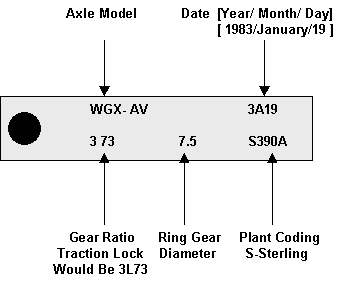
Looking at that tag, you can see the gear ratio stamped on the lower left, and the axle size (ring gear diameter) stamped in the bottom middle.
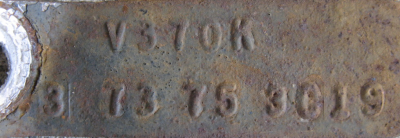
Looking at the axle tag above, you can see it’s a 3.73 gear ratio in a 7.5-inch axle.
Ford Rear Axle Codes
Axle codes are found on the Safety Standard Certification label on the driver-side door lock post. Codes indicate axle type, ratio, and limited-slip configuration.
Rear axle codes can be found on the Safety Standard Certification label attached to the left drivers side door lock post. The code appears as a number or letter/number combination in the ‘Axle’ column of the label.
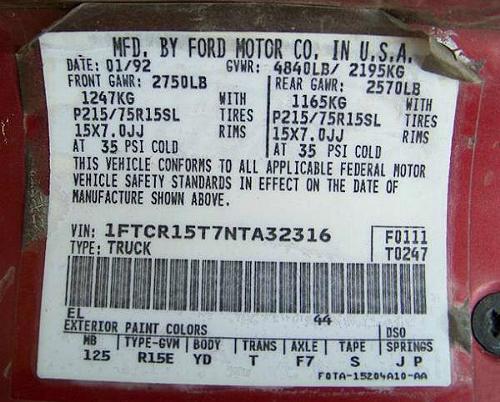
If you look at the ‘AXLE’ section on the label above, you’ll see that this Ranger has a ‘F7’ axle code. Using the chart below, we know that this axle is a 7.5-Inch axle with a 4.10 limited slip.
Axle codes for Ranger, Bronco II, Explorer and Aerostar (included because 4.10 gears and limited slips are more common than you’d expect).
| Aerostar | |||
| Code | Description | Capacity | Ratio |
| 22 | open 7.5″ | 2950 | 4.10 |
| 23 | open 7.5″ | 2950 | 3.45 |
| 24 | open 7.5″ | 2950 | 3.73 |
| 25 | open 8.8″ | 2950 | 3.27 |
| 29 | open 8.8″ | 2950 | 3.55 |
| B2 | L/S 7.5″ | 2950 | 4.10 |
| B4 | L/S 7.5″ | 2950 | 3.73 |
| B5 | L/S 8.8″ | 2950 | 3.55 |
| B9 | L/S 8.8″ | 2950 | 3.55 |
| (Note: Aerostars with axle codes starting with “1” are Spicer/Dana 30 axles with Aluminum housings) | |||
| Bronco II | |||
| Code | Description | Capacity | Ratio |
| 42 | open 7.5″ | 2640 | 3.45 |
| 44 | open 7.5″ | 2640 | 3.73 |
| 47 | open 7.5″ | 2640 | 4.10 |
| D2 | L/S 7.5″ | 2640 | 3.45 |
| D4 | L/S 7.5″ | 2640 | 3.73 |
| D7 | L/S 7.5″ | 2640 | 4.10 |
| Ranger | |||
| Code | Description | Capacity | Ratio |
| 72 | open 6-7/8″ | 2200 | 3.08 |
| 74 | open 6-7/8″ | 2200 | 3.45 |
| 82 | open 7.5″ | 2750 | 3.08 |
| 84 | open 7.5″ | 2750 | 3.45 |
| 85 | open 7.5″ | 2750 | 3.55 |
| 86 | open 7.5″ | 2750 | 3.73 |
| 87 | open 7.5″ | 2750 | 4.10 |
| 89 (1992-1998) | open 7.5″ | 4.10 | |
| 89 (1999-2001) | open 7.5″ | 4.56 | |
| 91 | open 8.8″ | 2750 | 3.27 |
| 92 | open 8.8″ | 2750 | 3.08 |
| 95 | open 8.8″ | 2750 | 3.55 |
| 96 | open 8.8″ | 2750 | 3.73 |
| 97 | open 8.8″ | 2750 | 4.10 |
| 98 | open 8.8″ | 2750 | 4.56 |
| F4 | L/S 7.5″ | 2750 | 3.45 |
| F5 | L/S 7.5″ | 2750 | 3.55 |
| F6 | L/S 7.5″ | 2750 | 3.73 |
| F7 | L/S 7.5″ | 2750 | 4.10 |
| K6 | L/S 8.8″ | 4.10 | |
| R5 | L/S 8.8″ | 2750 | 3.55 |
| R6 | L/S 8.8″ | 2750 | 3.73 |
| R7 | L/S 8.8″ | 2750 | 4.10 |
| R8 | L/S 8.8″ | 2750 | 4.56 |
| (Note 4.56 geared axles ’99-up are 31-spline) | |||
Related Articles
Ford Ranger Rear Axles (1983-2011)
Ford 7.5 & 8.8 Inch Axle Tag & Door Codes
Explorer 8.8-Inch Swap – No Welding
What Is A Torsen Limited Slip Differential
How To Spot A 31-Spline FX4 8.8-Inch Axle
Explorer 8.8 Axle Yukon Ultimate 88 Kit
Yukon Ultimate 88 Axle Kit W/C-Clip Eliminators
Rear Axle Shaft Seal Replacement
Broken Cross Pin Retaining Bolt
Last Updated:
About The Author
Jim Oaks is the founder of TheRangerStation.com, the longest-running Ford Ranger resource online since 1999. With over 25 years of hands-on experience building and modifying Ford Rangers — including magazine-featured builds like Project Transformer — Jim has become one of the most trusted authorities in the Ford Ranger off-road and enthusiast space.
Since launching TheRangerStation.com, Jim has documented thousands of real-world Ranger builds, technical repairs, drivetrain swaps, suspension modifications, and off-road adventures contributed by owners worldwide. TheRangerStation.com has been referenced in print, video and online by enthusiasts, mechanics, and off-road builders looking for practical, and experience-based information.