Introduction
As you become more serious about your off-roading, and you continue to modify your truck, you’ll most likely start thinking about your trucks differentials and how you can get more traction off-road. There are a variety of differentials available for the Ford Ranger, depending on what axle you’re working with. This page discusses the different types of differentials and your options.
Stock Differentials: Open vs Limited Slip
Your Ford Ranger came with either an open differential, or a limited slip differential in the rear axle. The main difference between them lies in how power is distributed when one wheel loses traction. While an open differential sends power to the wheel with the least resistance, a limited-slip differential (LSD) redirects it to the wheel with the most grip.
NOTE: The Ford Ranger did not come with a front limited slip differential.
Open Differential
How it Works: It uses spider gears to allow wheels to rotate at different speeds during turns.
Power Distribution: Splits torque 50/50. However, power follows the path of least resistance. If one wheel is on ice, it spins rapidly while the wheel on dry pavement gets no power (the “one-wheel peel”).
Best Use: Standard everyday driving on dry, paved roads where simplicity and low cost are priorities.
Limited-Slip Differential (LSD)
How it Works: Uses clutches, gears (like Torsen), or fluids to limit the speed difference between axles.
Power Distribution: When it senses one wheel slipping, it automatically transfers torque to the non-slipping wheel to maintain forward motion.
Best Use: Performance cars, off-roading, and towing, as it provides better stability and acceleration on slippery or uneven surfaces.
Identifying The Ford Limited Slip
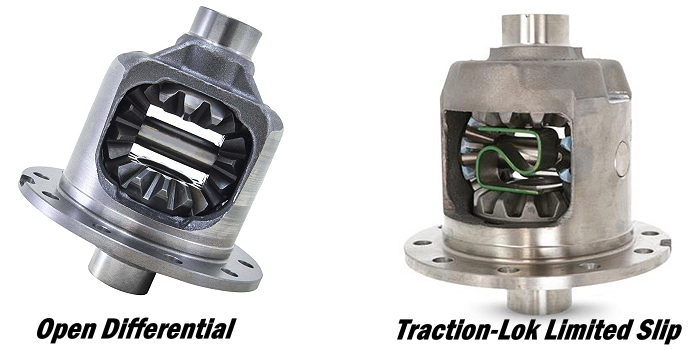
Ford Traction-Lok limited slip differentials are easy to spot. If you remove the differential cover and see an ‘S’ or ‘Z’ shaped spring in the middle of the differential, it’s a limited slip. If you just see the cross pin between the spider gears, it’s an open differential.
You can also identify your axle from the axle tag and door codes. See: Ford 7.5 & 8.8 Inch Axle Tag & Door Codes
Torsen Limited Slip
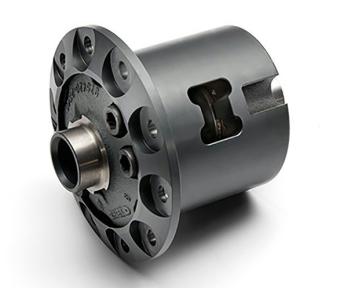
If you have a Ford Ranger FX4 you MAY have a Torsen limited slip which is a better limited slip than the Traction Lok.
A Torsen differential (a portmanteau of “Torque-Sensing”) is a purely mechanical (no clutches), gear-based limited-slip differential (LSD) that uses complex helical or worm gears to distribute engine power between wheels based on available traction. See: What Is A Torsen Limited Slip Differential
Limited Slip Limitations
The limited slip differential will send power to both wheels equally when traveling straight, however when one-wheel spins due to a lack of traction, the differential will automatically provide torque to the other wheel with traction. Limited Slip differentials limit the loss of torque to a slipping wheel through various mechanisms such as clutches, gears cones, and other methods dependent on the unit. The limited slip will not provide 100% lock up of the differential in extreme situations such as when a wheel completely loses traction.
The limited slip is obviously better than an open differential. But it won’t send 100% power to both wheels in extreme situations. When you’re stuck in the mud, or climbing a difficult trail, you want power going to both tires at the same time. Not just one. This is where a locker comes in.
Clutch Wear & Maintenance – Being a clutch-type limited-slip, the internal packs wear down over time, reducing effectiveness and requiring periodic maintenance or rebuilding.
Limited Slip vs. Locker: The Basics
The main difference is that a Limited-Slip Differential (LSD) allows for some speed difference between wheels, whereas a drop-in locker (like a Lock-Right) physically locks the axles together for 100% shared power.
Limited-Slip (LSD): Uses friction (clutches or gears) to transfer some torque to the wheel with grip. It never fully locks. If one tire is in the air, it will usually just spin.
Locker: Physically couples both axles together so they rotate at the exact same speed. It provides 100% torque to both wheels, regardless of whether one is off the ground.
Automatic Lockers (Always “Engaged”)
These are “automatic” because they lock based on torque application, not a switch.
Lunchbox Locker (e.g., Lock-Right, Aussie Locker)
-
-
- How it works: Replaces only the spider gears inside your existing carrier.
- The Turn: It stays locked under power. To turn on pavement, you must coast (take your foot off the gas) to let the outside wheel “ratchet” faster than the inside wheel.
- The Catch: If you hit the gas mid-turn, it will instantly lock, often causing a loud “clunk” and making the vehicle jerk or push straight.
-
Detroit Style Locker
-
-
- How it works: A full-carrier replacement that is much stronger than a lunchbox.
- The Turn: Like the lunchbox, it is normally locked. It uses heavy springs to keep “dog teeth” engaged. It only unlocks when the ground forces on the outside tire are stronger than the spring pressure (usually when coasting).
- The Catch: It is famous for “Detroit chatter” and can be very violent if it unlocks and re-locks suddenly.
-
Selectable Lockers (On/Off Switch)
These give you a choice: act like a standard “open” differential for the street, or lock 100% for the trail.
Air Locker (e.g., ARB Air Locker)
-
-
- How it works: Uses an onboard air compressor and a solenoid. When you flip the switch, air pressure pushes a locking ring to bridge the side gear and the carrier.
- Pros/Cons: Instant engagement and extremely strong. However, it requires an air system, and a leaking airline can leave you without a locker.
-
Electric Locker (e.g., Eaton ELocker)
-
-
- How it works: Uses an electromagnet. When energized, the magnet pulls a plate that forces pins or gears into a locked position.
- Pros/Cons: Simplest installation (just wires, no air lines). Some older models may take a second or a partial wheel rotation to fully “seat” and lock.
-
Summary Table
| Type | Mechanic | Behavior in a Turn | Best For |
|---|---|---|---|
| Lunchbox | Ratcheting gears | Must coast to unlock; clicks | Budget builds |
| Detroit | Heavy spring teeth | Heavy clunks; prefers coasting | Hardcore |
| Air | Pneumatic piston | Open (smooth) until switched | Ultimate control & speed |
| Electric | Electromagnet | Open (smooth) until switched | Ultimate control & speed |
How Lockers Effect Trail Maneuverability
There probably isn’t anyone that understands differentials more than John Currie from Currie Enterprises. John uses a Detroit locker in his front axle, and an E-Locker in the rear. He says that having the E-Locker in the rear allows him to make tighter turns on the trail. This video actually shows how different locker setups effect how your rig turns and maneuvers on the trail. The video is definitely a must see for anyone considering upgrading their differentials for off-road.
Front Lockers In 1998-2011 Ford Rangers
From 1998-2000 the Ford Ranger 4×4 used PVH locking hubs in the front axle. From 201-2011 the Ford Ranger 4×4 used a live front axle that was always spinning. Even in 2WD.
Steering Difficulty: With a live front axle, the locker will try to force both front wheels to turn at the same speed. When turning, the inner and outer wheels need to spin at different speeds. A locked differential prevents this, causing the vehicle to want to push straight ahead. This can lead to erratic and difficult-to-control handling, as well as increased tire wear. On wet or icy pavement, a front traction device can cause the vehicle to “plow” straight ahead during a turn (understeer) because the wheels cannot easily differentiate their speeds.
Component Stress: The added strain from the wheels being forced to turn at the same speed during a turn can put immense stress on components like the tie rods, half-shafts (CV axles), and even the differential housing, potentially leading to premature failure.
If you do want a locker in the front of your 2001-2011 Ford Ranger 4×4 and plan to drive it on the street, I would recommend that you: Convert Ford Ranger Live Axles To Manual Hubs
What Differentials Are Available
Dana 28 TTB (1983-1989)
None
Dana 35 TTB (1990-1997):
Dana Trac-Lok Limited Slip (P/N 74210X)
Auburn Gear Select-A-Loc (P/N AG 545013) – Electric locker for 3.54 & up gears
Detroit Locker (P/N DET162C-56A) – for 3.54 & up gears
TJM Air Locker (P/N TJM168PL21) – for 3.54 & up gears (DISCONTINUED)
ARB Air Locker (P/N ARBRD102) – for 3.54 & up gears
Eaton E-Locker (P/N EAT19821) – for 3.54 & up gears
Powertrax Lock-Right Locker (P/N 2310-LR)
Aussie Locker (P/N XD-13527)
Yukon Zip Locker (air locker) (P/N YZLM35-4-27)
Dana 35 SLA (1998-2011)
There isn’t as much option here for the 1998-2011 Ranger.
Powertrax Lock-Right Locker (P/N 2311-LR)
Powertrax No-Slip Limited Slip (P/N 9204352706)
Powertrax Grip-Lok Locker (P/N LK443527)
Torsen Differential (P/N 975420-0207B)
Ford 8.8-Inch Rear 31-Spline (FX4 Ranger & Explorer)
Ford Performance Torsen Limited Slip (M-4204-T31)
Detroit Locker (P/N DET187C-145A)
Detroit Truetrac Limited Slip (P/N 913A561)
Auburn Select-A-Loc E-Locker (P/N AG 545002)
Auburn Grip-N-Loc Limited Slip (PN AG 546054)
Eaton E-Locker (P/N EAT19660)
ARB Air Locker (P/N RD81)
Yukon Grizzly Locker (P/N YGLF8.8-31)
Yukon Dura Grip Limited Slip (P/N YDGF8.8-31-1
Powertrax Lock-Right Locker (P/N 1822-LR)
Powertrax No-Slip Limited Slip (P/N 9206883108)
Powertrax No-Slip Limited Sip for Trac-Lok (P/N 9206883128)
Powertrax Grip-LS Limited Slip (P/N LS108831)
Powertrax Grip-Pro Gear Driven Limited Slip (P/N GT108831)
Ford 8.8-Inch Rear 28-Spline (Ranger)
Detroit Locker (P/N DET187C-147A)
Detroit Trutrac Limited Slip (P/N 912A562)
Auburn Select-A-Loc E-Locker (P/N AG 545001)
ARB Air Locker (P/N RD82) (Currently Unavailable)
Yukon Grizzly Locker (P/N YGLF8.8-28)
Yukon Dura Grip Limited Slip (P/N YDGF8.8-28-1)
Aussie Locker (P/N XD-48831)
Powertrax Lock-Right Locker (P/N 1820-LR)
Powertrax No-Slip Limited Slip (P/N 9206882807)
Powertrax Grip-Pro Gear Driven Limited Slip (P/N GT108828)
Ford 7.5-Inch Rear
Auburn Gear Grip-N-Loc Limited Slip (P/N 546023)
PowerTrax Lock Right Locker (PN 1830-LR)
Detroit Truetrac Limited Slip (P/N 912A316)
Yukon Dura Grip Limited Slip (P/N YDGF7.5-28)
Most Common Axle Setups
1983-1997 Ford Rangers / Bronco II:
The most common setups for the front axle are
- Lock-Right 2310-LR (Dana 35 TTB)
- Aussie Locker XD-13527 (Dana 35 TTB)
The most common setups for the rear axle are
- Factory Traction-Lok limited slip
- Lock-Right 1830-LR (Ford 7.5)
- Lock-Right 1820-LR (Ford 8.8 28-Spline)
- Lock-Right 1822-LR (Ford 8.8 31-Spline)
1998-2011 Ford Ranger 4×4
The Most common setup for the front axle is:
- Stock open
- Powertrax Lock-Right Locker (P/N 2311-LR)
The most common setup for the rear axle is:
- Factory Traction-Lok
- Torsen Differential (Some FX4’s)
- Lock-Right 1820-LR (Ford 8.8 28-Spline)
- Lock-Right 1822-LR (Ford 8.8 31-Spline)
More Advanced Axle Setups
Rear Axles
Detroit Lockers were common, but over time people have found that a selected locker such as an ARB air locker or an electric locker has greater benefits. The ability to completely disengage the locker gives the vehicle better handling ability and also enables it to make tighter turns on the trails.
Realistically, if you’re not doing hardcore off-roading a good gear driven limited slip will get you everywhere you want to go.
Front Lockers
Likewise for the front, over time people have migrated from a Detroit Locker to a selectable ARB air locker or Eaton E-Locker.
Installations
Here are some links to some locker installs here at TRS.
Gears and Lockers Installation
Installing A Lock-Right Front Locker
Lock Right Locker Installation #1
Lock-Right Locker Ford 8.8 Installation
Cross Pin Clearance – Grinding A Gear Tooth
Other Related Articles
Locker Comparisons – Understanding Differentials / Lockers
What Is A Torsen Limited Slip Differential
1983-2011 Ford Ranger Off-Road Builders Guide
Ford Ranger 8.8 Ring & Pinion Installation (pdf)
Last Updated:
About The Author
Jim Oaks is the founder of TheRangerStation.com, the longest-running Ford Ranger resource online since 1999. With over 25 years of hands-on experience building and modifying Ford Rangers — including magazine-featured builds like Project Transformer — Jim has become one of the most trusted authorities in the Ford Ranger off-road and enthusiast space.
Since launching TheRangerStation.com, Jim has documented thousands of real-world Ranger builds, technical repairs, drivetrain swaps, suspension modifications, and off-road adventures contributed by owners worldwide. TheRangerStation.com has been referenced in print, video and online by enthusiasts, mechanics, and off-road builders looking for practical, and experience-based information.