
Introduction
Any avid off-roader knows that radio communications is an important part of wheeling. Especially if you are wheeling with a group of people. Radio communications is also a vital part of SHTF / survival situations. How will you communicate when phone service goes down?
When it comes to radio communications, you have different options:
- CB (Citizens Band) Radio
- GMRS (General Mobile Radio Service)
- FRS (Family Radio Service)
- MURS (Multi-Use Radio Service)
- Ham Radio (Amateur Radio Service)
- Ham Radio 2-Meter
There was a time when most truck enthusiasts had a CB radio mounted in their truck. Today, you may find a CB radio, 2M Ham radio, GMRS mobile, or FRS/GMRS handheld radios. They typically use them for basic communications with other people / vehicles in their group.
What Should You Run in 2026?”
- 90% of organized trail groups are now on GMRS
- CB is declining due to noise/interference
- Ham is used by serious overlanders
- FRS is still common for family trail rides
We’re going to discuss further the different types of radios (frequency ranges) and why you should, or maybe should not, have them.
Satellite Communications
For emergency-only communication beyond your local area, satellite devices like satellite phones or messengers (e.g., Garmin inReach) can be lifesavers. Unlike CB, GMRS, or Ham radios, they don’t rely on cell towers or local infrastructure and can reach help almost anywhere on the planet. However, they are generally limited to texting, SOS, or one-to-one voice calls, and their usefulness depends on the satellite network being operational. For group communication on the trail or in survival situations, traditional radios are still essential.
CB (Citizen Band Radio)
CB Radios have been around since the 1970’s. They’re a cheap form of communication and can be easily found for purchase.
Range can be a mile to several miles depending on terrain, proper antenna tuning, and power output. Power output is generally 4-watts, but some people have increased the power to increase its range.
The channels / frequencies:
| CB Frequency | CB Channel | Customary Use |
| 26.96500 | CB Channel 01 | open to all |
| 26.97500 | CB Channel 02 | open to all |
| 26.98500 | CB Channel 03 | open to all |
| 27.00500 | CB Channel 04 | open to all–4×4 channel |
| 27.01500 | CB Channel 05 | open to all |
| 27.02500 | CB Channel 06 | open to all |
| 27.03500 | CB Channel 07 | open to all |
| 27.05500 | CB Channel 08 | open to all |
| 27.06500 | CB Channel 09 | Emergency |
| 27.07500 | CB Channel 10 | open to all–regional roads |
| 27.08500 | CB Channel 11 | open to all |
| 27.10500 | CB Channel 12 | open to all |
| 27.11500 | CB Channel 13 | open to all–marine, RV |
| 27.12500 | CB Channel 14 | open to all–walkie talkies |
| 27.13500 | CB Channel 15 | open to all |
| 27.15500 | CB Channel 16 | open to all (also SSB) |
| 27.16500 | CB Channel 17 | open to all–North/South Traffic |
| 27.17500 | CB Channel 18 | open to all |
| 27.18500 | CB Channel 19 | Truckers–East/West Hwy Traffic |
| 27.20500 | CB Channel 20 | open to all |
| 27.21500 | CB Channel 21 | open to all–regional roads |
| 27.22500 | CB Channel 22 | open to all |
| 27.25500 | CB Channel 23 | open to all |
| 27.23500 | CB Channel 24 | open to all |
| 27.24500 | CB Channel 25 | open to all |
| 27.26500 | CB Channel 26 | open to all |
| 27.27500 | CB Channel 27 | open to all |
| 27.28500 | CB Channel 28 | open to all |
| 27.29500 | CB Channel 29 | open to all |
| 27.30500 | CB Channel 30 | open to all |
| 27.31500 | CB Channel 31 | open to all |
| 27.32500 | CB Channel 32 | open to all |
| 27.33500 | CB Channel 33 | open to all |
| 27.34500 | CB Channel 34 | open to all |
| 27.35500 | CB Channel 35 | open to all |
| 27.36500 | CB Channel 36 | open to all (also SSB) |
| 27.37500 | CB Channel 37 | open to all (also SSB) |
| 27.38500 | CB Channel 38 | open to all (also SSB, LSB) |
| 27.39500 | CB Channel 39 | open to all (also SSB) |
| 27.40500 | CB Channel 40 | open to all (also SSB) |
Common channel uses:
- Channel 3 – Unofficial Prepper channel
- Channel 4 – 4×4 groups
- Channel 9 – Emergency channel / Highway Patrol
- Channel 19 – Over the road truck drivers
- Channel 37 – Unofficial prepper channel
GMRS (General Mobile Radio Service)
GMRS Radios have become increasingly popular, and you will find more rigs with GMRS radios on the trail these days than CB radio. You can also get them as handheld radios or buy them as a mobile and handheld package deal. They’re reasonably priced and have a range of 2-miles for handhelds, and 5+ miles for mobile radios depending on the wattage output. Because of their high frequency range, they are more of a line of site radio, so they are greatly affected by terrain and obstacles.
- Most GMRS radios are 5-watts, but they can legally operate up to 50-watts.
- The range can be increased using repeaters.
- GMRS radios require a license to use.
- Most GMRS radios are also programmed with FRS frequencies.
- Channel 3 – Prepper / Survivalist channel
GMRS License: A GMRS license is $35, does not require any testing, is valid for 10-years, and covers the entire family.
A radio repeater is a combination of a radio receiver and a radio transmitter that receives a weak or low-level signal and retransmits it at a higher level or higher power, so that the signal can cover longer distances without degradation. GMRS repeaters can dramatically extend range, but most off-road trail communication is done radio-to-radio (simplex).
Channel Clarification
- 1–7 = shared FRS/GMRS
- 8–14 = FRS only (0.5W)
- 15–22 = shared (higher GMRS power allowed)
- 23–30 (on many radios) = repeater pairs
FRS (Family Radio Service)
FRS Radios
- FRS Channels 8–14 = 0.5W
- Channels 1–7 & 15–22 = up to 2W (depending on model)
- Channel 3 – Prepper / Survivalist channel
A radio repeater is a combination of a radio receiver and a radio transmitter that receives a weak or low-level signal and retransmits it at a higher level or higher power, so that the signal can cover longer distances without degradation.
FRS / GMRS Frequencies
Note: Channels 1-14 are FRS and channels 15-22 are GMRS
| GMRS Simplex Channels and Frequencies | |||
|---|---|---|---|
| Channel | Frequency | Max Power | Bandwidth |
| 1 | 462.5625 | 5W | 25kHz* |
| 2 | 462.5875 | 5W | 25kHz* |
| 3 | 462.6125 | 5W | 25kHz* |
| 4 | 462.6375 | 5W | 25kHz* |
| 5 | 462.6625 | 5W | 25kHz* |
| 6 | 462.6875 | 5W | 25kHz* |
| 7 | 462.7125 | 5W | 25kHz* |
| 8 | 467.5625 | 0.5W | 12.5kHz |
| 9 | 467.5875 | 0.5W | 12.5kHz |
| 10 | 467.6125 | 0.5W | 12.5kHz |
| 11 | 467.6375 | 0.5W | 12.5kHz |
| 12 | 467.6625 | 0.5W | 12.5kHz |
| 13 | 467.6875 | 0.5W | 12.5kHz |
| 14 | 467.7125 | 0.5W | 12.5kHz |
| 15 | 462.5500 | 50W | 25kHz* |
| 16 | 462.5750 | 50W | 25kHz* |
| 17 | 462.6000 | 50W | 25kHz* |
| 18 | 462.6250 | 50W | 25kHz* |
| 19 | 462.6500 | 50W | 25kHz* |
| 20 | 462.6750 | 50W | 25kHz* |
| 21 | 462.7000 | 50W | 25kHz* |
| 22 | 462.7250 | 50W | 25kHz* |
| GMRS Repeater Channels and Frequencies | ||||
|---|---|---|---|---|
| Channel | RX Frequency | TX Frequency | Max Power | Bandwidth |
| RPT15 | 462.5500 | 467.5500 | 50W | 25kHz* |
| RPT16 | 462.5750 | 467.5750 | 50W | 25kHz* |
| RPT17 | 462.6000 | 467.6000 | 50W | 25kHz* |
| RPT18 | 462.6250 | 467.6250 | 50W | 25kHz* |
| RPT19 | 462.6500 | 467.6500 | 50W | 25kHz* |
| RPT20 | 462.6750 | 467.6750 | 50W | 25kHz* |
| RPT21 | 462.7000 | 467.7000 | 50W | 25kHz* |
| RPT22 | 462.7250 | 467.7250 | 50W | 25kHz* |
*Note: 20kHz Authorized Bandwidth.
Check out this FRS/GMRS Frequency Chart
MURS (Multi-Use Radio Service)
MURS radios
| Channel | Frequency MHz |
| 1 | 151.820 |
| 2 | 151.880 |
| 3 | 151.940 |
| 4 | 154.570 |
| 5 | 154.600 |
This radio is more commonly used by businesses that don’t require a lot of range. These would be places like campgrounds, parks, hotels, etc where it’s all in one general location. Businesses choose these because they don’t require a license to use.
Channel 3 – Prepper / Survivalist channel
Ham Radio (Amateur Radio Service) 2-Meter
2-Meter (VHF) Ham Radio
Operates in the 144.000–148.000 MHz range and is the most popular amateur radio band in the United States. It provides clear, reliable communication and typically offers a 20–30 mile range for mobile or base stations under normal conditions. Because it operates primarily line-of-sight, range depends on antenna height and terrain. However, widespread repeater networks can extend coverage to 50 miles or more. A Technician-class amateur radio license is required to operate on this band.
70-cm (UHF) Ham Radio
Operates in the 420.000–450.000 MHz range and is commonly included alongside 2-meter capability in dual-band radios. While its direct range is similar in many situations, 70-cm often performs better in urban areas or wooded terrain because UHF signals can penetrate buildings and maneuver around obstacles more effectively. Like 2-meter, it is primarily line-of-sight, but repeater systems can significantly expand coverage. A Technician-class amateur radio license is also required for this band.
Ham Radio Options
Dual receive – Some radios actually have two radios built in one. This allows you to monitor two stations at once and switch between them at will. This is very useful for monitoring a repeater for very long-distance communication, while still talking to your friends on a simplex channel. It’s not a must have, but most will find it very useful. Some of these radios will even let you use them as repeaters (cross band repeat), but don’t worry too much about that if it doesn’t make sense. It’s mostly useful to listening to two frequencies at once.
Single, Dual, Triband, or Quad+ radio – The first thing you’ll need to decide is if you want a dual (or even tri) band radio or not. The two most used frequency groups in ham radio are 2m and 70cm (aka 440). There are many excellent and inexpensive 2m only radios. However, you will severely limit your access to repeaters if you choose to get a radio that does not support the 70cm frequency. This doesn’t mean there aren’t a lot of repeaters on 2m, but 70cm is very popular for repeater use as well. Most of the time while on the trail or traveling with friends we all use 2m simplex (radio to radio communications). If that’s all you care about and you’re willing to deal with losing access to some 70cm repeaters, just get a 2m single band radio. As for tri-band radios and above, I do not recommend them to most people. 6m and other frequencies available to tech licensees aren’t highly used by others at this time and it can make antenna configurations more complex. If you’ve got the money, go for it! It can’t hurt to have too much access to additional options, but it’s something most will never use.
PL, CTCSS, “encoding” oh my! – All modern radios will support Privacy “tones”. These are tones at a certain frequency that will give you access to repeaters and special equipment listening for communication with that signal. You WANT a radio that supports this. Without it you’ll be limited mostly to simplex only. This is only a concern if you are looking at much older radios in the used market. Make sure it has tone capability for use with repeaters! It has other uses as well, but this is the most important one. CTCSS is usually the technology keyword you should look for. DCS is also common in some radios and is the digital equivalent of the tone-based CTCSS system. Don’t worry if the radio doesn’t support DCS, it’s not commonly used at this time.
Channels
Prepper channel (VHF) = 146.420
Survivalist channel (VHF) = 146.550
Prepper channel (UHF) = 446.030
Amateur (Ham) Radio License Tests
You’ll need to take a test to get a license to use your Ham radio. All tests are simple multiple choice written tests. The two most popular licenses in the US are listed below and must be taken sequentially.
Technician class
This will get you the basic privileges. There are lots of options with this “basic” class and it will give you what you need to talk well over 30 miles in many areas. It’s not the ultimate emergency tool like the general license is, but it will allow you to communicate very long distances to call for help, or talk to others operators. The test is VERY easy, and over 1/2 of it is common sense about safety. Most people will pass with ease even if they bomb every single math question on the test. With that said, if you can divide and multiply, then you’ll ace the math stuff as well. Take some practice exams and see for yourself.
General class
This is where you really step up your distance of communication. General class is all about HF (or high frequency) privileges. HF has better distance propagation than what you see in the Tech privileges, and at higher power in some instances. This is the license you want if you need to talk long distances under your own power. It is the ultimate in emergency communications. Radios requiring this class come at greater complexity and cost. The test and math requirements are quite a bit higher than the tech exam, but nothing extremely difficult. Most of these tests are memorization of frequencies and law. There is a lot more focus on circuit design and understanding of components in this test. While not impossible, it will take a lot more studying.
3-3-3 Radio Plan (Survivalist Radio Schedule)
The 3-3-3 radio plan should be remembered and used by anyone with a 2-way radio. The object is simple:
- Turn your radio on every 3-hours starting at midnight.
- Tune your radio to channel 3
- Listen for 3-minutes.
If you have an emergency and transmit on channel 3 (whether it’s CB, GMRS/FRS, etc) for 3-minutes every 3-hours, there should be someone out there listening.
Off-Road Radio Comparison (2026 Update)
| Radio Type | License Required? | Typical Range | Cost Range | Best For |
|---|---|---|---|---|
| CB | No | 1–5 miles | $50–$150 | Budget trail groups, legacy setups |
| GMRS | Yes ($35 / 10 yrs, no test) | 2–5 miles handheld 5–20+ miles mobile (with repeater) |
$80–$400 | Modern off-road groups, overlanding |
| FRS | No | 0.5–2 miles | $40–$120 (pair) | Families, short-range trail spotting |
| MURS | No | 1–5 miles | $80–$250 | Low-interference business or campground use |
| Ham (2m / 70cm) | Yes (Test required) | 5–50+ miles Hundreds via repeaters |
$150–$800+ | Serious overlanders, emergency comms |
SHTF Radio Recommendations
Primary Radio — GMRS Mobile (Best All‑Around)
Why GMRS first:
- Doesn’t require antennas on towers
- Works directly between vehicles
- Strong repeater network in many areas
- Good combination of range and simplicity
- License ($35/10 years) covers your household
Recommendation:
- GMRS Mobile radio mounted in the vehicle
- High‑gain vehicle antenna (tuned and matched)
- Basic handheld GMRS as backup
Use case:
- Staying in touch with family / group
- Communicating around obstacles
- Better range than handhelds
Base Camp GMRS Option — Midland XT511
Looking for a reliable GMRS base camp solution? The Midland XT511 combines GMRS two-way radio functionality with multiple emergency features, making it ideal for outdoor enthusiasts and emergency preparedness.
- Range up to 32 miles
- 22 GMRS channels and 121 privacy codes
- Built-in flashlight for nighttime use
- NOAA weather alerts to stay informed of changing conditions
- AM/FM radio for news and entertainment
This versatile unit keeps your group connected even in remote locations and provides essential tools for emergencies. Trusted by adventurers and emergency responders alike, the XT511 is the ultimate base camp companion for SHTF or outdoor scenarios.
Secondary Radio — Dual‑Band Ham (Technician License Required)
Once you get licensed, a ham radio gives you:
- 2‑Meter (VHF) for local communication
- 70‑cm (UHF) for challenging terrain
- Access to repeaters and emergency nets
Why this matters in SHTF:
- Repeaters (when available) extend reach
- Ham community often organizes emergency comms
- Ham nets can help coordinate outside your group
Recommended Ham Setup:
- Dual‑band mobile or handheld
- Good antenna + mount
- Learn basic net discipline
Practical SHTF Radio Stack (Real Use)
Here’s a realistic “stack” that covers most survival scenarios:
- GMRS Mobile (primary)
- GMRS Handheld(s) (backup & spot comms)
- Dual‑Band Ham Radio (licensed secondary)
- Power options: Deep‑cycle battery, solar charging, backup handhelds
- Antenna options: Vehicle whip (tuned), portable mag mount or tripod portable antenna
Example Setup
- GMRS Mobile (in vehicle) with high‑gain antenna matched and tuned
- GMRS Handhelds (for everyone in group)
- Ham Dual-Band Mobile or Handheld, programmed with local repeaters & emergency frequencies
- Battery + Solar Panel for off‑grid power
- Spare Coax, Connectors, SWR meter for maintenance & adjustments
Why This Works
| Feature | GMRS | Ham VHF/UHF | Satellite |
|---|---|---|---|
| Local group comms | ✅ | ✅ | ❌ |
| Works without infrastructure | ✅ | ✅ | ❌* |
| Best MAX range | Good | Best with repeaters | Global |
| Easy setup | 👍 | Moderate | 👍 |
| Requires license | Yes | Yes | No |
* Satellite depends on the satellite network — which usually stays up even in disasters, but not forever if there’s extreme global disruption.
References
Here are some good references / guides for you to print out.
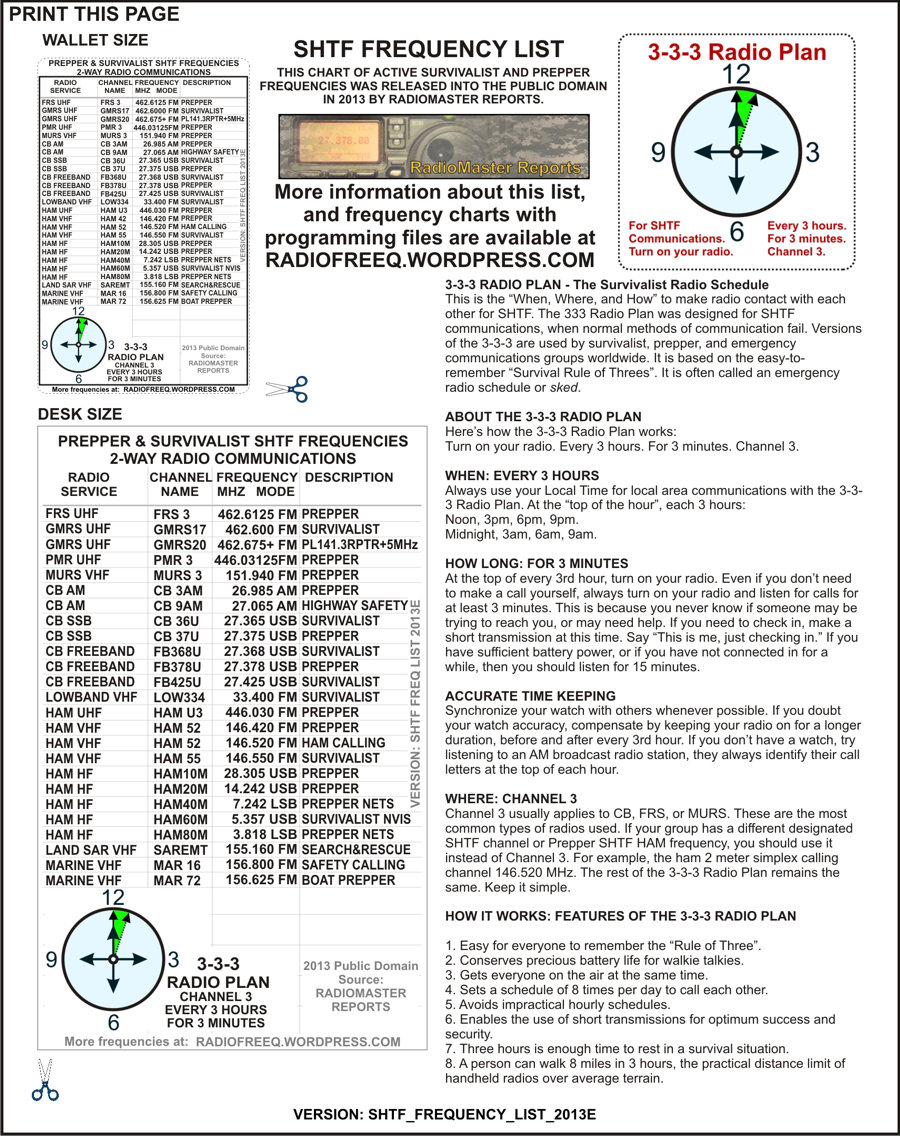
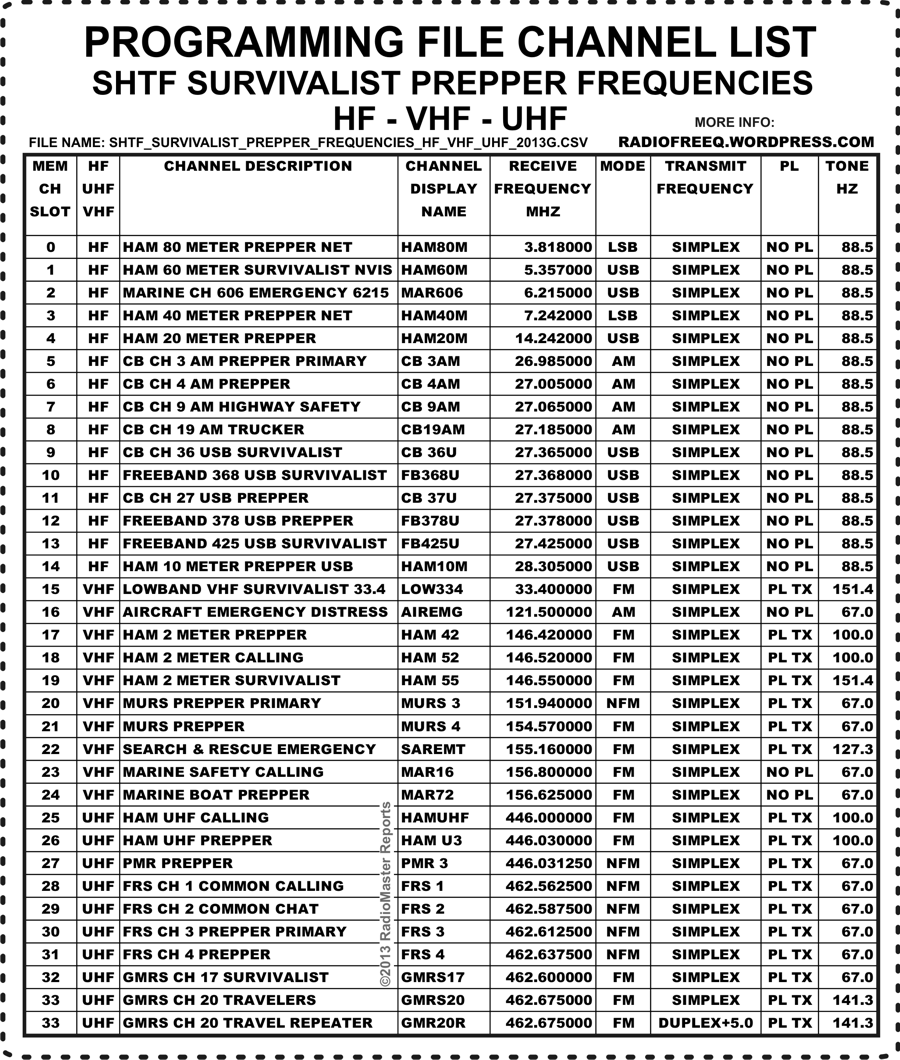
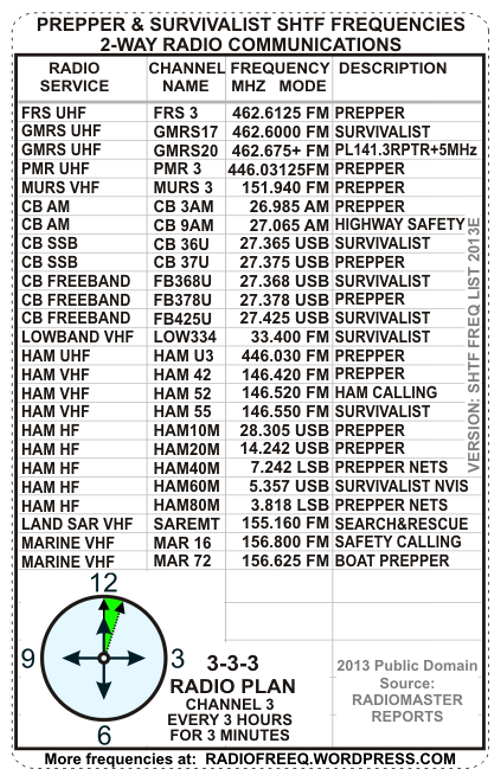
Resource:
Survivalists Radio Frequency Lists
Related Articles
GMRS Dash Install 2019-2023 Ford Ranger
Last updated:
About The Author
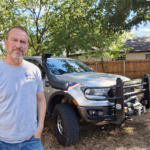
Jim Oaks is the founder of TheRangerStation.com, the longest-running Ford Ranger resource online since 1999. With over 25 years of hands-on experience building and modifying Ford Rangers — including magazine-featured builds like Project Transformer — Jim has become one of the most trusted authorities in the Ford Ranger off-road and enthusiast space.
Since launching TheRangerStation.com, Jim has documented thousands of real-world Ranger builds, technical repairs, drivetrain swaps, suspension modifications, and off-road adventures contributed by owners worldwide. TheRangerStation.com has been referenced in print, video and online by enthusiasts, mechanics, and off-road builders looking for practical, and experience-based information.