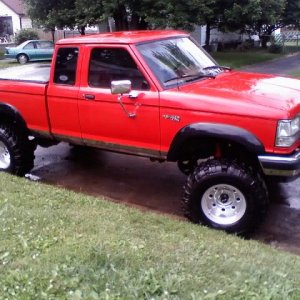
What did you do to your Ranger today? (Part Deux!)


Oh wise (electrical stuff) ones……

Keeping in mind that I’m a pretty smart engineer and I’ve worked with all this stuff for the better part of 60 years, I have what is probably a dumb question. And yeah, yeah, I know there are no dumb questions - just dumb people.

What did you do to your Ranger today? (Part Deux!)


30amp fuses. I don’t have a picture of the even smaller more modern fuses like this that I believe also come in 30 amp.

If I’m going to run a wire from here to there in the truck to power whatever, are these two fuses interchangeable because they’re both 30 A? Or does the big one somehow carry more whatever? My thinking is a 30 amp is a 30 amp is a 30 amp, independent of the physical size, when working in the same 12 V circuit.

I’m looking for the correct overall answer. Specifically, at the moment, I’m wiring in some electrical horns and also the little compressor for some air horns.

What am I missing? (I was going to ask if I was crazy, but I knew the flood that would come with that).

And while I have your attention, oh wise electrical ones, different question for my shop. if I take a 110 VAC circuit to a motor, and convert it to a 220 VAC single phase circuit, does that cut the cost of my electricity? I know it cuts the amps in half, but does it cut the electrical charge ($) for that unit in half?
 
Oh wise (electrical stuff) ones……

Keeping in mind that I’m a pretty smart engineer and I’ve worked with all this stuff for the better part of 60 years, I have what is probably a dumb question. And yeah, yeah, I know there are no dumb questions - just dumb people.

View attachment 140674

30amp fuses. I don’t have a picture of the even smaller more modern fuses like this that I believe also come in 30 amp.

If I’m going to run a wire from here to there in the truck to power whatever, are these two fuses interchangeable because they’re both 30 A? Or does the big one somehow carry more whatever? My thinking is a 30 amp is a 30 amp is a 30 amp, independent of the physical size, when working in the same 12 V circuit.

I’m looking for the correct overall answer. Specifically, at the moment, I’m wiring in some electrical horns and also the little compressor for some air horns.

What am I missing? (I was going to ask if I was crazy, but I knew the flood that would come with that).

And while I have your attention, oh wise electrical ones, different question for my shop. if I take a 110 VAC circuit to a motor, and convert it to a 220 VAC single phase circuit, does that cut the cost of my electricity? I know it cuts the amps in half, but does it cut the electrical charge ($) for that unit in half?
Yes, they will both carry 30 amps. If you were going to run it on a circuit that was constantly pulling higher amps, I would say go with the maxi fuse instead on the ATC/ATO style on the left. But if it’s just an air horns, you’ll be fine based off duty cycle.
International had an issue on the 40 amp ATC style injector driver module fuse in the DT466s. They would draw right at about 37-39 amps and overtime it would melt the fuse and holder. Turns out, the standard contacts on the fuse holder and ATC fuse couldn’t really handle the constant 35+ amps, even though it was a 40 amp fuse. The tabs would start to warm up and pull away from the fuse, making everything even hotter. Then you’d get a no start road call for a melted fuse and holder. They solved it by switching out the harness to a different alloy on the connector at the fuse. We solved it by replacing the ATC fuses with maxi fuses.
 
Yes, they will both carry 30 amps. If you were going to run it on a circuit that was constantly pulling higher amps, I would say go with the maxi fuse instead on the ATC/ATO style on the left. But if it’s just an air horns, you’ll be fine based off duty cycle.
International had an issue on the 40 amp ATC style injector driver module fuse in the DT466s. They would draw right at about 37-39 amps and overtime it would melt the fuse and holder. Turns out, the standard contacts on the fuse holder and ATC fuse couldn’t really handle the constant 35+ amps, even though it was a 40 amp fuse. The tabs would start to warm up and pull away from the fuse, making everything even hotter. Then you’d get a no start road call for a melted fuse and holder. They solved it by switching out the harness to a different alloy on the connector at the fuse. We solved it by replacing the ATC fuses with maxi fuses.

Thank you
 
I just put a 235 under my 87. I think that little tubular frame with the fold down bar is the same as on my 97, so it should be the same on yours. The 235 will fit in that frame with one exception. It’s snug, but it will fit.

If it’s like mine, it has a bolt that faces the rear. When you take the bolt out, there’s a little L-shaped bracket that hooks under the main bar. You have to tilt that back to let the tire down. If you’ve got a receiver hitch under the truck, that little bracket won’t pull back far enough to release the main bar. I used a grinder with a cut off wheel and I cut off about an inch or inch and a half of the tongue on that L bracket. There’s still enough left to catch the bar so you don’t have to hold the tire up while you try to thread the bolt.


Hope it helps
Thanks. That sounds like what I have save for a receiver hitch. I think I have a bolt for the carrier somewhere, but permanently storing it under there would first require finding that bolt. The original owner had it held up with a padlock and a wire rope that I had to cut. The guy I bought it from last spring had owned it since 1999 and didn't know that there was a padlock until I crawled under and then asked if he had the key.
For now I have it under my camper shell, which will be lockable as soon as I get around to cutting the latch bolts down so they don't stop the handle from turning all the way.

And while I have your attention, oh wise electrical ones, different question for my shop. if I take a 110 VAC circuit to a motor, and convert it to a 220 VAC single phase circuit, does that cut the cost of my electricity? I know it cuts the amps in half, but does it cut the electrical charge ($) for that unit in half?

For your last electrical question, my understanding is that watt-hours are watt-hours. Potential efficiency differences aside, if you double the voltage and halve the amperage that should work out to the same wattage and therefore the same cost.
 
Thanks. That sounds like what I have save for a receiver hitch. I think I have a bolt for the carrier somewhere, but permanently storing it under there would first require finding that bolt. The original owner had it held up with a padlock and a wire rope that I had to cut. The guy I bought it from last spring had owned it since 1999 and didn't know that there was a padlock until I crawled under and then asked if he had the key.
For now I have it under my camper shell, which will be lockable as soon as I get around to cutting the latch bolts down so they don't stop the handle from turning all the way.


For your last electrical question, my understanding is that watt-hours are watt-hours. Potential efficiency differences aside, if you double the voltage and halve the amperage that should work out to the same wattage and therefore the same cost.
If it helps at all I think the bolt is just a 1/2" or 12mm, if it's 12mm it could be tapped to 1/2" easy enough and both will take the stock lug wrench to remove (3/4" hex). As far as the having a receiver hitch that GREATLY depends on which of the 5429 (+/- 6) receiver options are installed, I keep forgetting to look at my '97 but I just have the generic $50 Curt hitch on mine but I think the spare comes out... should check one of these days...

As for what I've done to my Ranger today, it's dumb... my '97's been loosing coolant for a while and I was under the hood looking at something for someone here so I investigated... saw the thermostat gasket wet so thought I found it then found the heater return hose resting on one runner of the exhaust manifold! It was just starting to seep until I touched it... I tried rednecking it with a piece of 3/4" hose slit and held on with 3 hose clamps but that made it worse... then I wandered the garage for anything that might be 5/8" OD tube wise, ended up spotting an empty CO2 cartridge for a pellet gun, checked and it was about 11/16" OD so close enough! Cut both ends off and deburred in and out and grabbed some hose pinchers and cutter and it's now fixed!
 
Update: it turns out the cam synchronizer did the trick. The Road Ranger is roadworthy again!

When I finally got the sync in the other day, I was out of time that afternoon, so all I could do was rev it. It had the same warble that it had before I ever touched it. @Peter_'86_2.9L_Auto was over here today to help out, and we did a couple things to his truck. He must’ve brought me luck! After he left, I did a test drive in the Road Ranger, and it purred like a kitten under acceleration and under load. I’m sorry for the thoughts of gooey lizards and slimy frogs on all you guys because you put your lives, your wives, your families, your jobs, etc. in front of fixing my truck that you’ve never seen from a thousand miles away. You are all out of the doghouse.

On the other front, I took the new brake light switch on and off and apart and back together another 20 times on the Missing Linc.

View attachment 140580

Two brand new switches, and a new bushing kit, and it was still doing the same thing it was doing before: you could push it lightly, and the brake lights would come on, push it further, and then pull back on it, no lights, and then step on it again and brake HARD, no lights. No lights when you were braking hard. Not good.

Stupid design. The really stiff spring actually holds the switch open as you step on brakes. Eventually, if you step hard enough, it compresses the spring and makes contact. To fix it, I finally replaced the spring (which was NOT designed to be replaced) with a thinner/softer wire spring with a much lower spring rate. I had to do a trial and error about seven or eight times, taking a little bit off the spring each time, but I finally nailed it. I can now take that switch in and out with my eyes closed.

In retrospect, I’m thinking the linkage between the foot pedal and the vacuum booster/master cylinder may need adjustment to remove any slack in the motion in the connection. In any case, the lighter spring ended up doing the trick.


View attachment 140582

That’s how I feel, times 10!!! I’ve been fighting them both for months

Brake lights, air horns & hood star:

Update to the update on the brake light switch and actually a confession and some progress. And I finally put my air horns in in addition to doing a whole bunch of wiring cleanup behind the grill on the Missing Linc.

It turns out the original design of the brake light switch assembly may not have been the problem. The problem is the replacement parts. I know, for sure now, that the reason my brake light started being intermittent, was simply because the contacts had become corroded and carboned up from decades and hundreds of thousands of miles of use. When I put in the new switchs, which are fine, I also put in the new little black top-hat bushing - that bushing is the problem.

I called out to the two local Ford dealers I use, everyone born way after that truck was made, searching for the old fart like me who might know about it. Both of the guys I used to deal with were retired. I asked the manager at the one if he could have that guy call me since he wouldn’t give me his number. And he did call me, great guy, I miss him.

The cylindrical stud that comes off the side of the brake pedal is supposed to be able to wiggle about a 16th of an inch inside that black bushing. The only purpose of that bushing is to avoid a “click” noise when you step on the brakes, from metal to metal contact. It is supposed to float on that stud, and be tight outside in the eye of the push rod that goes to the vacuum booster/master cylinder. I ended up buying three of those bushings, and every single one of them was snug to the stud and was also snug inside the eye - no motion - so the push rod would not move to depress the spring and close the contact.

Someone said it, I apologize. I couldn’t find it right now, but simply removing the bushing solves the problem, and I can’t hear any click with all the other rattles in that 40 year-old truck. Very frustrating, but it’s all working properly now.

Now for something REALY important, the air horns and Lincoln Star hood ornament. When I got the truck, the guys before me had it stripped down and they were charging through the woods with it. Can you imagine anybody doing that? It had been banged up a little bit with a bronco hood, fender and door. The wiring behind the grill was a little suspect to say the least.

When I put the engine in and had the brainstorm to put in the Lincoln grille and quad lights, I always like to improve things, so I put in a whole lot more suspect wiring behind that grill. When I put the hood star on top of the grill originally, it didn’t clear the hood. So you would have to tilt it forward a little bit to close the hood. I’d forget that about every 10th time, and it finally snapped off the spring below it. That meant I had to take the grill off to fix it.

I basically redid 90% of the wiring behind the grill. I installed the airhorns facing down in front of the radiator, and I tossed the activated carbon vapor canister (which probably hadn’t been hooked up in decades), and I put the air compressor in it’s place.

IMG_6691.jpeg
IMG_6692.jpeg


If you look at the first picture closely, you can notice two chrome marine horns on either side of that opening, and an old fashioned deep toned Cadillac trumpet from the 60s or 70s below my red horns (both from SOM). The truck still has the two horns behind the headlights that came with it. I’ve done this before. They’re wired through a relay that also runs the compressor, but I left the original horns on the original circuit, which I tapped into to trip the relay. That way, if the fuse blows on all the extra ones, the two original horns will still honk.

EDIT: I also wired the quad headlights the way they’re supposed to be. When I originally wired them, I accidentally reversed a ground and a hot lead, so on low beams, the interior lights would glow a little bit, and on high beams, the interior lights would be bright and the exterior lights would glow. It’s a pretty cool effect, but I think it was burning up my multifunction switch, so since I was in there anyway…

My Lincoln grill and hood star were not the prettiest in the world, I’ve always been dissatisfied with the way the top of the grill sat under the hood, and the fact that the hood star was in front of the hood instead of being on top of it. It looked like some old fart did it laying on his back when he was sick. Oh, wait, I was. So while I was doing all this, to eliminate the problem of clipping it with the hood, I moved it up on top of that central rib. I had to fabricate a new spring system, so it would spring back instead of break off. It’s some of the best wire coat hanger work I’ve done in quite a while.

IMG_6706.jpeg


If you look close, shows better in daylight, you can see the red horns behind the grill. I ran out of time, but my next step is going to find an appropriate piece of stainless trim that I can cut and fabricate along the top of that Lincoln grill so it looks more finished.

What did you do to your Ranger today? (Part Deux!)


I’m not sure if I have something in the shed of miracles (it hurts me to say that). Project for another day…

Triple
IMG_5093.jpeg
 
Last edited:

Sponsored Ad

TRS Events & Gatherings

Featured Rangers

Want to see your truck here? Share your photos and details in the forum.

TRS Latest Video

Official TRS Merchandise

Follow TRS On Instagram

TRS Ranger Sponsors


Product Suggestions

Back
Top