
- Joined
- May 15, 2020
- Messages
- 4,865
- Points
- 601
- Age
- 71
- City
- Atlanta
- State - Country
- GA - USA
- Other
- Manufacturers factory tour, maybe big dealership tour
- Vehicle Year
- 1997 1987
- Vehicle
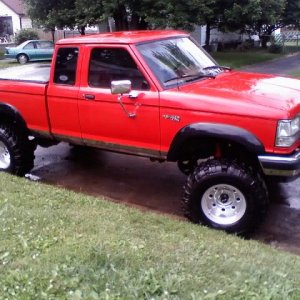
- Ford Ranger
- Engine
- 4.0 V6
- Transmission
- Manual
- Total Lift
- 97 stock, 3” on 87
- Total Drop
- N/A
- Tire Size
- 235/75-15
- My credo
- Never put off ‘til tomorrow what you can put off indefinitely
Update, so I’ve been calling around to mechanics I know. I’m a pretty good shade tree, but I don’t do it for a living. Well, I’ve got a buddy who’s also a shade tree, but he’s a shade tree under a towering oak. I’m a shade tree under a weak little pear tree.
It’s surprised me. He said to pour brake fluid around it. He said the chemicals in the brake fluid will eat through the crack down to whatever’s holding it overnight or within two days. Of course I’m going to try it. The brake fluid can’t hurt anything down there like the paint.
Any thoughts on that?
Update:
A little brisk today, but I still went out bright and early to try to get this cam synchronizer out. The other evening, I fabricated a tool to put over the head like the cap and wiggle it out or twist it out. I poured brake fluid around it three times in the last two days.
It’s about 1-5/8” in diameter on top, and I didn’t have any pipe that would cover it with little play. I cut a short piece of square stock, and then I cut it up so I had a smaller piece of square stock with two tabs sticking up from it. One tab was the width of the notch in the synchronizer, and the other tab was skinny but longer.
If you look close, I dimpled in the sides, so it would fit on the head of the synchronizer relatively snug. I bent the wide tab inwards and then cut it off before it would interfere with the half-moon spinner. The long tab went down the back, and I bent in the tip of it a little bit so would catch under the head of the synchronizer. Then I welded a handle on it. After test fitting it on the new one. I crept up behind the engine again and figured out the maximum length of the handle I could get away with for leverage, and I cut it off, and then cleaned up all the burrs.
It worked perfect on the new one. Same issue, there’s so much that is so close to the top of that sync when it’s installed, the back square head corners would not fall down around it in the back, but I was able to yank it back-and-forth just a little bit. My plan was to cut the corners off and make them round so they would snug up against the cylindrical head and I could still use the tab to twist it to break it loose. I also cut a piece of a wide wooden dowel that dropped down inside the half moon part that was a hair taller than the half moon so I wouldn’t damage the half moon by accident while I was yanking on it.
Before I did those modifications, I put 3/8” extensions together, put the nose in the bottom of the notch, and tapped on it gently with a hammer. At the last moment, I felt a little motion. Well, it still took over an hour, but without any tool, I was able to wiggle it out with just my hand. What a giant pain in the butt. My hand will be sore for a couple days.
So the tool worked in a sense because it gave me just enough leverage to break it from a seizure, but it didn’t work like I planned on using it at all, so I’m adding it to the new tool pile that doesn’t fix anything. I’m saving it for the dimensions. If I ever have to do it again I’m going to duplicate it, but instead of the square tube, I’m going to use a piece of 1/8 flat stock or smaller that can wrap around the head, and still maintain the tongue for the notch. I’m only wasting more typeset here for anybody in the future who might need to do it.
That turned it into a straightforward job. I compared the two synchronizers, and the old one had a longer tube on the bottom where it grabs the oil pump, which initially concern me, but the splines on the inside were the same level as the new one.
The next challenge was that when I tried to insert the new one, it went in about an eighth of an inch and then it seized up, and it took me another hour to get it back out again. I took a caliper and measured the diameter on all the different spots in the old one that make contact in the hole, and all the same spots on the new one, and they were the same (33.9 I think). The surface on the new one, was more irregular, I think it was cast and never turned/polished, neither of them. I sanded down the three concentric mounting surfaces 0.1 to 33.8. Remember the O-ring makes the seal, and this was not enough to alter the performance I put grease in the gears and I put slippery stuff on the rest, and I was able to get it in, locked down, and get the cap back on etc. and I did install it with the alignment tool, so it should be in the right place.
Yeah, success!!!! Well, no.
When I started the truck and reved it up, it sounded just like it did before I touched it. I’ll test drive it this morning, but I’m pretty sure it’s still the same. Just sitting in the driveway when I rev it up, I’m not sure the RPMs because I don’t have a tack. It’s pretty smooth probably to 2 or 3000 RPM, and then it gets a warble. Hard to type it out, but when you start low, and you slowly move up the RPMs, it starts out. Brrrrrrrrrrrrrrrrrrrrrr, it gets faster and louder, but it’s a consistent growl. Then you get to a certain point 3,000?), it will get a fluctuation. At higher rpm its
GRRRRRRRRRRRRRRRRRR and then GRRRRRRR. grrrrrrrrrrr GRRRRRRRR grrrrrrrr GRRRRR
So apparently replacing the sync did not correct my problem. BTW, the old one had a little bit more play in the shaft than the new one, but I don’t think that was significant. Of course, I only learned that when I got the old one out.
To recap:
- New fuel pump
- New fuel rail pressure regulator/release
- Pressures looks good when I’ve checked it
- New plugs and wires
- New idle air control
- New throttle position sensor
- New spark block
Do you think it could be the crank sensor?
What else could it be? I would greatly appreciate it, and be in your debt, if a couple of you really experienced guys could close your eyes for five minutes and walk through the sequence of how you would run down this problem. Talk to elementary like I was a kid just starting out, “did you check this and did you check that?”
In my mind, the only thing remaining after the crank sensor would be to pull the upper intake, manifold and fuel rail, and test/replace the injectors, yes/no
What am I missing?
Oh, but at least my bath faucet is still leaking.
Last edited: