How do I diagnose intermittent crank, no start caused by PATS?


Featured Build Threads

RussAdams

5+ Year Member

Joined
Apr 4, 2020
Messages
170
Points
601
City
Greater Washington, D.C. Metro area
State - Country
VA - USA
Vehicle Year
1999
Vehicle
Ford Ranger
Drive
4WD
Engine
4.0L
Transmission
Automatic
My 1999 4.0 OHV 4x4 automatic is intermittently doing the PATS flashing THEFT crank/no start dance. It does not seem to make a difference if I put the key in slowly or fast when it shows the fast flashing THEFT light when it's acting up. The truck does start, eventually.

I've been reading all the threads I can find about this, but I am not sure exactly how to diagnose which part is failing.

The truck has over 240,000 miles and the ignition switch is quite warn/loose when I insert the key. LOADS of play.

How do I go about diagnosing which part is bad?

1. Can the ignition switch slop cause this? How do I tell if it's the ignition switch slop?
2. Is the PATS Ignition Immobilizer Module/Transceiver bad? Can it work only intermittently? How do I tell this is the problem?
3. Is the PATS module itself?

I did find and read Jim Oaks' great article. I just am unsure how to proceed.

Is there a good HOW TO on using Forscan to read the PATS error codes?

Thanks so much for any advice.

Russ
 
Turn on the key and leave it on

Rapid flashing THEFT light will flash for 45-60seconds and THEN start to flash a trouble code, 2 digits with a 1 and then 1 to 6 flashes

11 Transceiver [transponder coil] not connected, or there is no power to it.
12 Transceiver internal fault.
13 No Key/no PATS key has been used to turn the ignition switch.
14 Incomplete key code received.
15 Invalid key code received.
16 CAN communications error.
 
I had just pasted those instructions into my response, when I saw Supercabs response pop up. Start with that and let's find out what codes are showing.

The intermittent nature of your problem makes me think you may have a loose connection somewhere.

The ignition cylinder activates the ignition switch by pushing a rod that pushes on the ignition switch further down the steering column. I would not expect a worn ignition cylinder to cause this problem unless it is so bad that it isn't pushing the rod far enough to properly activate the ignition switch. If that were the case, you should have a bunch of other intermittent electrical issues. It is possible for the harness connector to be loose or partially seated at the ignition switch. Check for that.

It would be good to ensure the harness plugs are firmly seated at the PATS tranceiver and control module.
 
Turn on the key and leave it on

Rapid flashing THEFT light will flash for 45-60seconds and THEN start to flash a trouble code, 2 digits with a 1 and then 1 to 6 flashes

11 Transceiver [transponder coil] not connected, or there is no power to it.
12 Transceiver internal fault.
13 No Key/no PATS key has been used to turn the ignition switch.
14 Incomplete key code received.
15 Invalid key code received.
16 CAN communications error.
Great!

I was not aware the THEFT light will flash codes. I'll look for that the next time it happens.
 
I had just pasted those instructions into my response, when I saw Supercabs response pop up. Start with that and let's find out what codes are showing.

The intermittent nature of your problem makes me think you may have a loose connection somewhere.

The ignition cylinder activates the ignition switch by pushing a rod that pushes on the ignition switch further down the steering column. I would not expect a worn ignition cylinder to cause this problem unless it is so bad that it isn't pushing the rod far enough to properly activate the ignition switch. If that were the case, you should have a bunch of other intermittent electrical issues. It is possible for the harness connector to be loose or partially seated at the ignition switch. Check for that.

It would be good to ensure the harness plugs are firmly seated at the PATS tranceiver and control module.
Thanks! I'll check the connections for sure. Can you point me to a schematic that shows the rod?

Russ
 
Thanks! I'll check the connections for sure. Can you point me to a schematic that shows the rod?

Russ
I don't have anything handy. If I go over to my house tomorrow, I'll take pictures. I jave 3 steering columns standing in my living room at the moment. But, it's not complicated. You should be able to see and get your hands on the switch. It is on top of the column, just behind where the ears are for the column mounting bolts.
 
These pics are of a 93 ranger. You can see the rod running down the top of the column to a recepticle. That is the actual switch location.
How do I diagnose intermittent crank, no start caused by PATS?
 
Turn on the key and leave it on

Rapid flashing THEFT light will flash for 45-60seconds and THEN start to flash a trouble code, 2 digits with a 1 and then 1 to 6 flashes

11 Transceiver [transponder coil] not connected, or there is no power to it.
12 Transceiver internal fault.
13 No Key/no PATS key has been used to turn the ignition switch.
14 Incomplete key code received.
15 Invalid key code received.
16 CAN communications error.
So it just happened again. Took a video, and it is flashing 1 - 6.

16 CAN communications error. I will now do the tests AI recommends below. Unless someone has a better approach?

Here's what I asked AI:
how to interpret 1999 ford ranger pats 16 can communications error

Here's what AI replied:
Code 16 in a 1999 Ford Ranger’s Passive Anti-Theft System (PATS) indicates a CAN communications error, meaning the PATS module and the Powertrain Control Module (PCM) failed to communicate over the Vehicle Communication Network. This is typically caused by faulty wiring, corrosion, or water intrusion in the connectors rather than a defective key.

Key diagnostic and repair steps include:

  • Inspect CAN Network Wires: The communication occurs via tan/orange and pink/blue wires. On the PCM’s 104-pin connector in the engine bay, these are at pins 15 and 16. On the PATS module (located above the glove box), they are at pins 5 and 6. At the OBD2 port, they are at pins 2 and 10.
  • Check for Corrosion and Water: Disconnect the PCM and PATS module connectors to look for water intrusion or corrosion. Removing and reinstalling these connectors often cleans the pins and restores the connection.
  • Verify PCM Communication: Use an OBD2 scanner to see if you can communicate with the PCM via the OBD2 port. If the scanner cannot connect, the issue is likely a break in the CAN network wiring or a faulty PCM.
  • Rule Out Key Issues: Code 16 is specifically a network communication fault, not a key recognition error (which would be codes 11-15). Therefore, reprogramming keys will not resolve this specific code.
 
Well, I hate AI because of all the screwy wrong garbage I've seen come out of it, plus other reasons. But in this case, it gave you good advice.
 
I worked on the Ranger today. The THEFT light was doing its fast flashing dance ending with code 16.

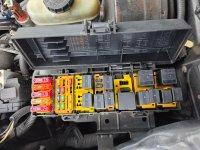
Removed and cleaned every fuse and relay in both the Cabin Fuse box and the under the hood Power Control Box. As I removed each one I shot a little WD40 into the slot and blew it out with compressed air.

I did the Power Control Box first. Tested afterwards and the THEFT light went out as it should. Ranger started right up.

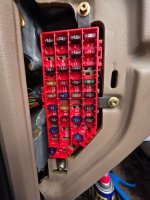
Went ahead and did the in cabin fuse box too.

Attached are photos of what my boxes looked like before I started. They are a bit different from the diagrams I've seen on the web. But match exactly the 1999 Workshop manual electrical diagrams.

Thanks for everybody's help!
 

Attachments

  • How do I diagnose intermittent crank, no start caused by PATS?
    Fuse Box in cabin.jpg
    200.7 KB · Views: 26
  • How do I diagnose intermittent crank, no start caused by PATS?
    Power Control Box under hood.jpg
    265.3 KB · Views: 30
I worked on the Ranger today. The THEFT light was doing its fast flashing dance ending with code 16.

Removed and cleaned every fuse and relay in both the Cabin Fuse box and the under the hood Power Control Box. As I removed each one I shot a little WD40 into the slot and blew it out with compressed air.

I did the Power Control Box first. Tested afterwards and the THEFT light went out as it should. Ranger started right up.

Went ahead and did the in cabin fuse box too.

Attached are photos of what my boxes looked like before I started. They are a bit different from the diagrams I've seen on the web. But match exactly the 1999 Workshop manual electrical diagrams.

Thanks for everybody's help!
I hope that fixed it.

For future reference, there is a product called electrical contact cleaner. Several companies make it. I use CRC brand most of the time. It will clean like brake cleaner and will not leave an oily residue like WD40 does and is non-conductive. That way there is no residue for dust and dirt to stick to in the future.
 
I hope that fixed it.

For future reference, there is a product called electrical contact cleaner. Several companies make it. I use CRC brand most of the time. It will clean like brake cleaner and will not leave an oily residue like WD40 does and is non-conductive. That way there is no residue for dust and dirt to stick to in the future.
I'm keeping my fingers crossed!

I used wd40 to disperse any moisture. I do know it can attract dirt/dust but was hoping it would protect against future corrosion.

Well you sent me down the look it up path...

Seems like a better approach would have been contact cleaner followed by CRC 2-26.

If the THEFT light dance returns I'll follow back up on this thread.

And I made a note to self to report back in 3 months if all is still well.
 

Upcoming TRS Events

Sponsored Ad

Featured Ranger Based Vehicle

TRS Latest Video

Official TRS Merchandise

Follow TRS On Instagram

Back
Top