
Introduction
Ford Rangers appeared with a reverse cut Dana 28 TTB (Twin Traction Beam) 4WD front axle in 1983. In 1990, Ford Introduced a 4.0L V6 to its engine lineup and replaced the Dana 28 TTB with a larger Dana 35 TTB axle to handle the increase in power. The Dana 35 TTB was also used in the 1990-1994 Ford Explorer 4×4.
A version of the Dana 28 found its way into the 1990-1997 Ford Aerostar AWD mini vans.
From 1993-1997 a version of the Dana 28 TTB that we call the Dana 35/28 TTB Hybrid found its way back into the Ford Ranger. This ‘hybrid’ used a Dana 35 axle beam but had a special housing that used a Dana 28 differential and gears. These Hybrid axles can be found in the:
- 1993-1997 Ford Ranger 3.0L Automatic
- 1993-1997 Ford Ranger 2.3L
For more information on the Dana 35/28 Hybrid, check out: Ford Dana 35 TTB Hybrid
In 1998, the Ford Ranger went to a Dana 35 SLA front suspension and axle. The Dana 35 SLA switched from a reverse rotation gear to standard rotation gear. The gears in a 1997 and older Ranger/Explorer will not work in the 1998 and newer Rangers. For more information on the Dana 35 SLA, check out: 1998-2011 Ford Ranger 4×4 Dana 35 SLA Front Axle
Overview
- 1983–1989: Dana 28 TTB front axle
- 1990–1997: Dana 35 TTB front axle
- 1993–1997: Some trucks used a Dana 35/28 hybrid axle
While these axles appear similar, they differ in strength, internal components, brake compatibility, axle shafts, gear ratios, and upgrade potential. This page documents those differences to help with identification, repairs, and build planning.
Ford Twin Traction Beam (TTB) Front Axle Overview
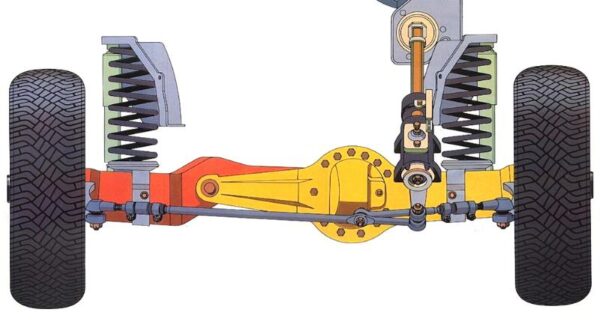
The TTB suspension combines the ride quality of independent suspension with the strength and serviceability of a solid axle. Developed by Ford and Dana, it uses traditional axle components like U-jointed shafts, serviceable wheel bearings, and locking hubs.
Each beam pivots from the frame, supporting a steering knuckle. Inboard ends cross near the frame center with a U-joint allowing independent movement, improving ride comfort while maintaining durability.
Dana Axle Types (1983–1997)
- Dana 28 TTB – 1983–1989
- Dana 35 TTB – 1990–1997
- Dana 35/28 Hybrid – 1993–1997 (Dana 35 housing with Dana 28 internals)
The Dana 35/28 hybrid appears like a Dana 35 but retains Dana 28 differential strength limitations. See Dana 35 TTB Hybrid Details.
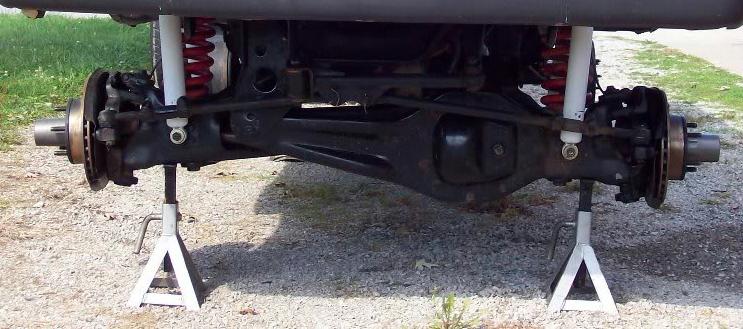
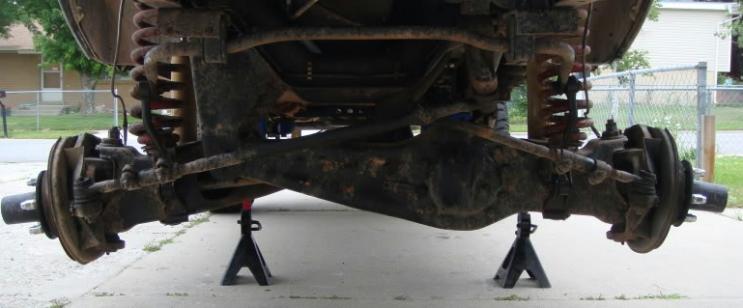
Dana 35 TTB (above) / Dana 28 TTB (below)
Dana 28 & Dana 35 TTB Specifications
| Specification | Dana 28 | Dana 35 |
| Width (Wheel Mount Surface – Surface) | 58 Inches | 59.5 Inches |
| Ring Gear Diameter | 6.625 Inches | 7.56 Inches |
| Ring Gear Bolts | (8) 3/8″ x 24 RH | |
| Pinion Stem | 1.312 Inch | 1.406 Inch |
| Carrier Breaks | 3.73 up, 3.45 & down | 3.55 up |
| Axle Shaft Diameter / Spline | 1.00 / 23 | 1.16″ / 27 |
| Bolt Pattern | 12 Bolt Pattern On Front Of Axle | 10 Bolt Pattern On Front Of Axle |
| Factory Ratios | 3.08, 3.45, 3.73, 4.10 | 3.27, 3.55, 3.73, 4.10 |
| Aftermarket Ratios | 4.56, 5.13 (Discontinued) | 4.56, 4.88 5.13 |
| U-Joints | 5-456x (1210 Series) | 5-297x (stock), 5-760x |
| Max Tire Diameter Rating | 31 Inches | 35 Inches (TTB), 33 Inches (SLA IFS) |
| Pinion Bearing Preload | 10 – 13 In Lbs (new) 6 – 8 In Lbs (used) | 15 – 25 In Lbs (new bearings) 6 – 8 In Lbs (used) |
| Backlash | 0.005-0.008 Inches | 0.005-0.008 Inches |
| Ring Gear Bolt Torque | 55 Lbs Foot | 70-90 Lbs Ft |
| Carrier Bearing Cap Torque | 30-45 Lbs Foot | 47-67 Lbs Ft |
| Pinion Nut Torque | 140 – 500 lbs-ft Foot (crush sleeve) | 170 – 500 lbs-ft (crush sleeve) |
| Fluid | 2 Quarts Hypoid Gear Lubricant SAE 80W or 90W | 3 Quarts Hypoid Gear Lubricant SAE 80W or 90W |
| Exploded Views & Part Numbers | Click HERE | Click HERE |
| Resource – Randy’s Ring & Pinion | ||
Visual Differences: Dana 28 vs Dana 35
The Dana 28 TTB has a narrower width, smaller ring gear, and thinner axle shafts. The Dana 35 TTB has thicker beams, larger U-joints, and more robust spindles. Visual clues:
- Ring gear bolt pattern: Dana 28 is smaller, Dana 35 has 8 bolts.
- Axle shaft spline count: Dana 28 = 23, Dana 35 = 27.
- Dana 35 has a larger diff cover with more mounting bolts.
The below photos show the visual differences between the Dana 28 and Dana 35:


Axle Shaft Dimensions & Comparison
Ranger Dana 28 uses 1.00″ diameter, 23-spline shafts.
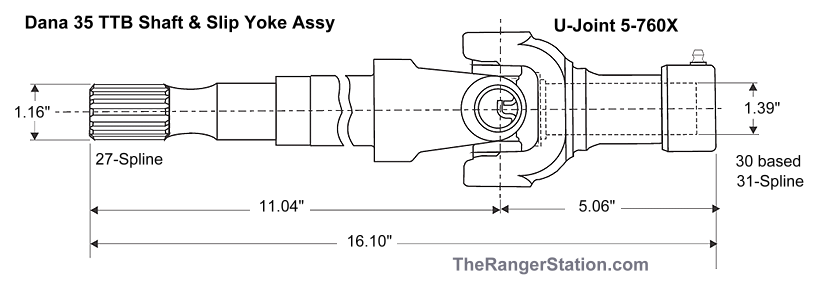
Dana 35 uses 1.16″ diameter, 27-spline shafts.
For hybrid Dana 35/28 axles, the outer shaft is Dana 35, but internal strength is limited by Dana 28 differential.
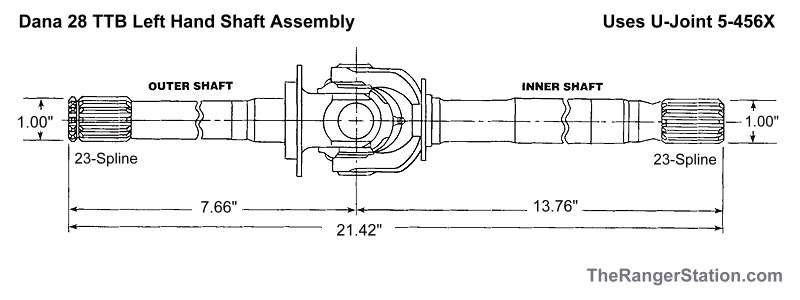
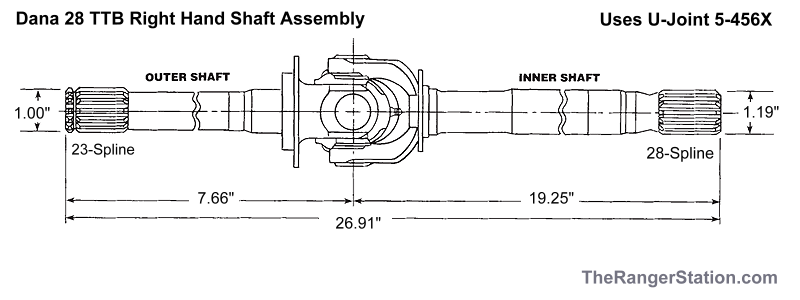
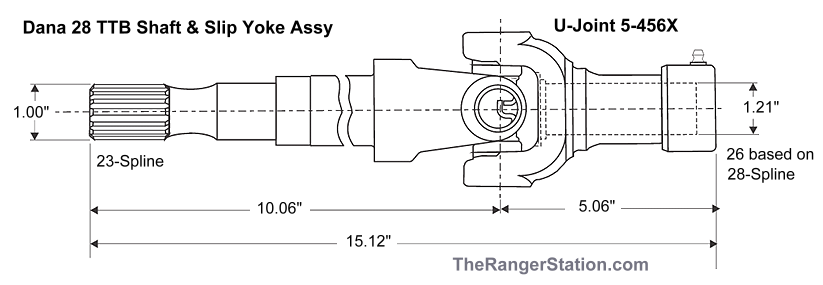
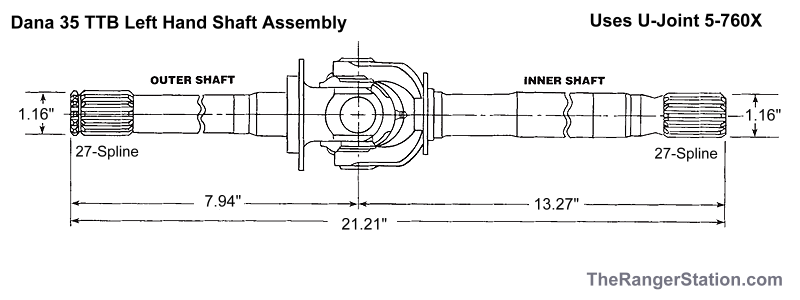
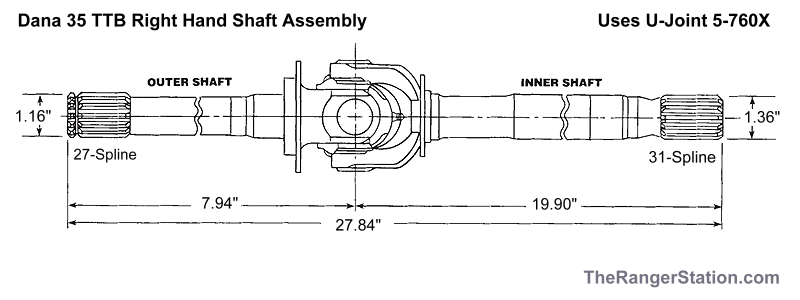
Below is a picture of a Dana 28 & Dana 35 driver side axle shaft with the dimensions shown:
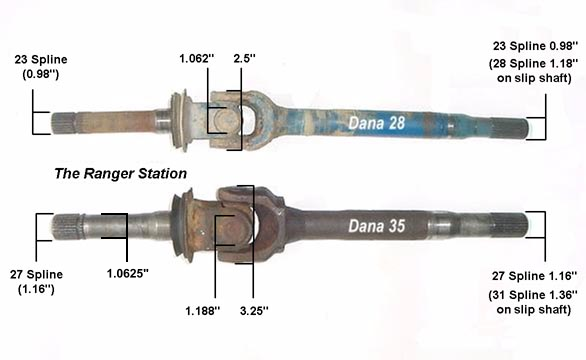
Axle Shaft Dimension Chart
| Component | Dana 28 TTB | Dana 35 TTB | Why It Matters |
|---|---|---|---|
| Left Axle Shaft | 1.00″
23-spline |
1.16″
27-spline |
Thicker shafts and more splines increase torsional strength. |
| Right Axle Shaft | Outer: 1.00″
23-spline Inner: 1.19″ 28-spline |
Outer: 1.16″
Inner: 1.36″ 31-spline |
Stronger inner shafts handle locker and low-gear loads. |
| Axle Shaft & Slip Yoke | 1.00″
23-spline shaft 1.21″ 28-spline yoke |
1.16″
27-spline shaft 1.39″ 31-spline yoke |
Larger yokes resist wear and failure under suspension travel. |
| U-Joint Size | 5-456 | 5-760 | The 5-760 U-joint is significantly stronger and widely supported. |
Spindles, Hubs & Brake Compatibility
Spindles
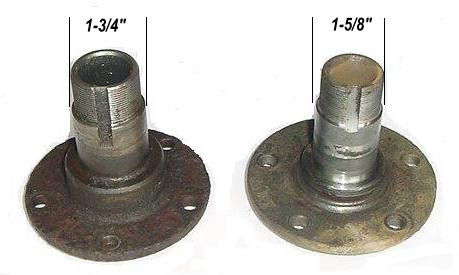
Dana 28 spindles are thinner and use smaller brake rotors/drums. Dana 35 spindles support larger brakes and aftermarket upgrades. Upgrading tires beyond 31″ on Dana 28 often requires a Dana 35 swap for safety.
Here’s a picture of a Dana 35 (Left) and Dana 28 (Right) spindle with dimensions shown:
Brakes
The 1983-1994 front brake is a single piston caliper with slide pins. In 1995 the caliper was upgraded to a dual piston (2-piston) caliper and the rotor was upgraded to 1.023 inches thick. The caliper bolts to the steering knuckle and does not use slide pins.
The 1983-1988 axle beams are different than the 1989-1997 beams. In 1989, Ford moved the ball joints from the beam to the steering knuckle. So you can not swap the 1995-1997 steering knuckles on to these beams. The dual piston calipers will only fit the 1995-1997 steering knuckles, and those knuckles can only be swapped on to the 1989-1994 beams. So if you have a 1983-1988, you’ll need to swap in a 1989-1994 beam, or swap in a 1995-1997 beam with the dual piston calipers.
For more information about the front brakes and brake upgrades, check out ‘Ford Ranger Brake Upgrades‘.
Dana Axle Identification Labels
Your front axle may have a code stamped on the left carrier arm between the fill plug and axle end. It will look like ‘F17A‘ or similar. What this code represents is;
E = 1980’s
F = 1990’s
1 = Last digit of year
7 = Ranger
A = Light Truck Engineering
For more information on breaking down codes, click HERE.
Since the Dana 28’s were built in the 1980’s, their code will start with an ‘E’ whereas the Dana 35’s were built in the 1990’s and will start with an ‘F’. The above-mentioned code would indicate that the axle was a Ranger axle built in 1991.
There is a manufacturers label on the back side of the right axle beam that lists the year manufactured and gear ratio.
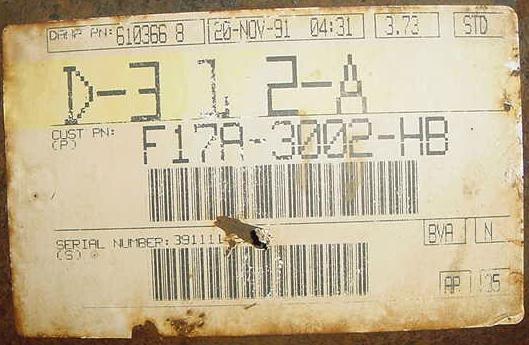
The top left corner of the sticker has the Dana PN (also called BOM (Build of Material) number). The 610366 identifies this as a:
610366 FORD 35 FRONT 1990 1/2-92 1/2 EXPLORER
Note: The ‘8’ after the 610366 actually corresponds to the gear ratio
The second box from top right identifies it as having 3.73 gears.
The third box indicates whether it’s a standard differential or Trac Lok
These stickers are on the back side of the passenger side axle beam.
Build of Material (BOM) Numbers
For replacement parts, Dana lists build-of-material numbers. Typical reference numbers for Ranger axles:
| 610171 | FORD | DANA 28 | FRONT | 1983-1984 FORD RANGER |
| 610223 | FORD | DANA 28 | FRONT | 1984 1/2-1985 FORD RANGER / BRONCO II |
| 610249 | FORD | DANA 28 | FRONT | 1986-87 FORD RANGER / BRONCO II |
| 610298 | FORD | DANA 28 | FRONT | 1987 1/2 FORD RANGER / BRONCO II |
| 610300 | FORD | DANA 35 | FRONT | 1990 FORD RANGER / BRONCO II |
| 610307 | FORD | DANA 28 | FRONT | 1988-1989 FORD RANGER / BRONCO II |
| 610365 | FORD | DANA 35 | FRONT | 1990 1/2-92 1/2 FORD RANGER / BRONCO II |
| 610366 | FORD | DANA 35 | FRONT | 1990 1/2-92 1/2 FORD EXPLORER |
| 610410 | FORD | DANA 35 | FRONT | 1993-1994 1/2 FORD EXPLORER ABS |
| 610418 | FORD | DANA 28 | FRONT | 1993-1994 1/2 FORD RANGER (Hybrid axle) |
| 610419 | FORD | DANA 35 | FRONT | 1993-1994 1/2 FORD RANGER |
| 610436 | FORD | DANA 35 | FRONT | 1992 1/2 FORD RANGER |
| 610437 | FORD | DANA 35 | FRONT | 1992 1/2 FORD EXPLORER |
| 610483 | FORD | DANA 35 | FRONT | 1995-1997 1/2 FORD RANGER ABS |
| 610484 | FORD | DANA 28 | FRONT | 1995-1997 1/2 FORD RANGER ABS (Hybrid axle) |
| 610652 | FORD | DANA 35 | FRONT | 1997-1997 1/2 RANGER |
| 610653 | FORD | DANA 28 | FRONT | 1997 RANGER NON ABS (Hybrid Axle) |
Build Of Material Numbers For 1983-1989 Dana 28 Axles:
| Bill of Material | Diff Type | Ratio |
| 1983-1984 Ford Ranger | ||
|---|---|---|
| 610171-1 | Standard | 3.08 |
| 610171-3 | Standard | 3.45 |
| 610171-5 | Standard | 3.73 |
| 610171-6 | Trac Lok | 3.73 |
| 610171-8 | Standard | 3.45 |
| 610171-9 | Standard | 3.73 |
| 610171-10 | Standard | 4.10 |
| 610171-11 | Standard | 3.08 |
| 610171-12 | Standard | 3.45 |
| 610171-13 | Standard | 3.73 |
| 610171-14 | Standard | 3.45 |
| 610171-15 | Standard | 3.73 |
| 610171-16 | Standard | 4.10 |
| 610171-17 | Trac Lok | 4.10 |
| 1984-1/2 To 1985 Ford Ranger / Ford Bronco II | ||
| 610223-1 | Trac Lok | 3.73 |
| 610223-2 | Standard | 3.08 |
| 610223-3 | Standard | 3.45 |
| 610223-4 | Standard | 3.73 |
| 610223-5 | Standard | 3.45 |
| 610223-6 | Standard | 3.73 |
| 610223-7 | Standard | 4.10 |
| 610223-8 | Trac Lok | 4.10 |
| 610223-9 | Standard | 3.45 |
| 610223-10 | Standard | 3.73 |
| 610223-11 | Standard | 4.10 |
| 1986-1987 Ford Ranger / Ford Bronco II | ||
| 610249-1 | Trac Lok | 3.73 |
| 610249-2 | Standard | 3.08 |
| 610249-3 | Standard | 3.45 |
| 610249-4 | Standard | 3.73 |
| 610249-5 | Standard | 4.10 |
| 610249-6 | Trak Lok | 4.10 |
| 610249-7 | Standard | 3.45 |
| 610249-8 | Standard | 3.73 |
| 610249-9 | Standard | 4.10 |
| 1987-1/2 Ford Ranger / Ford Bronco II | ||
| 610298-3 | Standard | 3.45 |
| 610298-4 | Standard | 3.73 |
| 610298-5 | Standard | 4.10 |
| 610298-7 | Standard | 3.45 |
| 610298-8 | Standard | 3.73 |
| 610298-9 | Standard | 4.10 |
| 1988-1989 Ford Ranger / Ford Bronco II | ||
| 610307-1 | Standard | 3.45 |
| 610307-2 | Standard | 3.73 |
| 610307-3 | Standard | 4.10 |
| 610307-4 | Standard | 3.45 |
| 610307-5 | Standard | 3.73 |
| 610307-6 | Standard | 4.10 |
NOTE: 610418, 610484, and 610653 are Dana 35/28 Hybrid axles. They’re listed in the Dana parts catalog under the Ford Model 28 /174 IFS Front Axles.
NOTE: For a breakdown of part numbers check out the Dana 28 Parts Catalog.
Build Of Material Numbers For 1990-1997 Dana 35 Axles:
| Bill of Material | Diff Type | Ratio |
| 1990 Ford Ranger / Ford Bronco II | ||
|---|---|---|
| 610300-1 | Standard | 3.73 |
| 610300-2 | Standard | 3.55 |
| 610300-3 | Standard | 3.73 |
| 610300-4 | Standard | 3.55 |
| 610300-5 | Standard | 4.10 |
| 610300-6 | Standard | 4.10 |
| 1990-1/2 – 1992-1/2 Ford Explorer | ||
| 610366-1 | Standard | 3.73 |
| 610366-2 | Standard | 3.55 |
| 610366-3 | Standard | 3.73 |
| 610366-4 | Standard | 3.55 |
| 610366-5 | Standard | 3.27 |
| 610366-7 | Standard | 3.55 |
| 610366-8 | Standard | 3.73 |
| 1990-1/2 92 1/2 Ranger/Bronco II | ||
| 610365-1 | Standard | 3.73 |
| 610365-2 | Standard | 3.55 |
| 610365-3 | Standard | 3.73 |
| 610365-4 | Standard | 3.55 |
| 610365-5 | Standard | 4.10 |
| 610365-6 | Standard | 4.10 |
| 610365-7 | Standard | 3.27 |
| 610365-8 | Standard | 3.27 |
| 610365-9 | Standard | 3.55 |
| 610365-10 | Standard | 3.73 |
| 610365-11 | Standard | 4.10 |
| 1992-1/2 Ford Explorer | ||
| 610437-1 | Standard | 3.27 |
| 610437-2 | Standard | 3.27 |
| 610437-3 | Standard | 3.55 |
| 610437-4 | Standard | 3.73 |
| 610437-5 | Standard | 3.73 |
| 1992-1/2 Ford Ranger | ||
| 610436-1 | Standard | 3.27 |
| 610436-2 | Standard | 3.27 |
| 610436-3 | Standard | 3.55 |
| 610436-4 | Standard | 3.55 |
| 610436-5 | Standard | 3.73 |
| 610436-6 | Standard | 3.73 |
| 610436-7 | Standard | 4.10 |
| 610436-8 | Standard | 4.10 |
| 1994-1/2 Ford Explorer – ABS | ||
| 610410-1 | Standard | 3.73 |
| 610410-2 | Standard | 3.73 |
| 610410-3 | Standard | 3.27 |
| 610410-4 | Standard | 3.27 |
| 610410-5 | Standard | 3.55 |
| 1993-1994 1/2 Ford Ranger | ||
| 610419-1 | Standard | 3.73 |
| 610419-2 | Standard | 3.27 |
| 610419-3 | Standard | 3.27 |
| 610419-4 | Standard | 3.73 |
| 610419-5 | Standard | 3.45 |
| 610419-6 | Standard | 3.45 |
| 1995-1997 1/2 Ford Ranger – ABS | ||
| 610483-3 | Standard | 3.27 |
| 610483-4 | Standard | 3.27 |
| 610483-7 | Standard | 3.73 |
| 610483-8 | Standard | 3.73 |
| 610483-11 | Standard | 3.27 |
| 610483-12 | Standard | 3.73 |
| 1997-1997 1/2 Ford Ranger | ||
| 610652-1 | Standard | 3.27 |
| 610652-2 | Standard | 3.73 |
| 610652-3 | Standard | 3.27 |
| 610652-4 | Standard | 3.73 |
NOTE: For a breakdown of part numbers check out the Dana 35 Parts Catalog.
Related Articles
- Ford Dana 35 TTB Hybrid
- Dana 28 Parts Catalog / Exploded View
- Dana 35 Parts Catalog / Exploded View
- Dana 28 / Dana 35 Repair & Rebuild
- Replacing Axle Pivot Bushings
- Ford Ranger Brake Upgrades
- 1983-2011 Ford Ranger 4×4 Locking Hubs
- Dana 44 Spindle & Hub Conversion On Dana 35 TTB
- The Ford Ranger Front Suspension
- Should You Replace A Dana 35 TTB With A Dana 44?
- Beefing Up The Ford Ranger Dana 35 TTB
- 1983–1997 Ford Ranger TTB Suspension Modification Guide
Last Updated
Last Updated:
About The Author

Jim Oaks is the founder of TheRangerStation.com, the longest-running Ford Ranger resource online since 1999. With over 25 years of hands-on experience building and modifying Ford Rangers — including magazine-featured builds like Project Transformer — Jim has become one of the most trusted authorities in the Ford Ranger off-road and enthusiast space.
Since launching TheRangerStation.com, Jim has documented thousands of real-world Ranger builds, technical repairs, drivetrain swaps, suspension modifications, and off-road adventures contributed by owners worldwide. TheRangerStation.com has been referenced in print, video and online by enthusiasts, mechanics, and off-road builders looking for practical, and experience-based information.