
The Creation of TRS Photo Galleries
When I created The Ranger Station (TRS) back in 1999, people would send me photos and details about their Ford Ranger or Bronco II, which resulted in me setting up photo galleries. If people didn’t have a homepage with their truck’s photos, I would create a page here at TRS. If they did have a homepage, I would add their truck photo to the gallery but link it to their homepage instead of creating a page here.
In recent days, I’ve been going through our old photo galleries and looking at all of the dead links that once linked someone’s truck photos to their CarDomain or GeoCities accounts. CarDomain and GeoCities no longer exist. It’s a sad loss. I’ve searched for some of these accounts in the Internet Archive, and you can usually find the page, but they rarely have any photos. If they do, they’re usually just small thumbnails.
I’ve tried to create new pages here at TRS for some of those individuals, using archived information from their CarDomain pages and searching our forum for old photos. I’ve been able to salvage some, but not others. This is especially difficult when the photos they posted here were simply links to their CarDomain photos.
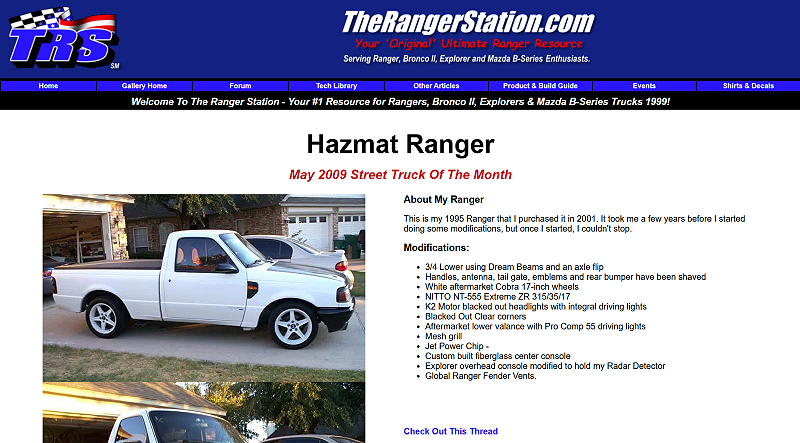
It hasn’t been a total loss, though. For members like “Hazmat Ranger,” I was able to find his CarDomain page, find photos of his Ranger in our forum, and create a new page for our Street Rangers Photo Gallery like I would have done 20 years ago for someone who didn’t have a homepage anywhere.
See: Hazmat Ranger – 1995 Ford Ranger
The Slow Downfall of CarDomain

CarDomain was the “Facebook for your car” before Facebook even existed. So, what happened?
The platform’s demise was a slow-motion combination of corporate mismanagement and a shifting internet culture:
The Corporate Merry-Go-Round
In 2012, CarDomain was sold to Source Interlink Media, starting a tragic cycle of corporate reshuffling. It bounced around under various media umbrellas, eventually ending up alongside mainstream publications like Car and Driver. Corporate executives never truly understood what made CarDomain special. They didn’t value the raw, user-generated community threads. Instead, they tried to corporate-ize the platform, diluting its identity and alienating core users.
The Missing Mobile Leap
CarDomain was a product of the desktop era. It relied on large, immersive monitors where users could look through side-by-side photo grids and read long paragraphs of text. As the world migrated to smartphones, CarDomain completely failed to adapt. They never developed a compelling, smooth mobile experience.
A Graveyard of Dead Links
When the corporate overlords finally pulled the plug and shut down CarDomain’s servers for good, they didn’t just close a website—they burned a library. Decades of blood, sweat, tears, and highly specific technical fabrication history vanished overnight.
Builders who had documented years of custom bodywork, suspension and engine mods, car shows, or off-road adventures lost everything if they hadn’t backed up their files locally.
For TRS, it left us with images in old forum posts that no longer worked and a gallery full of links to pages that no longer existed.
The Rise & Fall of GeoCities

At its peak in the late 1990s, GeoCities was the third-most-visited destination on the entire internet. Organized into themed “neighborhoods” like Area51 for sci-fi fans or Hollywood for film buffs, it gave over 38 million regular people a free 2 MB slice of digital real estate to build their own custom homepages.
The story of what happened to GeoCities is a classic tale of the dot-com boom, corporate mismanagement, and the evolution of social media.
The $3.6 Billion Acquisition (1999)
In January 1999, right at the height of the dot-com bubble, Yahoo! purchased GeoCities for a staggering $3.57 billion in stock. Yahoo! bought the platform primarily for its massive user base and web traffic. However, the service had never actually been profitable.
The Corporate Decline (2000–2008)
Almost immediately after the acquisition, things began to sour. Yahoo! introduced strict new Terms of Service that claimed exclusive rights to all user-created content, causing a massive backlash and a user exodus.
To monetize the platform, Yahoo! began heavily plastering free pages with aggressive pop-up advertisements and introduced rate limits that artificially slowed down free pages to force users into buying paid premium hosting.
At the same time, the internet was shifting. The “Wild West” era of building custom HTML galleries with flashing text, visitor counters, and auto-playing MIDI files was being replaced by the modern profile-driven social media boom. Platforms like MySpace, and later Facebook, made it much easier for people to connect with friends without needing to learn how to code or maintain a standalone website.
The Great Deletion (2009)
By 2009, Yahoo! deemed GeoCities obsolete and decided to shut it down to cut costs and streamline its portfolio.
On October 26, 2009, Yahoo! pulled the plug on the United States version of GeoCities. With the flip of a switch, 38 million user pages were deleted from Yahoo’s live servers.
The Rise of Disposable Media
Platforms like Facebook Groups, Instagram, and Reddit have taken over and left CarDomain, GeoCities, and countless websites and forum communities for dead. The internet shifted from documenting a build to glancing at it. Instead of creating a permanent repository of knowledge, people began taking a quick photo on their phone, posting it to a timeline to chase a few temporary “likes,” and moving on.
Why Preservation Matters
The loss of CarDomain and GeoCities is a harsh reminder of why standalone, enthusiast-run communities like The Ranger Station are so critical. Social media networks are rented spaces; they do not care about preserving the history of a 1991 Ranger or a classic 1996 build.
There is still a massive amount of work to be done, and truth be told, some people might consider it pointless to spend days chasing down dead links and low-res photos for trucks built twenty years ago.
But I don’t see it that way. I see those old gallery submissions as a fundamental part of our collective history. They represent the foundation of the Ford Ranger enthusiast community. If I can preserve even a small fragment of that history, I will.
The history of the custom Ford Ranger belongs to the people who built them, not the corporate entities that buy and sell domain names.
Let’s keep the real internet alive.

About The Author
Jim Oaks is the founder of TheRangerStation.com, the longest-running Ford Ranger resource online since 1999. With over 25 years of hands-on experience building and modifying Ford Rangers — including magazine-featured builds like Project Transformer — Jim has become one of the most trusted authorities in the Ford Ranger off-road and enthusiast space.
Since launching TheRangerStation.com, Jim has documented thousands of real-world Ranger builds, technical repairs, drivetrain swaps, suspension modifications, and off-road adventures contributed by owners worldwide. TheRangerStation.com has been referenced in print, video and online by enthusiasts, mechanics, and off-road builders looking for practical, and experience-based information.