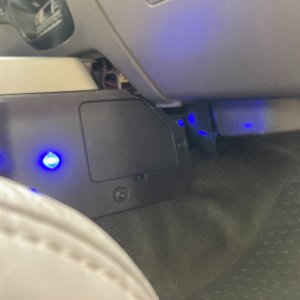
Is there a significance in the bottom number of this relay?


Featured Build Threads

Not exactly understanding what you're doing, but I can tell you when I did my parasitic draw test with everything off, I still got a 28 AMP draw until the battery saver mode kicked in which takes 45-60 minutes.
 
That's high. I assume the 50 amp fuse is still removed? Ideally it should be closer to 0.015 - 0.030amps with all fuses installed. That is usually just what it takes to keep the radio memory alive and monitor security systems, like PATS, if you have them. Does it go to 0 when you remove the 10amp pcm fuse? 0.2amps will drain a healthy group 59 battery in about 2 weeks.
50A fuse in. Radio removed a while ago for access. 10A in or out makes no difference. 50A fuse out gives 0.
 
Not exactly understanding what you're doing, but I can tell you when I did my parasitic draw test with everything off, I still got a 28 AMP draw until the battery saver mode kicked in which takes 45-60 minutes.
Pretty much same as you I expect. Tracking a power draw. My post above explains further. I was unaware of the battery saver. It will be dark here soon so I will have to wait until tomorrow to follow your guide. Thanks.
 
Last edited:
50A fuse in. Radio removed a while ago for access. 10A in or out makes no difference. 50A fuse out gives 0.
Ok. That changes things. So, you're getting a draw from something controlled by a fuse in the cab. Pcm is not an issue. Next thing is to pull the fuses inside the cab one at a time to see which circuit is causing it.

Watch Jims video and start narrowing it down. As mentioned, the timers in the gem complicate this procedure. You have to wait for them to turn everything off.
Thanks. I pulled every fuse in the dash panel previously while watching the light and there was no change. Perhaps using a meter and following Jim's guide will be more productive.
 
I have to wonder if there is a different relay (or fuse) that controls the "sleep" mode of the PCM that you can pull to eliminate the 0.2A draw right away... I'd look for it myself but I don't have any schematics for trucks after '94 (maybe one of the fuses OP has it narrowed down to is it?)

0.2A does seem about what should be normal before it goes to "sleep" however (afterward it should then be less than 0.05A).

OP have you waited a full hour with all doors closed and all fuses/relays in place to see if it does drop to 0.05A or less?
With key off, pcm should be dead. He also stated in post 17, where he gives us updated circuit conditions, that removing fuse 10 for the pcm made no change to the current draw. As long as the key is off, the pcm relay is de-energized, so the other, bigger pcm fuse is also out of the picture.

What gets me is that he is reporting different symptoms now that he is using an ammeter instead of the test light. But I feel better about the data he is reporting now. Hopefully Jims video helps him understand the process better. Otherwise, we'll just go one step at a time.
Is there a significance in the bottom number of this relay?


By the way, I'll be unavailable most of tomorrow due to surgery. So, you knowledgeable guys please stay tuned for him. I should be back in action on Wednesday.
 
With key off, pcm should be dead. He also stated in post 17, where he gives us updated circuit conditions, that removing fuse 10 for the pcm made no change to the current draw. As long as the key is off, the pcm relay is de-energized, so the other, bigger pcm fuse is also out of the picture.

What gets me is that he is reporting different symptoms now that he is using an ammeter instead of the test light. But I feel better about the data he is reporting now. Hopefully Jims video helps him understand the process better. Otherwise, we'll just go one step at a time.
View attachment 150097

By the way, I'll be unavailable most of tomorrow due to surgery. So, you knowledgeable guys please stay tuned for him. I should be back in action on Wednesday.
Oh wow! Hope all is well and that things go well for you.

As for the PCM... There must be something here that I'm not following or is missing... So far all I see is that OP has just been pulling & reinserting fuses & relays without ever having allowed the truck to actually go into "sleep" (battery saver) mode. I think until that happens with all fuses & relays still in place, we can't know for sure what the real issue is. I have to wonder if what is happening is the normal current draw that occurs before that event and OP just isn't realizing it (he already admitted in post #18 he wasn't aware of the battery saver).

The symptoms changing with the ammeter may be because the meter maintains a working voltage going to the PCM. The test light however just consumes most of the voltage (leaving only a volt or two that actually makes it to the PCM). The PCM cannot work with that, so it just sits in that state indefinitely.

My suggestion about identifying the battery saver relay and pulling it was so one didn't have to wait the whole hour for it to go into sleep. But maybe that's not the best idea (the potential is there this might not identify the fault if it is internal to the PCM itself).
Best to just allow it to sit for that hour w/ammeter connected inline & all doors closed, and report back from there.
 
All good thoughts. Lets explore a few for fun.

. So far all I see is that OP has just been pulling & reinserting fuses & relays without ever having allowed the truck to actually go into "sleep" (battery saver) mode. I think until that happens with all fuses & relays still in place, we can't know for sure what the real issue is. I have to wonder if what is happening is the normal current draw that occurs before that event and OP just isn't realizing it (he already admitted in post #18 he wasn't aware of the battery saver).
I agree completely.
The symptoms changing with the ammeter may be because the meter maintains a working voltage going to the PCM.
Yes. It does allow the voltage to reach the pcm. However, once the key is turned off, the pcm osn't doing anything. It should have 0amps of current draw or such a negligent amount that we could not read it with normal meters. The pcm is also not served by the battery saver. So there is nothing about the pcm that has a delayed off or go to sleep feature.
My suggestion about identifying the battery saver relay and pulling it was so one didn't have to wait the whole hour for it to go into sleep.
That would be a great feature. However, the battery saver relay(s) is soldered to the circuit board inside the gem. It is not considered a serviceable item.
Best to just allow it to sit for that hour w/ammeter connected inline & all doors closed, and report back from there.
Yes. That's a royal PITA. But that is what Ford did to us.
 
Oh wow! Hope all is well and that things go well for you.
Thank you. I'm having a pacemaker/defibrillator implanted. Outpatient surgery.

I'll finally be a 100% real electrician - wired right down to my heart.
 

Event Coverage

Sponsored Ad

Featured Ranger Based Vehicle

TRS Latest Video

Official TRS Merchandise

Follow TRS On Instagram

Back
Top