
By Mike Lingenfelter
Disclaimer: No warranty is given or implied with this modification. It works on my truck and may work on yours. If you attempt this modification, you need some basic mechanical skills. Keep in mind that this truck has a 3″ body lift which provides additional under-hood clearance. There are also fully engineered kits on the market from reputable companies that do the same thing for hundreds of dollars more. I’m cheap, so I made mine for $25.
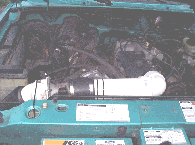
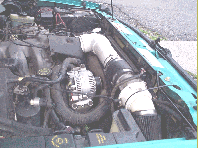
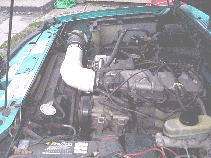
The air induction system started out by using a conical K&N air filter from a 5.0 Mustang. The majority of the unit is made from 3-inch schedule 40 PVC pipe.
The stock air box was completely removed. From the conical air filter, air moves into a 3-inch 45-degree ell that has been cut to get the desired sweep. He removed about 50% of the ell, making a 22.5 degree or 1/8 bend.
To adapt the ell to the flange on the mass air required the use of a PVC toilet flange. The ell was glued to the outlet side, and the large flange area allowed him to drill and tap holes in the PVC to match the mass air unit.
The outlet on the mass air unit has no flange.
The stock cold air tube clamped to the outside of the mass air unit. He used a 3-inch Furnco rubber fitting. The fitting was designed to connect two pieces of of 3-inch schedules 40 PVC pipe.
From the rubber fitting, air moves through 12-inches of PVC pipe and then into a close 3-inch 90-degree ell to a short piece of 3-inch PVC.
The greatest challenge was to adapt the 3-inch PVC to the throttle plate. Again, a Furnco fitting was used. This time he used a 3-inch cap. The cap was clamped to the end of the 3-inch pipe, and the end was cut out to match the opening of the throttle plate. The cap simply provides an interference or friction fit over the throttle body.
Since air pressure inside the PVC is less than that outside the PVC, the atmosphere continually pushes the the tube on the throttle assembly. The rest is “Zip tied” in place.
A vacuum fitting was placed after the K&N filter for a required connection.
At present the crankcase vent goes to a small K&N filter, but it will soon be piped into the PVC to be earth friendly. As you can see, the whole thing draws fresh air from behind the passenger side headlight.
The benefits were smooth throttle response and improved fuel economy.
Mike stated that you may try 2.5-inch pipe to add more velocity to the incoming air and add performance.
The buildup of this induction cost Mike $25. He used a K&N filter that was given to him by a friend. You may also want to add an aluminum bracket to hold the new piece in place.
About The Author

Jim Oaks is the founder of TheRangerStation.com, the longest-running Ford Ranger resource online since 1999. With over 25 years of hands-on experience building and modifying Ford Rangers — including magazine-featured builds like Project Transformer — Jim has become one of the most trusted authorities in the Ford Ranger off-road and enthusiast space.
Since launching TheRangerStation.com, Jim has documented thousands of real-world Ranger builds, technical repairs, drivetrain swaps, suspension modifications, and off-road adventures contributed by owners worldwide. TheRangerStation.com has been referenced in print, video and online by enthusiasts, mechanics, and off-road builders looking for practical, and experience-based information.