
Introduction
Learn how to identify the rear axles in your 1983-2011 Ford Ranger, Bronco II, Explorer, or Aerostar using axle tags and door codes. This guide covers both 7.5-inch and 8.8-inch Ford axles, including gear ratios, limited slip differentials, and axle capacities. By understanding axle tags and door sticker codes, you can quickly determine the type and specifications of your rear axle for maintenance, repairs, or upgrades.
This guide includes:
- Reading axle tags on 7.5-inch and 8.8-inch Ford rear axles
- Interpreting axle codes from the Safety Standard Certification (door sticker)
- Identifying gear ratios, axle capacities, and limited slip differentials
- Reference tables for Ranger, Bronco II, Explorer, and Aerostar axles
Identifying Your Axle From The Axle Tag:
You can identify which axle you have by the tag attached to the inspection cover.
Here is an example of an axle tag:
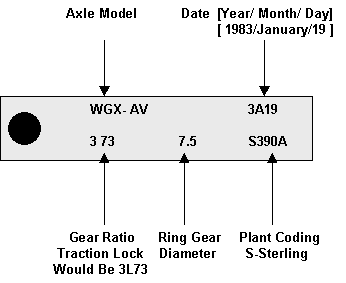
Looking at that tag, you can see the gear ratio stamped on the lower left, and the axle size (ring gear diameter) stamped in the bottom middle.
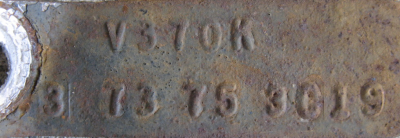
So, looking at the axle tag above, you can see it’s a 3.73 gear ratio in a 7.5-inch axle.

And looking at the axle tag above, you can see it’s a 3.73 gear ratio with a limited slip in an 8.8-inch axle.
Axle Codes (Door Sticker):
Rear axle codes can be found on the Safety Standard Certification label attached to the left driver’s side door lock post. The code appears as a number or letter/number combination in the ‘Axle’ column of the label.
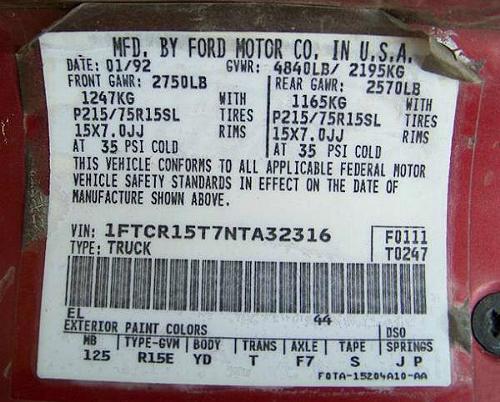
If you look at the ‘AXLE’ section on the label above, you’ll see that this Ranger has a ‘F7’ axle code. Using the chart below, we know that this axle is a 7.5-Inch axle with a 4.10 limited slip.
Axle codes for Ranger, Bronco II, Explorer and Aerostar (included because 4.10 gears and limited slips are more common than you’d expect)
Ranger |
|||
| Code | Description | Capacity | Ratio |
| 72 | open 6-7/8″ | 2200 | 3.08 |
| 74 | open 6-7/8″ | 2200 | 3.45 |
| 82 | open 7.5″ | 2750 | 3.08 |
| 84 | open 7.5″ | 2750 | 3.45 |
| 85 | open 7.5″ | 2750 | 3.55 |
| 86 | open 7.5″ | 2750 | 3.73 |
| 87 | open 7.5″ | 2750 | 4.10 |
| 89 (1992-1998) | open 7.5″ | 4.10 | |
| 89 (1999-2001) | open 7.5″ | 4.56 | |
| 91 | open 8.8″ | 2750 | 3.27 |
| 92 | open 8.8″ | 2750 | 3.08 |
| 95 | open 8.8″ | 2750 | 3.55 |
| 96 | open 8.8″ | 2750 | 3.73 |
| 97 | open 8.8″ | 2750 | 4.10 |
| 98 | open 8.8″ | 2750 | 4.56 |
| F4 | L/S 7.5″ | 2750 | 3.45 |
| F5 | L/S 7.5″ | 2750 | 3.55 |
| F6 | L/S 7.5″ | 2750 | 3.73 |
| F7 | L/S 7.5″ | 2750 | 4.10 |
| K6 | L/S 8.8″ | 4.10 | |
| R5 | L/S 8.8″ | 2750 | 3.55 |
| R6 | L/S 8.8″ | 2750 | 3.73 |
| R7 | L/S 8.8″ | 2750 | 4.10 |
| R8 | L/S 8.8″ | 2750 | 4.56 |
| (Note 4.56 geared axles ’99-up are 31-spline) | |||
Bronco II |
|||
| Code | Description | Capacity | Ratio |
| 42 | open 7.5″ | 2640 | 3.45 |
| 44 | open 7.5″ | 2640 | 3.73 |
| 47 | open 7.5″ | 2640 | 4.10 |
| D2 | L/S 7.5″ | 2640 | 3.45 |
| D4 | L/S 7.5″ | 2640 | 3.73 |
| D7 | L/S 7.5″ | 2640 | 4.10 |
Explorer |
|||
| Code | Description | Capacity | Ratio |
| 41 | Open 8.8″ | 3200 | 3.27 |
| 42 | Open 8.8″ | 3200 | 4.10 |
| 43 | Open 8.8″ | 3200 | 3.08 |
| 44 | Open 8.8″ | 3200 | 3.73 |
| 45 | Open 8.8″ | 3200 | 3.55 |
| 46 | Open 8.8″ | 3200 | 3.73 |
| D1 | L/S 8.8″ | 3200 | 3.27 |
| D2 | L/S 8.8″ | 3200 | 4.10 |
| D4 | L/S 8.8″ | 3200 | 3.73 |
| D5 | L/S 8.8″ | 3200 | 3.55 |
| L73 | L/S 8.8″ | 3200 | 3.73 |
| L – Limited Slip DifferentialC – Conventional Differential | |||
Aerostar |
|||
| Code | Description | Capacity | Ratio |
| 22 | open 7.5″ | 2950 | 4.10 |
| 23 | open 7.5″ | 2950 | 3.45 |
| 24 | open 7.5″ | 2950 | 3.73 |
| 25 | open 8.8″ | 2950 | 3.27 |
| 29 | open 8.8″ | 2950 | 3.55 |
| B2 | L/S 7.5″ | 2950 | 4.10 |
| B4 | L/S 7.5″ | 2950 | 3.73 |
| B5 | L/S 8.8″ | 2950 | 3.55 |
| B9 | L/S 8.8″ | 2950 | 3.55 |
| (Note: Aerostars with axle codes starting with “1” are Spicer/Dana 30 axles with Aluminum housings) | |||
Related Article:
Ford 7.5-Inch Information & Specifications
Ford 8.8-Inch Information & Specifications
Last Updated:
About The Author
Jim Oaks is the founder of TheRangerStation.com, the longest-running Ford Ranger resource online since 1999. With over 25 years of hands-on experience building and modifying Ford Rangers — including magazine-featured builds like Project Transformer — Jim has become one of the most trusted authorities in the Ford Ranger off-road and enthusiast space.
Since launching TheRangerStation.com, Jim has documented thousands of real-world Ranger builds, technical repairs, drivetrain swaps, suspension modifications, and off-road adventures contributed by owners worldwide. TheRangerStation.com has been referenced in print, video and online by enthusiasts, mechanics, and off-road builders looking for practical, and experience-based information.