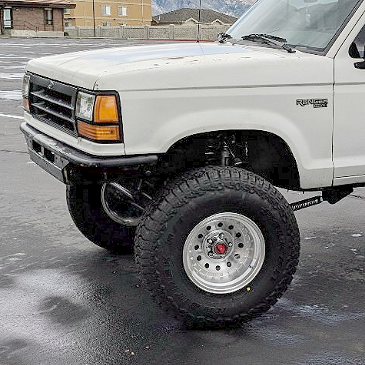
The leveling kit is probably 1"-2". You get a lot more forgiveness with the 33x10.5R15 tires over the 33x12.5R15. Those recommending the suspension lift over the body lift are recommending for lots of good reasons, one of them being that it doesn't raise the center of gravity without improving the suspension geometry. It will perform better, be safer in general, and allow you to have better steering geometry depending on the kit you get.
If you are not afraid of spending money, companies like Autofab and Solo Motorsports provide cut and turn kits for the Dana 35. I'd give them a look and if you can afford it, I'd recommend those as they bolt right up to your stock mounting points. It is my understanding that 33" tires will fit without body modifications using these kits. You would need to cut the body panels to get 35" tires.
15x7 or 15x8 wheels with ≈4–4.5" backspacing is recommended, but no matter what, if you really want to make sure you get the right stuff the first time, Speedway Motors makes a backspacing tool that will measure this stuff for you with a bolt on kit. I recommend this if you are trying using some mix and match lift kits.
Below is a chart for cruising speed in 5th gear:
MPH = (RPM × Tire Diameter) / (Trans Ratio × Axle Ratio × 336)
| Axle Ratio | 60 mph | 65 mph | 70 mph | Notes |
| 3.73 | 1,800 | 1,950 | 2,100 | Quite tall; may feel sluggish on hills or when passing. Many owners re-gear. |
| 4.10 | 1,980 | 2,140 | 2,310 | Better balance for 33s — keeps the 4.0L in a stronger part of the powerband. |
| 4.56 | 2,200 | 2,380 | 2,570 | Even stronger pull; common swap when running 33s or larger. |
- 4.10 gears + 33s → Most popular and recommended combo by owners running this tire size. Good compromise between highway manners and usable power.
- 4.56 gears + 33s → Excellent if you tow, wheel, or want strong low-end pull. Slightly higher RPM on the highway but very capable.
Stock output for the 4.0l was approximately:
- 160 hp @ ~4,200 RPM
- 220 lb-ft torque @ ~2,500–3,000 RPM
Stock output for the 3.0l was approximately
- 145 hp @ 4,800 RPM
- 165–170 lb-ft torque @ ~3,000 RPM
Powerband characteristics:
| Engine | Peak HP | Peak Torque | Strong Powerband | Notes |
|---|
| 4.0L V6 (most common 4x4) | 160 hp @ 4,200 rpm | 220 lb-ft @ 2,500–3,000 rpm | 2,100 – 3,500 rpm | Best match for bigger tires and towing |
| 3.0L V6 | 145 hp @ 4,800 rpm | 165–170 lb-ft @ ~3,000 rpm | 2,200 – 3,800 rpm | Similar character but less powerful overall |
| 2.3L I4 | ~100–115 hp range | Lower torque peak | Narrower, lower RPM | Least common in 4x4; feels weaker with 33s |
These engines have a broad, flat torque curve. They feel strong from just off idle through the mid-range but taper off if you keep them above ~4,000 RPM for long periods. Consider the powerband when you are deciding on your final drive because redoing them are a pain in the butt! The 4.56 will keep you in that powerband on the highway which will make it feel a lot more responsive in passing.
I hope all this helps you with your decision!