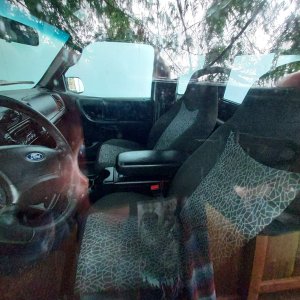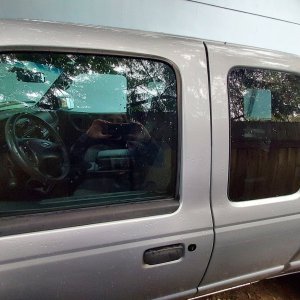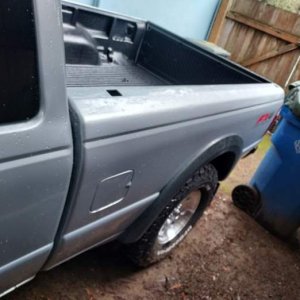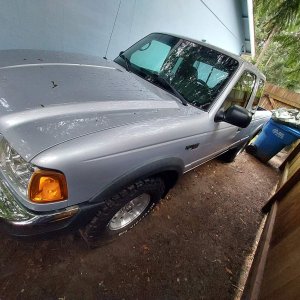
What did you do to your Ranger today? (Part Deux!)


It was new in 1973. You know Rick bought those batteries on FB Marketplace. Got a good deal. 237 batteries for $7.00, plus a couple big coffee cans to store them in.

Hey hey hey! The batteries were new from Harbor Freight (about a year ago), but I also tried two or three other batteries and everything was doing the same thing.

And I would never buy coffee cans. I’m still working on ones that I saved 20 years ago.
You did use a new battery, right? It should have enough force to lift the needle, I did it with the speedo in a vise oriented like it would be in a vehicle I think... I can try again today on the non tach cluster I have...

No biggie, I’ll get it. I actually have a bench top DC voltage generator, but at this point, I don’t know if the original was correct, so I’m just going to have to play with it a little bit.
 
Last edited:
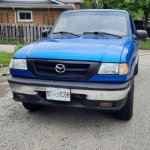
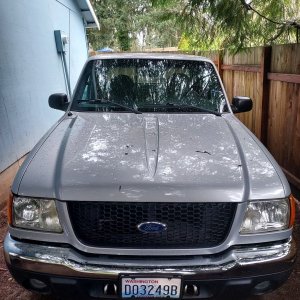
Restored the front end.
 

Attachments

  • What did you do to your Ranger today? (Part Deux!)
    before.jpg
    51 KB · Views: 12
  • What did you do to your Ranger today? (Part Deux!)
    after.jpeg
    54.1 KB · Views: 11
Update on the check engine light and funky idle. The vacuum hose underneath the butterfly was disconnected. Seems to run perfect in the driveway, but I haven’t had it on the road yet, but I’m 99% sure that was the issue. We’ll see.
 
Speedo calibration questions.

Before I pull the needle on the old speedo, a 1.5 V battery brought it to 40 MPH, and that’s where I set it on the new speedo. @scotts90ranger said when he did it, it was 42. I figure I’ll start there with a brandy new quality battery.

1st question: is anybody aware of a calibration chart? Charge that would show what the different reading should be at different voltages? I actually have a desk top DC voltage generator, so calibration chart with softball problems.

Now, when the school radar camera says I’m going 41 miles an hour, the speedo reads 34 miles an hour, so reads 7 mph low.

2nd question: would that mean I am reading seven mph low at any speed? Or am I reading 20% low at any speed? Question is, is the needle rise linear or proportional?

Assuming it reads 7 mph low at any speed: I’m thinking I’ll remove it, attach a brandy new quality battery and wherever it reads, simply pull the needle and set it 7 MPH higher, and reinstall. Yes/no?

3rd question: one Internet video (the guy didn’t strike me as an expert or as a rocket scientist in general) simply presented that if you pull the needle, and, with no power, you set it at zero at the restraining pin on the bottom, it knows where to go all by itself. For clarity, it was not a matter of letting it fade counterclockwise until it hits the pin, but rather actually placing it at the pin, so there is no downward pressure, no matter how slight. Yes/no?

As always, any at all input is greatly appreciated.

I won’t be doing it for a few hours. @Curious Hound understands that it will take me a couple hours to come to grips with the concept, and build the strength, to actually go to a retail store and buy a brand new battery that’s not on sale. It goes against every fiber in my being.
 
Speedo calibration questions.

Before I pull the needle on the old speedo, a 1.5 V battery brought it to 40 MPH, and that’s where I set it on the new speedo. @scotts90ranger said when he did it, it was 42. I figure I’ll start there with a brandy new quality battery.

1st question: is anybody aware of a calibration chart? Charge that would show what the different reading should be at different voltages? I actually have a desk top DC voltage generator, so calibration chart with softball problems.

Now, when the school radar camera says I’m going 41 miles an hour, the speedo reads 34 miles an hour, so reads 7 mph low.

2nd question: would that mean I am reading seven mph low at any speed? Or am I reading 20% low at any speed? Question is, is the needle rise linear or proportional?

Assuming it reads 7 mph low at any speed: I’m thinking I’ll remove it, attach a brandy new quality battery and wherever it reads, simply pull the needle and set it 7 MPH higher, and reinstall. Yes/no?

3rd question: one Internet video (the guy didn’t strike me as an expert or as a rocket scientist in general) simply presented that if you pull the needle, and, with no power, you set it at zero at the restraining pin on the bottom, it knows where to go all by itself. For clarity, it was not a matter of letting it fade counterclockwise until it hits the pin, but rather actually placing it at the pin, so there is no downward pressure, no matter how slight. Yes/no?

As always, any at all input is greatly appreciated.

I won’t be doing it for a few hours. @Curious Hound understands that it will take me a couple hours to come to grips with the concept, and build the strength, to actually go to a retail store and buy a brand new battery that’s not on sale. It goes against every fiber in my being.
Hey. I have a gauge cluster on the bench, a pile of good batteries and a 12v regulated power supply already set up. I'll play with it in a little while. I'm about to have a meeting with a woman bringing me a new defibrillator battery. After that, I'll start your experiment.
 
Last edited:

Hey. I have a gauge cluster on the bench, a pile of good natteries and a 12v regulated power supply already set up. I'll play with it in a little while. I'm about to have a meeting with a woman bringing me a new defibrillator battery. After that, I'll start your experiment.

Eric,

I think you know I like you, and I consider us friends, and I think of TRS as part of my extended family. I completely understand your admiration for me, it’s something I’ve learned to live with all my life. But I have a concern.

As much as you must love me, I don’t think it’s a good idea to use your defibrillator battery to try and solve my problem with my speedometer. It’s just not that important. What if you damage that battery, and your defibrillator fails when you need it? Then I’d have to go through all the feigned guilt stuff. I always appreciate help, but I’d just use a Walmart battery or such if you feel compelled.

Second, I’d be careful about putting 12 V on the speedo. If 1.5 V brings it to around 40 mph, I would be concerned 12 V might blow it/burn it up.

Having said all that, I would be curious what the speedo reads out of the shoot if you apply 1.5 V to it.

@scotts90ranger showed me to contact to the top left and bottom right solder joints immediately around the speedo servo motor when looking at the circuit board side. That’s what I did.

In the video I saw, that guy actually made up Y connectors, and connected one to both top connections, and one to both bottom connections, but again, I’m not sure he knew what he was doing. The video did not inspire me. I couldn’t find anything else on the Internet that spoke to the actual calibration of the needle.

Be healthy, my friend…
 
I don't believe it's voltage based, from what I remember when I looked into it it's a stepper motor so depending on what of the 4 points gets voltage it should pull the needle to a specific location. I can try again tomorrow, tonight will be helping my brother with something or other...
 
What did you do to your Ranger today? (Part Deux!)


The contacts in question are the 4 around the bell shaped thing by the two screws.
 
Well, that's fun.

1.5 volts
20260526_101943.jpg


3 volts
20260526_102205.jpg


7.5 volts (old smoke alarm battery)
20260526_102035.jpg
 
It seemed to max out at 50mph. Read the same with 14 volts.

The more I think about it and consider how the stepper motor works, I'm wondering if a more accurate calibration would be obtained by applying 12.5 volts and aligning the needle to 50mph.
 
Last edited:
Sponsored Ad

TRS Events & Gatherings

Latest posts

Featured Rangers

Want to see your truck here? Share your photos and details in the forum.

TRS Latest Video

Official TRS Merchandise

Follow TRS On Instagram


Product Suggestions

Back
Top