While you are technically correct, it's usually better to plan and design with the larger numbers. A bit of reserve capacity is good to have, especially if the next day turns out to be cloudy or you're in the shade a lot and can't get a full recharge. Besides, at this small size, the price difference between 120 watts, 150watts or 200watts isn't really that much. Furthermore, don't concentrate on just "watts". You need to think about "watt-hours" . That is the battery capacity that carries your load over time. "Watts" and "amps" are instantaneous measurements. Watt-hours or Amp-hours tell you how long your power bank will supply those watts or amps. And that is what you need. You want it to keep the CPAP running all night long, not just for a minute or two.
EDIT: whenever I say "you" in this point, I mean the generic "you", not Curious Hound - I quoted him to make sure I made it clear I agree with him.
EDIT2: What I did last night was, I yada-yada-ed the math. In retrospect, that wasn't helpful.
Yes, I totally agree. While trying to not ramble on as long as I usually do, I'm afraid I understated the power budget issue. In fact I started to go down that road with my solar panels comment and then got worried I was going to bore everyone to tears.
Absolutely, when you're deciding how much battery capacity you might need for a given project, my general rule of thumb is try to figure out how much power you _actually_ need, as accurately as possible, then double or even triple whatever battery capacity you think you might need, if not more. In the case of a medical device, and this is one of the things I cut out of my message (can't believe I did that), I would be _extremely_ conservative about my power budget.
This is where things get nerdy and boring. There are very few battery specifications from very few battery manufacturers that I trust. 99% of them lie, or mislead, and even with high quality batteries from reputable manufacturers, exactly what those watt-hour /amp-hour specs mean can vary from company to company, and also according to how you use the batteries. Some watt-hour ratings will hold up if you drain them slowly but the math falls apart when you start pulling lots of current from them.
I wasn't trying to split hairs on the watts required. I meant to start the discussion of where those watt-hours were going to come from, and I wasn't trying to be the final word on that, but I failed to make it clear that ... well actually I failed to be clear at all I think.

I didn't want to drone on or talk down to anyone, just start the conversation. So I'll risk both of those things and say:
1) Solar is a pain in the a$$ to plan for. It's unreliable and fussy and almost totally variable. Yes, it's almost like free money in the long run, but the shorter your time of need, the more likely it is to let you down, and even when it works it's usually under-delivering from whatever math you started with. This is why, especially for a medical device, I would have a backup. And a backup for the backup.
2) The term "solar generator" really irritates me. It's marketing BS. They're just giant battery packs, some of which have a crappy solar controller and/or crappy inverter, and some even have a tiny little solar panel on top which would probably charge the thing in about a month. I'm on record here in various places with my opinions about questionable lithium batteries, so I'll leave that there. Whatever they actually are, they _may_ be a relatively affordable way to carry around a lot of battery capacity. Safety, I'd be really careful which one of those I chose and I certainly wouldn't sleep anywhere near it.
3) Running wall warts/laptop chargers etc from inverters. Again, especially with a medical device, if I didn't have a _real_ sine wave inverter (and 99% of the ones that say "true sine wave" are lying, they're just multi-step square wave inverters), I'd be very careful running a medical device from an inverter. Some switching power supplies run pretty well from junky inverters, some really don't. They can overheat and oscillate and squeal and shut down from dirty power sources. It's just something you'd want to test before your life depended on it working. This is one of the reasons I think avoiding the DC-AC-DC conversion would be the most elegant.
You are now realizing that it's true, I could bore you to tears talking about this subject.
Seriously though, I didn't mean to undersell the safety issues involved here, I was hoping to get a little back and forth going to figure out the best solution for this project. I must confess I don't know how long this trip is or what the conditions might be, so I didn't do a great job. Mea culpa.



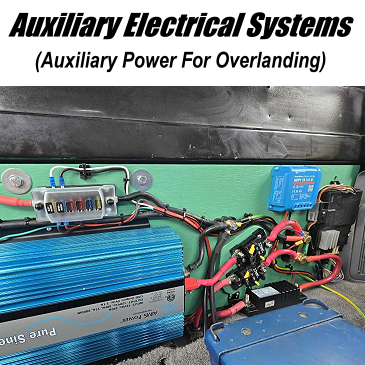


 Those will charge off of a 12v source, too, in case solar fails you.