Best way to run cpap while camping?


superj

Slow rider

Article Contributor
U.S. Military - Veteran
Joined
Oct 1, 2021
Messages
5,304
Points
101
City
corpus christi, texas
State - Country
TX - USA
Other
2004 ford ranger
Vehicle Year
2024
Vehicle
Ford Ranger
Drive
2WD
Engine
2.3 EcoBoost
Transmission
Automatic
Total Lift
0
Total Drop
0
Tire Size
Stock
My credo
drives a stick shift ranger
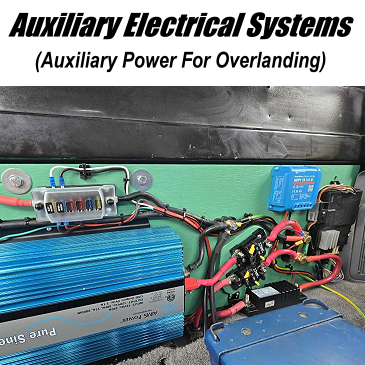
Google says I can get two 100 Watt Solar panels, a solar charge controller, and a 100 amp hour battery, and that'll run a cpap machine for 8 hours.And then it'll charge in a 6 hour day.What do you guys think?

I need a set up for when when I go to big bend
 
I tried one of those online solar panel set up deals where you put all your information in , and that's what it told me
 
Look at the label on your CPAP and see how many amps or watts it takes. I just looked at my old resmed model and it requires 1.5 amps input at 120volts. That would be 180watts. So, for an 8 hour night of sleep, it would need 12amp-hours (AH) or 1440watt-hours (WH). So, to be on the safe side, get a powerbank that provides 2,000WH or maybe 15AH at 120volts.

If that's all you want to use it for, just get a whole package deal with powerbank and solar charging from somebody like Jackery or Bluetti or something like that. You can get inexpensive setups even from Harbor Freight, Home Depot, Lowe's, etc. It can also charge your phone.

There are several articals in our tech library if you want more info. Here is one.
 
That instruction deal is whay i was trying to find. I knew i had seen one.

And yes, jist the cpap. Its a resmed airsense 10.

It says:

dv24v and 3.75a

On the tag on the bottom

Best way to run cpap while camping?
 
That instruction deal is whay i was trying to find. I knew i had seen one.

And yes, jist the cpap. Its a resmed airsense 10.

It says:

dv24v and 3.75a

On the tag on the bottom

View attachment 143824
There should be another label on the power supply that you plug into the wall. That will be the info you want. It will probably be the numbers I mentioned above.

I should find a new doctor and get my prescription renewed. I stopped using 5 or 6 years ago when my Dr. Retired.

Just looked again. Mine is a ResMed Air10. Same DC ratings on the base unit.
 
Those "solar generators" are great! I got one for my BIL who works storm outages. His wife liked it so much she took it from him! 🤣 Those will charge off of a 12v source, too, in case solar fails you.
 
That instruction deal is whay i was trying to find. I knew i had seen one.
There should be another label on the power supply that you plug into the wall.

Looks like AC input is 115V at 1.5A.

@superj : If you need a manual for the machine, as long as you have an FCC ID number, you can get manuals and other information from the FCC website. Just google "FCC ID lookup" to find their website. If they got it, you can download it as a .pdf.

I just checked if there was a manual for your CPAP machine at the FCC, and this is a screen shot I made of the manual page for specifications showing your power supply's AC voltage input:

Best way to run cpap while camping?


HTH
 
The AC power supply will often be a bit oversized for the device it's powering, especially on a medical device. What the actual device needs is 90 watts (24v x 3.75a). The power supply won't be 100% efficient, but it'll be well over 80%, so given that that spec sheet claims 104 watts MAX, I think you could plan your power budget for 120 watts and be pretty safe.

There are a few ways you could get there. Your proposed setup should get the job done - the tricky part of that setup is that solar panels need direct sunlight, no shadows at all anywhere on the panels, to get full output. You actually lose a fair amount of efficiency going from solar through the charge controllers, converting from DC to AC and then back to DC for the device itself.

For a one-off trip, it might be just as easy (although I don't know about price) going with one of those big charge banks/"solar generators" (as some companies call them and as mentioned above) that can accept solar panel inputs for charging as well as other charging methods, wall power, cigar lighter etc.

I think the most elegant and most efficient solution - and this might not make sense for a one-off trip but I think would be great in the long run - would be to use 24v worth of solar panels into a 24v charge controller that can put out a regulated 24v, wired into 2x12V batteries, and make a cable to connect that directly to the CPAP machine. That would take less solar to charge and less battery capacity to run. (maybe even 30-40% overall)

Of course, the solar generator has a whole other bunch of uses so you might get better value out of something like that in the long run. Also depends on what you might already have on hand or readily available for parts

I don't want to be too long-winded here. If you want me to elaborate on anything I'd be happy to. It's an interesting and useful project.
 
I have to googlw solar generator. I dont know what that is
 
The AC power supply will often be a bit oversized for the device it's powering, especially on a medical device. What the actual device needs is 90 watts (24v x 3.75a). The power supply won't be 100% efficient, but it'll be well over 80%, so given that that spec sheet claims 104 watts MAX, I think you could plan your power budget for 120 watts and be pretty safe.
While you are technically correct, it's usually better to plan and design with the larger numbers. A bit of reserve capacity is good to have, especially if the next day turns out to be cloudy or you're in the shade a lot and can't get a full recharge. Besides, at this small size, the price difference between 120 watts, 150watts or 200watts isn't really that much. Furthermore, don't concentrate on just "watts". You need to think about "watt-hours" . That is the battery capacity that carries your load over time. "Watts" and "amps" are instantaneous measurements. Watt-hours or Amp-hours tell you how long your power bank will supply those watts or amps. And that is what you need. You want it to keep the CPAP running all night long, not just for a minute or two.
 
Last edited:
I have to googlw solar generator. I dont know what that is
This is a step above the one I bought my BIL. However, the one I got him looks like it may only barely meet your needs.
Best way to run cpap while camping?
 
I have to googlw solar generator. I dont know what that is
It's not really a good term. It's a phrase that was coined to describe a machine with solar generating panels, an inverter to turn that power from DC to AC and, usually, a battery to store energy for use when the sun is unavailable. Basically, a quiet machine to replace a generator that relies on an internal combustion engine and tank of fuel.
 
While you are technically correct, it's usually better to plan and design with the larger numbers. A bit of reserve capacity is good to have, especially if the next day turns out to be cloudy or you're in the shade a lot and can't get a full recharge. Besides, at this small size, the price difference between 120 watts, 150watts or 200watts isn't really that much. Furthermore, don't concentrate on just "watts". You need to think about "watt-hours" . That is the battery capacity that carries your load over time. "Watts" and "amps" are instantaneous measurements. Watt-hours or Amp-hours tell you how long your power bank will supply those watts or amps. And that is what you need. You want it to keep the CPAP running all night long, not just for a minute or two.
EDIT: whenever I say "you" in this point, I mean the generic "you", not Curious Hound - I quoted him to make sure I made it clear I agree with him.

EDIT2: What I did last night was, I yada-yada-ed the math. In retrospect, that wasn't helpful.

Yes, I totally agree. While trying to not ramble on as long as I usually do, I'm afraid I understated the power budget issue. In fact I started to go down that road with my solar panels comment and then got worried I was going to bore everyone to tears.

Absolutely, when you're deciding how much battery capacity you might need for a given project, my general rule of thumb is try to figure out how much power you _actually_ need, as accurately as possible, then double or even triple whatever battery capacity you think you might need, if not more. In the case of a medical device, and this is one of the things I cut out of my message (can't believe I did that), I would be _extremely_ conservative about my power budget.

This is where things get nerdy and boring. There are very few battery specifications from very few battery manufacturers that I trust. 99% of them lie, or mislead, and even with high quality batteries from reputable manufacturers, exactly what those watt-hour /amp-hour specs mean can vary from company to company, and also according to how you use the batteries. Some watt-hour ratings will hold up if you drain them slowly but the math falls apart when you start pulling lots of current from them.

I wasn't trying to split hairs on the watts required. I meant to start the discussion of where those watt-hours were going to come from, and I wasn't trying to be the final word on that, but I failed to make it clear that ... well actually I failed to be clear at all I think. :LOL: I didn't want to drone on or talk down to anyone, just start the conversation. So I'll risk both of those things and say:

1) Solar is a pain in the a$$ to plan for. It's unreliable and fussy and almost totally variable. Yes, it's almost like free money in the long run, but the shorter your time of need, the more likely it is to let you down, and even when it works it's usually under-delivering from whatever math you started with. This is why, especially for a medical device, I would have a backup. And a backup for the backup.

2) The term "solar generator" really irritates me. It's marketing BS. They're just giant battery packs, some of which have a crappy solar controller and/or crappy inverter, and some even have a tiny little solar panel on top which would probably charge the thing in about a month. I'm on record here in various places with my opinions about questionable lithium batteries, so I'll leave that there. Whatever they actually are, they _may_ be a relatively affordable way to carry around a lot of battery capacity. Safety, I'd be really careful which one of those I chose and I certainly wouldn't sleep anywhere near it.

3) Running wall warts/laptop chargers etc from inverters. Again, especially with a medical device, if I didn't have a _real_ sine wave inverter (and 99% of the ones that say "true sine wave" are lying, they're just multi-step square wave inverters), I'd be very careful running a medical device from an inverter. Some switching power supplies run pretty well from junky inverters, some really don't. They can overheat and oscillate and squeal and shut down from dirty power sources. It's just something you'd want to test before your life depended on it working. This is one of the reasons I think avoiding the DC-AC-DC conversion would be the most elegant.

You are now realizing that it's true, I could bore you to tears talking about this subject. :LOL: Seriously though, I didn't mean to undersell the safety issues involved here, I was hoping to get a little back and forth going to figure out the best solution for this project. I must confess I don't know how long this trip is or what the conditions might be, so I didn't do a great job. Mea culpa.

 
Yeah, I think there’s a lot of misleading information out there from manufacturers.

I bought one of those little battery tender solar panel things awhile back. Tried to use it to power an LED light strip. Having it on the dash didn’t do much of anything and putting it on the roof in direct sun it only half lit the LEDs that *should* have fully lit according to the manufacturer indications of output from the solar panel and draw from the lights. Major disappointment. Apparently I need a much bigger panel to run the lights, or even just to reliably charge a battery to run the lights with.

DC to AC to DC racks up a lot of efficiency losses. IMHO, far better if you can go same/same or one jump. I’d be looking to do a 24v DC setup to power it (the CPAP) and skip the plug in power converter. Staying DC to DC will eliminate losses.
 

Sponsored Ad

TRS Events & Gatherings

Featured Rangers

Want to see your truck here? Share your photos and details in the forum.

TRS Latest Video

Official TRS Merchandise

Follow TRS On Instagram


Product Suggestions

Back
Top