By rocket5979
There are quite a few misconceptions that get thrown around a lot when talking about nitrous. Stuff like “it will kill your engine” and “your tranny cannot take it” and so on. Well those overstatements are just plain wrong if you follow some of these steps I am about to outline and also just be safe and patient with things.
Step 1) First you got to ask yourself, “Why do I want this power and what for”?
Sometimes people only want about 20-30 more hp and really don’t even need to go with a nitrous setup. This is where some of you should be truthfully answering to yourselves, “Am I wanting to do nitrous for the power or am I wanting to do it because it would sound cool to say I have nitrous?” Another 20-30 hp is easily attainable with most basic aftermarket boltons like CAI, exhaust and tune and so on. With allot of vehicles just those three mods alone will usually net you between 20-30 additional horsepower alone.
Step 2) Once that is decided you will need to see if your vehicle can take it. This will be based upon the condition, mileage and overall upkeep of the drive train of the vehicle over its life so far. For those of you who bought used just go back as far as you can go into the vehicles history. There is no set rule here. Your choice as to whether or not you choose to install nitrous oxide onto your vehicle is totally dependent upon your confidence in your vehicle’s condition. If it is in good to great condition then your vehicle is probably a good candidate.
Step 3) Now you need to establish what SIZE of shot you want to go with. This will be based upon your power aspirations and also upon your vehicles limitations, not only engine and transmission but also stock fuel system limitations as well. A good rule of thumb is to not spray more than half the stock horsepower of your cars engine. So for instance if you have a stock 2000 5.0 V8 Explorer that originally came with 215 hp then you would want to keep your shot around 100hp at the flywheel. This is assuming a stock engine, transmission and fuel system. If those are modified to take the power then you can run a much bigger shot.
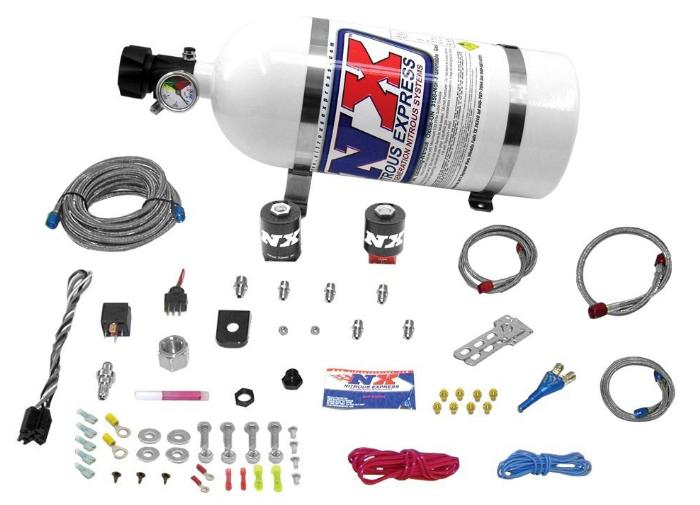
Step 4) Wet or Dry??? This debate has gone on since the dark ages of nitrous. Which one is safer and which one is easier to tune? Both have their places within the world of cars. All a dry nitrous kit is a bottle with nitrous oxide under high pressure, a hose (line), a nitrous solenoid (think of this as the nitro on/off switch) another short hose (line) and the nozzle with its jet. The way the shot is sized is based upon how much bottle pressure the kit manufacturer tells you to stay at. For the 100 wetshot I run in my 2005 Lincoln LS the jet size is .055 if I am not mistaken. That is just the size of the hole through which the nitrous has to get through. The smaller the hole at a given bottle pressure and the smaller the shot of nitrous. Most nitrous systems usually operate between 900-1100 psi of nitrous bottle pressure. No when you go to a wet kit all you do is take the aforementioned dry kit and add a hard-line or steel braided fuel hose going from the fuel injection line to another solenoid to control the fuel (on/off) and then to a slightly different kind of injection nozzle. Now instead of having one port to hook up the hose and one port that lets the nitrous spray out and into the intake. You have two (one for fuel and the other for nitrous). Now being that most fuel injection systems operate anywhere between 40-65 psi of fuel pressure you will have to pick the right fuel jet that matches the corresponding nitrous jet to give you the correct air/fuel ratio. If you have any question on this just contact your nitrous kits manufacturer.
Step 5) How do I activate the nitrous shot? Some will tell you to use a wide open throttle switch and a RPM window switch along with a master arming switch to activate the nitrous. While this is a good way to do things and keep it safe, there are better.
What I am talking about are progressive nitrous controllers. All a progressive controller does is not only act like a WOT switch and RPM window switch but they also ramp the power from your nitrous up instead of letting it all hit at once. The nitrous hitting all at once is what can really kill a stock drive train. The way the controller does this is that is pulses the nitrous and/or fuel solenoids. Since the solenoids are either one or off and no in between they must be pulsed and left open a certain amount of time to get whatever percentage of your nitrous shot you want at that certain RPM. If you understand how your fuel injectors work in our EFI systems it is pretty much the same concept.
Progressive controllers used to cost an arm and a leg and were very hard to set up. Even some nowadays still are. While the one I am about to mention isn’t exactly a walk in the park to install, any skilled mechanic/electrician/home DIY’er should be able to do it. My progressive controller cost me $206 and has all the options I would ever need. The best part is that if you add the price of the WOT switch and the RPM window switches up they usually come right close to the Controllers price. The great thing is that the controller does all the stuff that a window switch and WOT switch does but much more too.
Step 6) Now that we talked about the more technical stuff lets go ahead and talk about more of the other necessities that you will want to include in a safe and reliable nitrous system. Timing is one thing that people question if they need to retard when spraying nitrous. While some say that you don’t have to pull timing until spraying 100 shot or bigger, I like to err on the side of caution with my daily driver car. I would keep things safe and retard spark timing 1 degree for the first 50 hp of nitrous and then 2 degree’s of retard for every additional 50 hp. I would venture a guess that not many in here will be going past 100 shot which keeps things simple. 1 degree for 50, 2 degree’s for 75, and 3 degree’s for 100 shot. Pulling timing will keep a safety net in there so that the vehicle will be less likely to detonate if problems somehow do arise.
Step 7) Do I need to go with colder plugs? Yes you do. I would suggest going with one heat range colder plug for 50 shot and 2 ranges colder for 100 shot of nitrous. If you are running a platinum type of plug I suggest you also go to a copper type of plug instead. The plats tend to burn too intense and can sometimes cause ill effect with nitrous.
Along with the plugs and heat range you should usually start gapping your plugs at .035″ for nitrous up to 100 shot. If you go with a bigger shot then you will need to either close the gap a little more (to eliminate spark blowout) or install an aftermarket ignition to make the spark intense enough so as not to blow out.
Step 8) Do I need a nitrous bottle pressure gauge? Yes you do. The reason for this is that in step 4 if your nitrous kit manufacturer tells you that their 75 shot jets work with 900 psi bottle pressure the if bottle pressure goes up then the shot size will too. Depending on how your nitrous is tuned, that may cause enough of a lean condition to cause damage. Say if bottle pressure went from 900 to 1200 psi due to a hot day in the sun. Well that would be about 33% more nitrous injected. So that 75 shot that you thought you were running now has turned into a 100 shot. Bad day if you’re only injecting enough fuel for 75 hp worth of nitrous.
Step 9) Should I get a nitrous filter or fuel filter? Yes to both. The name of the game here is keeping your nitrous and fuel solenoids clean. If they gum up or otherwise cannot function correctly then you might run into a condition where your system tries to close the solenoids but they stay open and still spraying. That is another bad day. You can install your nitrous filter anywhere in the nitrous tract. I happened to put mine right after the bottle which is in the trunk. The fuel filter (wet nitrous system) I put as close to my fuel solenoid as possible to make sure no particles or gunk reached the fuel solenoid.
Step 10) How do I make sure my stock fuel pump can keep up with the fuel needs of my wet nitrous shot if something somehow goes wrong? Install a Fuel Pressure Safety Sensor (FPSS). It only allows the nitrous to be active if it senses above 30-psi fuel pressure. Once the fuel pressure drops below that threshold it will break the circuit and not allow the system to be armed anymore which will stop the nitrous from being injected.
Step 11) How do I add more fuel in my dry nitrous system setup? With dry nitrous instead of dealing with an extra fuel line and solenoid you will have to add more fuel via a tune intended for your nitrous. The new tune will need to be able to retard your spark timing and also add more fuel through the stock fuel system.
The problem some of the newer vehicle PCM’s (Power PC processors) people are running into is that the only way to program those PCM’s is with an SCT Xcal2. Anyone that has programmed on of those vehicles knows it takes about 15 minutes to do so with the unit. That is a long time just to wait to retune your PCM then run it on the nitrous and then switch back to the regular tune right after running. Nitrous is usually used on a little more spur of the moment basis. What I did to counteract this was just retard my spark timing all the time even when not running nitrous and then used a wet nitrous kit to add in my fuel too. That way I would not have to retune all the time because the spark is always retarded and the fuel is taken care of by the wet nitrous system instead of the PCM and stock fuel pump and injectors.
Those of you that have the Ford vehicles with the EEC-V computer have the ability to hotswap programs on the fly because your computers can be chipped through the rear J3 service port on the back.
Addendun:
This is an addendum that I also included for my previous nitrous write-up with a little additional information. Some of the info is redundant, but most is not. Enjoy!
How much does it cost?
Nitrous will be MUUUUUUUCH cheaper in the short run than a supercharger. But people do argue that in the long term the supercharger wins out over the nitrous because of the bottle refills. I own both a blown vehicle and a nitrous injected vehicle so I can speak from both perspectives here. Yes, my complex nitrous setup for parts alone cost me about $500 total (I got good deals) where as my supercharger ran me $5,000+. It will take A LOOOOT of refilled nitrous bottled to equal that out! In some peoples situation I am pretty sure they aren’t about to throw $3,000+ at a supercharger or turbo so that option is out the window for some. Nitrous when setup properly can be very reliable and safe too.
Which TYPE of nitrous kit..wet or dry???
I highly recommend wet nitrous shots because they are inherently safer when setup and ran correctly. You will hear a lot of bad stories of “fuel puddling” in the intake and blowing it off with a wet system, but that is simply not true. Very RARELY does that ever happen (happens with dry kits too) and if it does it is ONLY because the system was not setup, used, and/or tuned correctly.
Which brand of kit???
Some say only to go with this or that brand but there are many good brands out there. Some of the well proven ones are: NX, NOS, Nitrous Works, Edelbrock, Venom and Zex. Any of these are great brands to pick from so if you see one that is a REAL good price and is what you think you want then don’t hesitate to pick it up.
Which type of kit???
Don’t worry if you cannot find a kit made SPECIFICALLY for your vehicle. The reason why it is not a big deal is because nitrous oxide systems are VERRRRRY simple in design and construction. Any generic universal EFI V8 nitrous kit will work just fine for what most people will need in here. If you have a carbed engine then some of the items such as jetting recommendations and fuel pressures stated in here will be different from what you would run. Most will still apply.
How can I make it safe???
First…Install (or have it installed) correctly…This is a very simple job that most any skilled vehicle DIY’er can do IMPO.
Second…Have it tuned by a professional in person (mail order tunes get real close, but not maximum safety) who knows what they are doing so they get the A/F and timing spot on for good power and, more importantly, safety.
Third…Make sure your running a safely sized shot. Rule of thumb is no more than 50% more than the vehicles stock horsepower (up to 125 shot maxx on 99% of vehicles).
Fourth…Make sure that in addition to the kit that you also get a wide open throttle activation switch along with an RPM window switch. Those when used in combination will only allow the nitrous system to activate once the master arming switch is on, the gas pedal is all the way to the floor, and the engine RPM’s are where you want it to spray.
Fifth…If you really want a lot of safety for your vehicle then get a 40 psi Hobbs fuel pressure switch. What it will do is, also in conjunction with all the other aforementioned switches, only allow the nitrous to be active when fuel pressure is above 30 psi. This is good to have just in case a stocker fuel pump takes a dive and fuel pressure drops while spraying nitrous. More air and low fuel causes a lean condition and BOOM! This switch is not necessary but is advisable.
Overall if approached correctly nitrous can be a cheap and reliable way to make a lot more power in a relatively stock vehicle.
I hope this helps some of you in your future nitrous endeavors. When setup, tuned, and used properly nitrous can be just as safe as any other part on a car.
If you have ANY questions about this write-up or are not sure about something that I may have forgotten to cover consult a local nitrous system expert or email me, do not guess. While nitrous can get kind of complex, it is still very basic in concept.
As mentioned above:
Which type of kit???
“Any generic universal EFI V8 nitrous kit will work just fine for what most people will need in here.”
Here are some instruction manuals for
Nitrous Express Ford EFI Nitrous Kit
1999-Up Ranger Nitrous Works Nitrous Kit
About The Author
Jim Oaks is the founder of TheRangerStation.com, the longest-running Ford Ranger resource online since 1999. With over 25 years of hands-on experience building and modifying Ford Rangers — including magazine-featured builds like Project Transformer — Jim has become one of the most trusted authorities in the Ford Ranger off-road and enthusiast space.
Since launching TheRangerStation.com, Jim has documented thousands of real-world Ranger builds, technical repairs, drivetrain swaps, suspension modifications, and off-road adventures contributed by owners worldwide. TheRangerStation.com has been referenced in print, video and online by enthusiasts, mechanics, and off-road builders looking for practical, and experience-based information.