
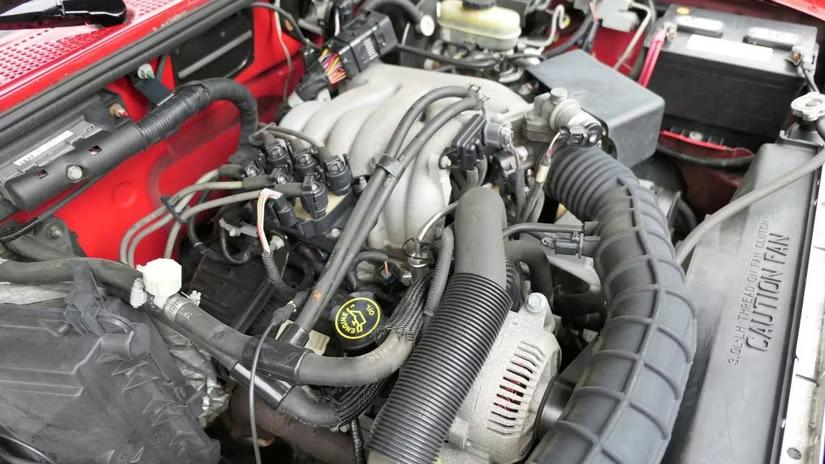
The Ford Vulcan V6 is a 3.0L, 60° V6 engine, first introduced for the 1986 model year and originally designed to be the optional engine in the Ford Taurus and Mercury Sable. In 1991 it became available in the Ford Ranger where it replaced the Cologne 2.9 engine (which it is not related to) as the base V6 in the Ranger.
The Vulcan was a clean-sheet design using the metric system. The engine block is built by Sherwood Metal Products, the intake comes from Ford’s Essex Casting, and the engine is assembled at Ford’s Lima Engine plant in Lima, Ohio.
The Vulcan is a straightforward pushrod design, with 2 valves per cylinder. Bore is 3.504 inch, and stroke is 3.15 inch. The engine was designed to use electronic fuel injection from the start (there was never a carburetor-equipped version) and was also sold in a “flexible fuel” configuration that could burn normal gasoline, E85 (a blend of 15% gasoline and 85% ethanol) or any mixture of these two fuels.
In 1991, it was updated with lower-friction pistons, a strengthened block, roller camshaft and other changes that resulted in a power rating of 145 hp and a torque rating of 160 ft·lbs. In 1998 further improvements were made, with a new intake manifold, changes in engine management and cam timing; output was further increased to 155 hp (115 kW) and 185 ft·lbs. A plastic upper intake was added in 2001.
This engine has become very well-known for its durability and is common to find engines running strong at 300,000 miles and beyond.
2008 was the last year that the 3.0L V6 was offered in the Ford Ranger. The 3.0L EcoBoost is an entirely different engine.
Engine Specifications |
|
| Engine Displacement (Cubic Inches) | 183 CID |
| Block | Cast Iron 60º V-6 |
| Type | Over-head Valve Engine |
| Bore x Stroke | 3.50 x 3.14 |
| Compression Ratio | 9.3:1 |
| Valve Lifters |
Hydraulic (1986 – 1993) Hydraulic Roller Tappets (1994 – 2001) (Same as 5.0L) |
| Fuel System | Fuel Injection |
| Fuel Pressure | 30 – 40 PSI |
| Horsepower |
145hp @ 4800 RPM (1991 – 1995) 147hp @ 5000 RPM (1996 – 1997) 145hp @ 5000 RPM (1999) 150hp @ 4750 RPM (2000 – 2001) 146hp @ 5050 RPM (2002) 154hp @ 5200 RPM (2003 – 2004) 148hp @ 4900 RPM (2005-2008) |
| Torque |
165 @ 3600 RPM (1991 – 1995) 162 @ 3250 RPM (1996 – 1997) 178 @ 3750 RPM (1999) 190 @ 3650 RPM (2000 – 2001) 180 @ 3500 RPM (2002) 180 @ 3900 RPM (2003 – 2004) 180 @ 3950 RPM (2005 – 2008) |
| Oil Pressure | 40 – 60 PSI @ 2500 RPM |
Tune Up |
|
| Spark Plug | AWSF-32PP (Motorcraft SP432) |
| Spark Plug Gap | 0.044 inch |
| Ignition Timing | 10 degrees BTDC |
| Firing Order | 1-4-2-5-3-6 |
| Distributor Rotation |
Clockwise (1991 – 1994) Distributorless (1995 – Later) |
Capacities |
|
| Oil Capacity With Filter Change | 4.5 Quarts |
| Cooling System Capacity (Quarts) | W/AC- 10.2 / W/O AC 9.5 |
Torque Specifications |
|
| Cylinder Head |
Torque in 2 steps [1st (33-41 ft-lbs), 2nd (63-73 ft-lbs)] (1991 – 1998) Torque in 4 steps [1st (59ft-lbs), 2nd (loosen 1-full turn), 3rd (34-40ft-lbs) 4th (63-73ft-lbs)] (1999 – Later) |
| Main Bearing Bolts | 60 ft-lbs |
| Rod Bearing Bolts | 26 ft-lbs |
| Crankshaft Pulley Bolts | 107 ft-lbs |
| Flywheel to Crankshaft Bolts | 59 ft-lbs |
| Upper Intake Manifold / Throttle Body | 19 ft-lbs |
| Exhaust Manifold | 19 ft-lbs |
Miscellaneous Specifications |
|
| Bore Spacing | 4.33 inches |
| Connecting Rod Length | 5.53145 inches |
| Block Height | 8.661 inches |
| Piston Compression Height | 1.5354 inches |
| Main Bearing Journal Diameter | 2.5194 inches |
| Connecting Rod Journal Diameter | 2.1257 inches |
Ignition / Firing Order
Here is how the 3.0L ignition history breaks down:
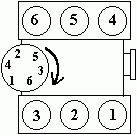
1986–1994 (Distributor System):
Early 3.0L Rangers featured a traditional distributor with a single coil and a spinning rotor to mechanically route the spark to each cylinder individually.
1991-1994 Firing Order 1-4-2-5-3-6
1995–2008 (Waste Spark System):
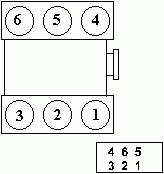
Ford converted the engine to a distributorless Electronic Ignition System (EDIS). This setup remained entirely unchanged until Ford completely discontinued the 3.0L engine option in the Ranger after the 2008 model year.
1995-2008 Firing Order 1-4-2-5-3-6
Troubleshooting Firing Order:
There are only 3 coils in the coil pack, not 6. The spark plugs are fired in PAIRS The pairs are
[3 4] [2 6] [1 5]This is why it looks the way it does, the PAIRS come from the way a V6 engine is balanced
The spark plug wires can just as easily be:
[4 3] [2 6] [5 1]This would work just fine, because 3 and 4 are still firing together at the same time, as are 2 and 6, and 1 and 5. As long as the PAIR are on the correct coil their order doesn’t matter. Now that its all cleared up, lol, 2 and 6 wires will ALWAYS be on the center coil, in the pack.
So there really are only 2 ways it can be wired
[3 4] [2 6] [1 5]OR
[1 5] [2 6] [3 4]That’s it, try it one way if that doesn’t work then reverse 1 5 and 3 4. All done. This applies to the 3.0l and 4.0l they are the same in the matched pairs because they are balanced the same way
Reliability
TopSpeed.com ranked the 3.0L Vulcan V6 as one of the ‘Ten Ford Engines That Are Almost Too Reliable’:
“Designed from the ground up to be reliable, fuel-efficient, and cheap to maintain, the 3.0-liter Vulcan V6 is Ford’s often unsung hero of the 1990s. Though nothing about the Vulcan V-6 was revolutionary at the time of its debut in 1986, it was engineered for big mileage without needing much maintenance. Although the Vulcan got off on a rough start with premature failures of head gaskets, and idle and water pump issues, the Cologne V-6 replacement turned its reputation around three-fold in 100,000-mile increments.
The key to its stellar durability is its simple construction. Its pushrod OHV valvetrain housed in its cast-iron block was a proven formula. Only the Vulcan V6, was fed by electronic fuel injection that allowed the use of traditional gasoline, or ethanol, and even a mixture of both. Making power for the Taurus, Probe, Aerostar, Tempo, and eventually the Ranger, the Vulcan was and is one of the Blue Oval’s most bulletproof engines.”
TopSpeed also stated that it’s expected average mileage is 300,000.
Related Articles
1999 Ford Ranger V6 3.0L FFV Head Gasket Replacement
Ford Camshaft Position Sensor (CMP) / 3.0L, 4.0L & 5.0L
3.0L Camshaft Position Sensor – Synchronizer
60mm 3.0L Escape Throttle Body on 3.0L Ranger Intake
Supercharging the Ford 3.0L Vulcan
Lasted Updated:
About The Author

Jim Oaks is the founder of TheRangerStation.com, the longest-running Ford Ranger resource online since 1999. With over 25 years of hands-on experience building and modifying Ford Rangers — including magazine-featured builds like Project Transformer — Jim has become one of the most trusted authorities in the Ford Ranger off-road and enthusiast space.
Since launching TheRangerStation.com, Jim has documented thousands of real-world Ranger builds, technical repairs, drivetrain swaps, suspension modifications, and off-road adventures contributed by owners worldwide. TheRangerStation.com has been referenced in print, video and online by enthusiasts, mechanics, and off-road builders looking for practical, and experience-based information.