
Introduction
This article is about the 2.9L V6 engine used in the 1986-1992 Ford Ranger and 1986-1990 Ford Bronco II.
Ford Cologne
The Ford Cologne 2.9L V6 is a 60° cast iron block V6 engine built by the Ford Motor Company in Cologne, Germany, hence the name. Over the years, the Cologne V6 was available with engine displacements of 1.8, 2.0, 2.3, 2.4, 2.6, 2.8, 2.9 and 4.0 liters. All except the Cosworth 24v derivative and later 4.0-liter SOHC engines were pushrod overhead valve engines, with a single camshaft between the banks.
Originally, the Cologne V6 was installed in cars intended for Germany and continental Europe, while the British “Essex” V6 was used in cars for the British market. Later, the Cologne V6 largely replaced the Essex V6 even for British-market vehicles. These engines were also used in the United States, especially in compact trucks.
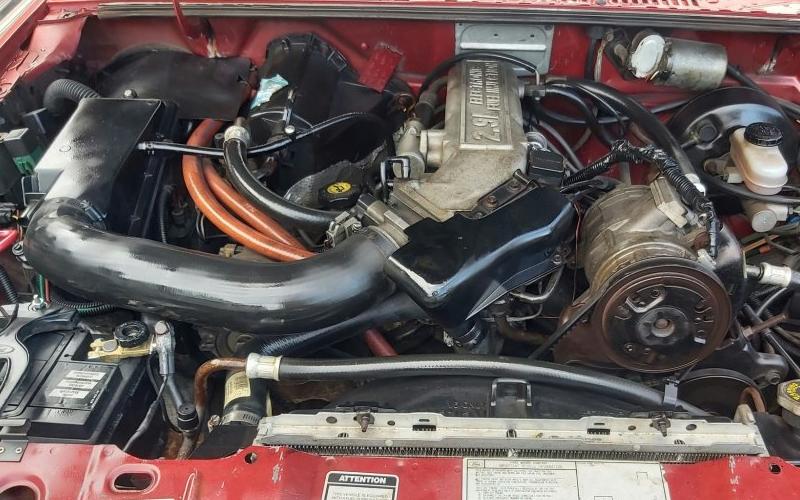
Ford 2.9L vs Ford 2.8L
The 2.9 L shares the same basic design as the 2.8 L model, bar a few subtle differences. The camshaft is chain-driven rather than gear driven, so it rotates in the same direction as the crankshaft. The arrangement of the exhaust valves is different, eliminating the “Hot-Spot” that existed on the 2.8 L model. The cylinder heads also sport a more conventional three-port exhaust manifold.
Ford 2.9L Cologne – Europe
In Europe, this engine was commonly fitted with the Bosch L-Jetronic fuel-injection system, married to Ford’s EEC-IV engine management. An unusual feature on European 2.9 engines is a split-intake system, with two intake pipes going from the filter box to the intake manifold, which contains two separate plenums, each feeding one cylinder bank. The plenums are connected only by a small cross-over port to equalize pressures between the sides. This engine was rated at 144 hp at 4800 rpm for the Merkur Scorpio in the US market and 150 to 160 hp for the European market.
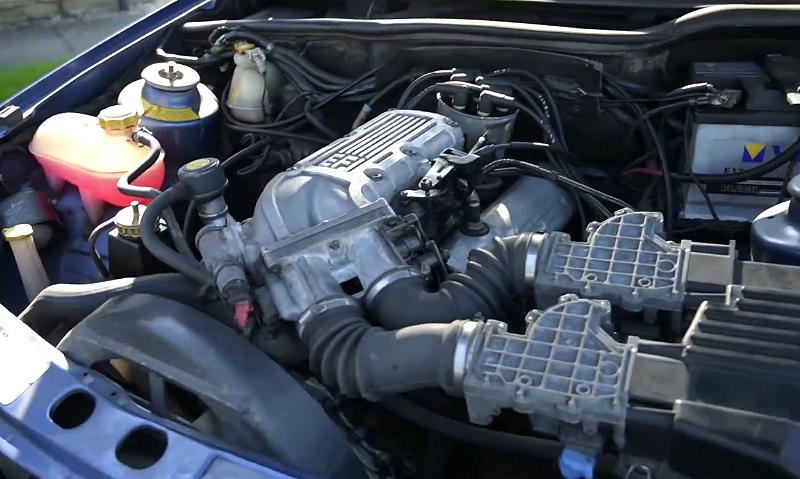
Ford 2.9L Cologne V6 – Europe
North American 2.9 Reliability:
The North American version of this engine suffered from several serious reliability issues over its lifespan.
Cylinder Heads
Cylinder head cracking was common in early models. Compared to the relatively stout European heads, the North American 2.9 had apparently been subject to a reduction of material around the valve stem guides and rocker shaft mounting pedestals. Some engines would suffer from this failure after overheating only once. Most common symptoms are clean spark plugs, white exhaust smoke when warm, low compression on one or more cylinders, and “snot” on the oil cap or dipstick. Sometimes the “Snot” can just be condensation, so make sure the Engine is warm before checking. The best course of action is to drain the oil, pull the heads, and have them magnafluxed to make sure you have a crack, if you do have a crack, DO NOT RUN THE TRUCK, coolant in the oil toasts crankshaft bearings, requiring a total rebuild. If the truck isn’t run to long than you can probably get away with just heads.
The cylinder heads underwent a redesign for the 1989 model year, receiving additional material in problem areas, largely eliminating this specific failure. These head casts are commonly printed with the “89TM” designation. After-market heads are also available from World Products, with similar design improvements to the early OEM design.
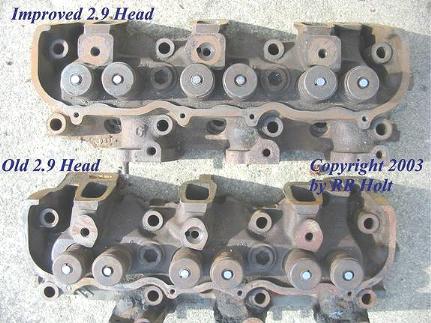
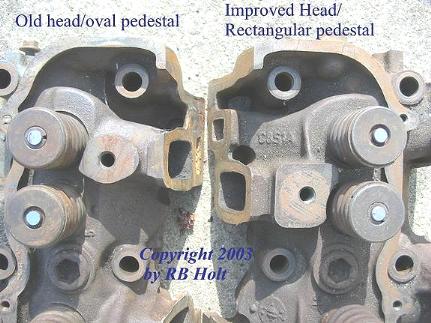
Note the straighter valve cover mating surface on the improved heads. That is why old-style valve covers tend to leak on the newer heads. New valve covers have a turned-up flange, while the old-style valve covers have a turned-down flange. The important feature, as far as resistance to cracking is concerned, is that the improved heads are identified by the rectangular shaped rocker pedestals, while the old-style heads have oval pedestals.
Oiling Problems
Additionally, oiling problems were common and added to the poor reputation of the North American 2.9. Many poorly maintained or high mileage engines exhibit serious valve train noise. This problem is due to a number of design faults. Valve train oil pressure was entirely dependent upon a supply fed through the two center cam bearings. Even slight bearing wear could cause complete loss of oil pressure to the hydraulic valve lifters, rocker shaft, and rockers. Excessive internal “bleeding” through the half-moon camshaft thrust plate also contributed to this, though this can be remedied by reinstalling the thrust plate in an upside-down position. This condition is sometimes mistaken for ticking fuel injectors. This condition isn’t a cause for alarm unless it does it very loudly or after long freeway trips. If it does have the oil pressure checked, it could be low.
In the event that a cylinder head crack occurs, coolant can often enter the crankcase, contaminating the oil. This quickly led to cam bearing damage, triggering valve train oil pressure loss. As a result, these two design faults led to catastrophic engine failure in many North American 2.9s.
Valve Cover Leaks
Valve covers have been known to leak. Other than making the engine look nasty and smell nasty, these pose no danger. Some claims have been made of the motor catching fire because so much oil leaked on the exhaust, but this is rare. Replace with Fel Pro “Rubber” or Fel Pro “Blue” and leaks should be taken care of.
Actually, A Reliable Engine
Regardless of these problems, many of these engines are still on the road in the US, and when maintained properly, are highly reliable powerplants. Use of synthetic oil and proper cooling system maintenance is essential if owners of early-model 2.9s wish to avoid trouble.
Replaced By The 3.0L In 1993
The 2.9L co-existed alongside the 3.0L, the Engine which replaced it, until 1992, when Ford introduced a “More Refined” Ranger. The 2.9L wasn’t a refined engine like the 3.0L “Vulcan”. It was rough, noisy, and crude. The 3.0L was none of these things so it replaced the 2.9L in 1993. Even with its meager low-end torque (compared to the 2.9L) it still is the only Small V6 offered in the Ranger, next to the Big Brother 4.0L. The 4.0L is related to the 2.9L however, so in a way it still lives on. The 3.0L is in NO WAY related to the 2.9L V6 Engine.
Specifications |
|
| Engine Family | Cologne |
| Engine Displacement (Cubic Inches) | 177 |
| Cylinders | 6 |
| Arrangement of Cylinders | “V” Shape |
| Bore x Stroke | 3.66 x 2.83 |
| Compression Ratio | 9.0:1 |
| Valvetrain | Pushrod Overhead Valve |
| Fuel System | MPFI (Multiport Electronic Fuel Injection) |
| Fuel Pressure | 30-40 psi |
| Horsepower | 140 hp @ 4600rpm |
| Torque | 170 lbs. ft. @ 2600rpm |
| Oil Pressure | 20 psi @ warm Idle 55 psi @ 2000rpm |
Tune Up |
|
| Spark Plug | AWSF-42C |
| Spark Plug Gap | 0.044 |
| Ignition Timing | 10 degrees BTDC |
| Firing Order | 1-4-2-5-3-6 |
| Distributor Rotation | Clockwise |
Capacities |
|
| Oil Capacity With Filter Change | 5.0 quarts |
| Oil Capacity Without Filter Change | 4.0 quarts |
| Cooling System Capacity (Quarts) | W/AC- 7.2 / W/O AC 7.8 |
Torque Specifications |
|
| Cylinder Head | Torque in 3 steps [1st (22ft-lbs), 2nd (51-55ft-lbs), 3rd (Turn 90 degrees)] |
| Main Bearing Bolts | 65-75 ft-lbs. |
| Rod Bearing Bolts | 19-24 ft-lbs. |
| Crankshaft Pulley Bolts | 85-96 ft-lbs. |
| Flywheel to Crankshaft Bolts | 47-52 ft-lbs. |
| Intake Manifold | 15-18 ft-lbs. [5-steps (hand start & snug) (3-6) (6-11) (11-15) (15-18) (Repeat 15-18 after warm up)] |
| Exhaust Manifold | 20-30 ft-lbs. |
Valve Specifications |
|
| Seat Angle Degree | 45 |
| Face Angle Degree | 44 |
| Spring Test Pressure | 143 lbs. @ 1.22in |
| Spring Installed Height | 1.58-1.61in |
| Stem to Guide Clearance Intake | 0.0008-0.0025in |
| Stem to Guide Clearance Exhaust | 0.0018-0.0035in |
| Stem Diameter Intake | 0.3159-0.3167in |
| Stem Diameter Exhaust | 0.3149-0.3156in |
Crankshaft Specifications |
|
| Main Bearing Journal Diameter | 2.2433-2.2441 in |
| Main Bearing Oil Clearance | 0.0008-0.0015 in |
| Shaft Endplay | 0.004-0.008 |
| Thrust on No. | 3 |
Connecting Rod Specifications |
|
| Journal Diameter | 2.1252-2.1260 in |
| Oil Clearance | 0.0006-0.0016 in |
| Side Clearance | 0.004-0.011 in |
Piston & Ring Specifications |
|
| Piston to Bore Clearance | 0.0011-0.0019 in |
| Ring Side Clearance Top Compression | 0.0020-0.0033 in |
| Ring Side Clearance Bottom Compression | 0.0020-0.0033 in |
| Ring Side Clearance Oil Control | Snug |
| Ring Gap Top Compression | 0.015-0.023 in |
| Ring Gap Bottom Compression | 0.015-0.023 in |
| Ring Gap Oil Control | 0.015-0.023 in |
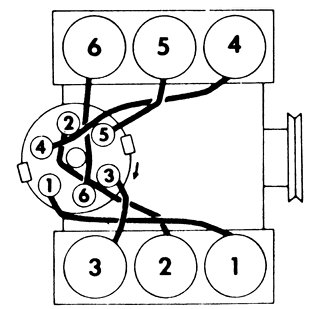
Firing Order 1-4-2-5-3-6 / Distributor Rotation – Clockwise
Link
Related Articles
Kunz Korner – 2.9 Performance Tips
2.9L MAF Conversion – Detailed Procedures
5.0L Throttle Body on 2.9L Intake
How To Build And Modify Ford V-6 Engines (.pdf)
Last Updated:
About The Author

Jim Oaks is the founder of TheRangerStation.com, the longest-running Ford Ranger resource online since 1999. With over 25 years of hands-on experience building and modifying Ford Rangers — including magazine-featured builds like Project Transformer — Jim has become one of the most trusted authorities in the Ford Ranger off-road and enthusiast space.
Since launching TheRangerStation.com, Jim has documented thousands of real-world Ranger builds, technical repairs, drivetrain swaps, suspension modifications, and off-road adventures contributed by owners worldwide. TheRangerStation.com has been referenced in print, video and online by enthusiasts, mechanics, and off-road builders looking for practical, and experience-based information.