
Introduction
The purpose here is to eliminate the need to pull off the driver’s side tire, spindle, axle and the entire Dana 28 / Dana 35 carrier from the vehicle. This must be done with the stock set up to be able to access the axle “C” clip. I simply replace the axle “C” clip with a spring placed in the axle slip yoke on the, passengers’ side).
Note: You could also so that by eliminating the c-clip you’re able to remove the axle shaft without having to remove the carrier.
The Process
The removal of the differential is required to do this trick the first time; however, it will never need to be removed again to change the inner axle U-joint. After the differential housing has been removed, remove the “C” clip from the axle. Now bolt the Differential housing back to the I beam, Take the spring and place it inside the slip yoke on the inner axle on the passenger’s side. Then simply slide the outer axle into the inner axle and finish replacing the rest of the front end.
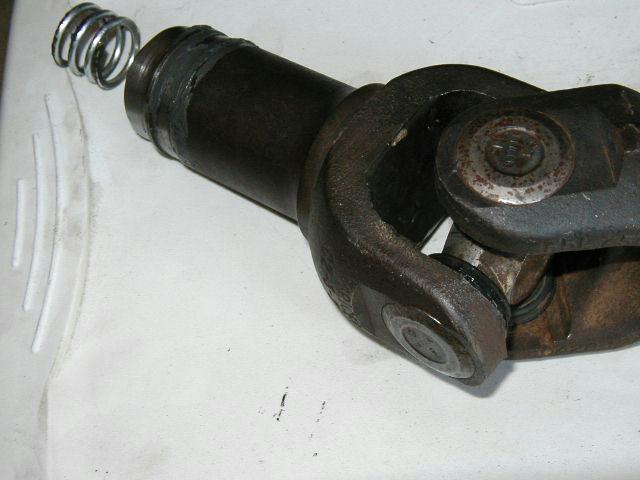
When it comes time to put on the spindle, it should have some resistance to it. Meaning it should have spring tension against it from the spring that was added. It should not be super hard to deal with though. If it is really hard for you to get the spindle on, the spring is either too strong or too long. The spring is also one inch in diameter, and the springs steal itself, is about 1/8″ thick. Now once the five nuts are started, I torque them in a pattern like you would do the lug nuts.
What springs does KTRANGER use?
I didn’t use a valve spring because I feel they are too strong. There is an end cap that is pressed inside the axle which can be popped out if the tension is too extreme. I bought mine at an old-time hardware store. they are basically 1″ diameter and cut to length accordingly.
The way I know the length is by applying the spindle. it should have enough tension against it to make it firm when you try to bolt the five nuts onto it. If it isn’t firm or you can’t push the spindle inward with one hand, the spring rate is two strong or the length isn’t proper.
KTRANGER has over one thousand miles of experience with this swap on as many as five trucks. None have ever had any trouble with this setup. The concept is quite simple.
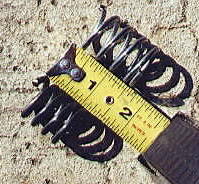
You are replacing the axle “C” clip in the housing, (used to hold the axle inside the housing) with a spring inside the slip yoke between the inner and outer axle. What this does is put constant pressure on the axles in both directions. Pushing the axle into the housing and the hub at the same time. It will also allow the slip yoke to work as it did before as required. To the right is a photo of the springs used by KTRANGER.
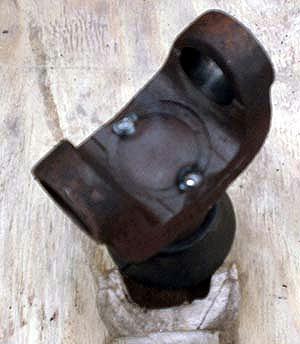
Update by Arctic601 & 4x4junkie – You need to modify the female yoke to keep the spring from blowing the cap off. You can put a few tack welds around the cap since it’s just pressed in. Or you can take a piece of flat steel, grind it down into a circle that would snugly fit in the recess around the end of the splines and tack it in. You may also find a washer that will fit. Finally, you can smear RTV sealant around the edges to seal it.
Update 11/2008
Detroit offers a spring P/N 4610 to be used as a c-clip eliminator.
Related Articles:
Dana 35 / 28 C-Clip Eliminator (External)
Co-Author:
This article was written by TRS forum member KTRANGER and submitted to the author to be published at The Ranger Station for other Ford Ranger owners to use.
Last Updated:
About The Author
Jim Oaks is the founder of TheRangerStation.com, the longest-running Ford Ranger resource online since 1999. With over 25 years of hands-on experience building and modifying Ford Rangers — including magazine-featured builds like Project Transformer — Jim has become one of the most trusted authorities in the Ford Ranger off-road and enthusiast space.
Since launching TheRangerStation.com, Jim has documented thousands of real-world Ranger builds, technical repairs, drivetrain swaps, suspension modifications, and off-road adventures contributed by owners worldwide. TheRangerStation.com has been referenced in print, video and online by enthusiasts, mechanics, and off-road builders looking for practical, and experience-based information.