The Road Ranger. 1997 SEMI


Step Trailer Update:

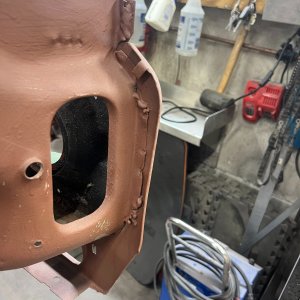
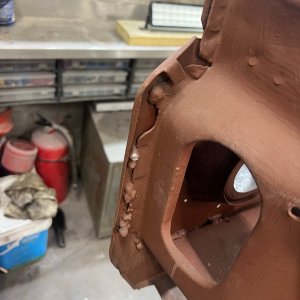
The Road Ranger and step trailer are motoring down the road great. But I noticed the framework for the trailer “pin” is scraping the truck bed, on the inside corners where the “fifth wheel“ assembly is, when I’m making turns. When I first built the trailer, that fabrication was hitting the back fenders on a sharp turn, and I had redone it all before I went up for nationals this year. I measured it 1000 times, and before I finally welded it, I went in the church parking lot across the street and drove it every which away and in circles and turns. Everything cleared. But I can see the scuff marks, and of course that scares me, I don’t want to bind it and break something.

I haven’t gotten much done with all the hurricane Rugrat refugees in the house, but I took a couple of them across the street, and I did everything to that truck I could think of, measuring everything, and I think I figured it out.

I don’t have the classic pin in the plate fifth wheel. It’s an upside down ball trailer hitch, so the trailer can tilt side side. I knew that, and I thought I had still left plenty of clearance for anything that would happen on the road. And it looks like I was right.

First, the bed of the truck tilts up a little bit towards the back. That was by design a little bit, so when I have a load, it will level out. The only place it’s scraping is on that last 2 inches, on top of the light assemblies. That’s 1/8 inch aluminum on top of some fairly thin 2 x 2 tubing. The pin pivot point isn’t centered between the two axles, it’s actually just a few inches in front of the back axle, which was also by design, so the truck would “pull” that axle and the trailer, not “carry” either one.

Since the city widened the road and put in a slightly elevated sidewalk at the end of my driveway (that’s now a steeper incline), there’s a pretty pronounced hump. That sidewalk/hump is right under the rear wheels when I turn left or right out of the driveway.

Apparently, when I pull out and I’m turning, the truck will tilt as much as 6-7 inches from one side to the other, which doesn’t happen on the road. At the same time, the back wheels of the trailer are still sitting square on the driveway. That one location/turn is apparently where I’m getting interference.

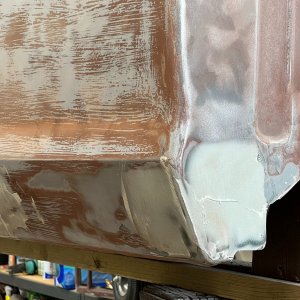
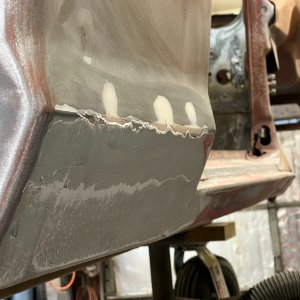
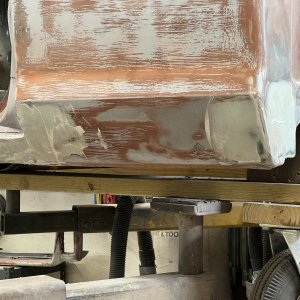
There’s only a scrape on top of the light assembly on the left. When I turn left, I have to cross the lane on my side of the road, so it doesn’t tilt as much as if I turn right. On the right, the pin assembly has actually caught on the inside corner of that part of the bed, and actually bent the 2x2 tubing, crushed it, about a half inch. I figured out that happens because it’s a much tighter turn to the right creating a bigger slant on that hump..

The frame and fenders are all attached solid to the truck frame, it’s only the axle that floats underneath it. When I did my twist and turn test across the street, I also realized that in tight turns that rear axle will move left or right about an inch to either side. No big deal because it tracks going down the road, but that has the effect of moving the pinpoint to the left or right, which affects the clearances in a tight turn.

With all that, I would have to make some pretty substantial changes to the 2 x 2 frame I installed on top of the truck frame in the back. The other solution was just to use a longer offset hitch for my pin, which just raises the assembly up a couple inches. That’s easy to try and remove if it doesn’t work. So, that’s what I did, I swapped out the 4 inch offset for a 6 inch offset.

The Road Ranger.  1997 SEMI


One of the other reasons I redid that whole pin assembly before nationals, was because the trailer was not square left to right with the back of the truck (just top step deck). It also slopes up a little bit towards the front with that same idea that when there was a load on it, it would all level out. I haven’t seen it on level ground since I swapped the hitch, but I’m concerned it might slope up too much now.

I can fix that by correcting another oversight. On the rear of the trailer when I put my axle mounts on the frame, I put all three the same on each side. With the double axle and the equalizer, the one in the center should actually be longer so it hangs lower. Now, the springs can hit the bottom of the frame when I go over a speed bump or something like that, they’re not totally free on that equalizer at its limits.

So my plan is the next time I hook it up, which will be Saturday, I’ll measure it all out again, and then replace those middle spring/equalizer mounts with longer ones that will level the trailer front to back where I want it. That will bring the tail end up a couple inches, but I can live with that.

I now have all my brake parts to do the brakes on those two back axles, so I’ll just do it at the same time, but not right now.

Two points in presenting all this.

First, I would want everybody to have the most up-to-date information and findings if they’re going to try to do something like this, buttt….

Second, I’ll reiterate my disclaimer again that I don’t advise anybody to do this, certainly not the trial and error way I put it together, it’s all a toy for me, and I make no representation about the road worthiness or load handling capability, especially if someone put a serious load on such a thing. I have a unique combination of engineering experience, hands-on, mechanical and fabrication experience, experience with trucks and trailers, etc. that makes me feel comfortable with what I’ve done. But in this posting, there is certainly not a design for others to duplicate.

But it is a blast!
 
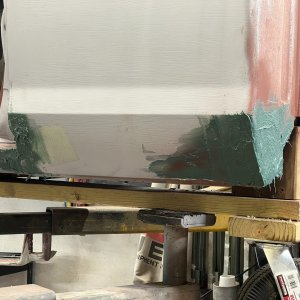
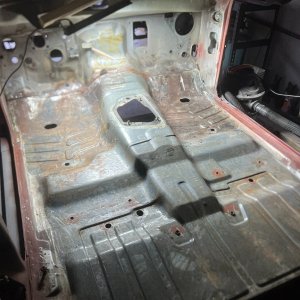
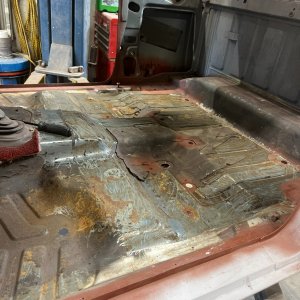
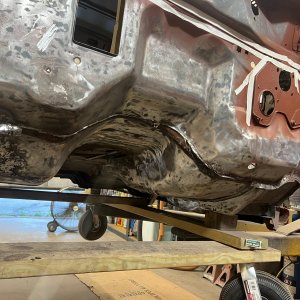
I forgot to put in the picture of the special equipment I used when I was measuring everything, as well as a couple pictures of the damage.

IMG_2998.jpeg
IMG_2996.jpeg
IMG_3032.jpeg
IMG_3028.jpeg


On the right, that’s an every day pair of dollar store needle nose. You can’t have enough of them. Spread out across your workshop.

The red bar and pointer device is a premium SW&CH hitch level and alignment tool sourced from the SOM. (scrap wood and coat hanger from the shed of miracles). A scrap piece of a 2 x 2 pressure-treated stake, and scrap pressure treated 1 x 2 painted red from a different trailer project. The 1x2 was measured, centered, and notched to sit level across the bed, with the 2 x 2 at a perfect 90° angle to sit in the tightly in the coupler at deck level, fasted with a couple of scrap screws from my scrap screw bowl. I did use a good sheet rock screw for the pivot point.

I actually switched to a full-size coat hanger and cut it up and straightened it with a loop on the end because the white one in the picture was a drop scrap from a coat hanger partially used from who knows what, that was about a half inch too short.

It seems silly, and I presented silly, but A lot of getting the job right is the right tools even if they’re not commercially available. Of course I use pressure-treated for durability so it will last between the tractor trailer projects..
 
Last edited:
The only thing I can say is, when you blaze a new trail, there is going to be bumps and scrapes along the way.
 
I went to the driveshaft shop today. They got the two piece driveshaft installed properly to eliminate a vibration.

I was surprised that they just jacked up the truck and got underneath it to pull the driveshaft, no floor lift. When they did it, they put the jack underneath the rear differential, which is on the front rear axle.

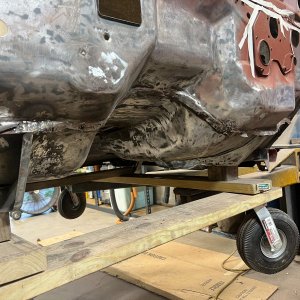
These pictures from the sides show how much up and down motion I have on that back axle on the four link set up. You can see here how far the back axle can drop down if the front axle goes over a curb, and I already know that when the back axle goes over a curb, the tire can rise up to scuff the inside of the fender, about 8 inches, and I never lose traction on the front axle. Just a reminder, the four fenders are mounted directly to the truck frame, and the back axle actually pulls behind the truck on a four link set up that allows free up-and-down motion. I control bounce when it is not loaded with the same rear shocks I have on my Lincoln town cars.

The Road Ranger.  1997 SEMI
 
I went to the driveshaft shop today. They got the two piece driveshaft installed properly to eliminate a vibration.

I was surprised that they just jacked up the truck and got underneath it to pull the driveshaft, no floor lift. When they did it, they put the jack underneath the rear differential, which is on the front rear axle.

These pictures from the sides show how much up and down motion I have on that back axle on the four link set up. You can see here how far the back axle can drop down if the front axle goes over a curb, and I already know that when the back axle goes over a curb, the tire can rise up to scuff the inside of the fender, about 8 inches, and I never lose traction on the front axle. Just a reminder, the four fenders are mounted directly to the truck frame, and the back axle actually pulls behind the truck on a four link set up that allows free up-and-down motion. I control bounce when it is not loaded with the same rear shocks I have on my Lincoln town cars.

View attachment 128043View attachment 128044

Now that we know how much articulation that monster has we all fully expect you to put 35s on it and take er to Moab..
 
Now that we know how much articulation that monster has we all fully expect you to put 35s on it and take er to Moab..
We need a bigger laugh emoji.
 
Technical afterthought on the design. On a real fifth wheel stand axle, the fifth wheel is centered between the two rear axles, maybe with a little bit of forward and backward adjustment to balance weight on those two axles.

On the Road Ranger, my “5th wheel” is actually mounted on the top of the four link system, just a little bit in front of the rear axle. So all the weight is primarily on that axle and the two trailer axles,
 
I really haven’t done much with the Road Ranger since last summer, mostly for health reasons. Carlisle Ford Nationals are in a couple weeks, almost 1000 miles for me one way, so the last week or so I’ve been going all around the truck and seeing what I need to address or upgrade. I’m hoping to avoid an all night affair like the last two times I drove up. Here’s the list so far.

Priority “have to” items:

I had a tiny antifreeze leak that I couldn’t find for the last six months. The new brunette is about 45 minutes away, over an hour during rush-hour, and now that the temperature has warmed up, I looked under the hood when I got there, and I found the leak. A pinhole on a heater hose. That’s already fixed.

I measured all the geometry I could think of when I fabricated the fifth wheel, and then the trailer tongue, but in use, when I first went up north, part of the trailer tongue assembly could still scratch the top of the back fenders of the truck. I redid that tongue assembly when I got back two years ago, but now I have a scuff right above the tail lights on either side of the fifth wheel opening. I’ve modified a few things, it barely touches now when I go over some kind of hump on an angle, but I think I’m going to use the cut off wheel and just trim about a quarter inch off the tongue brackets where they contact the Aluminum light housings. I’ve got a couple of options to modify the light housings if that doesn’t solve it. Remember the “light housings” are really the corners of a cross bed toolbox that I cut out and flipped over.

The next priority is the spare tire on the truck (235/75/15 ), and one of the two spare tires for the trailer (185/65/14). Slow leaks. The truck spare is obviously placed high and very exposed. The one I have looks like it’s brand new, except it’s got some cracks in the side. So it’s got to go, but I want a good looking tired because of its location. I have two in the tire pile I will dig out, but if they’re not good enough and pretty enough, I’m going to go salvage one somewhere.

I have the spare trailer tires on OEM Ranger spare tire carriers that I mounted sideways on each side of the trailer up by the front legs. One has a slow leak. I’m either going to figure it out and seal it for good, or just swap it with one of the six or seven replacements I already have for other projects planned.

“Want to” items.

I’d like the CB to be working much better. The two pretty antennas I first put on interfered with each other, too close together, so I added a third one in the middle on a separate cable to the back of the radio. After doing some homework, it appears that I could disconnect one of the duel antennas and just work off one of them. So I took the third antenna off, disconnected the passenger side antenna, and tried the CB on the driver side only.

It gets out, and I can receive, but not like it’s supposed to. At this point, I suspect it may be the radio itself. It’s a 90’s vintage period-correct cobra 29 LTD. I have two other cobra 29 LTD radios, so I’m going to bench test them in the garage, but basically swap them and try them for a week and see if any one performs much better than another. I also have a 148 SSB, but I would have to modify the mount since it’s about a half inch wider, and then I have a pile of small CBs, but I really want the look of that 29 LTD in the truck. I don’t know if I’ll have time before nationals, but if none of them are working properly, I may send a couple out for repair, or I know I can buy a brand new one for about $115 when they have them on sale.

I have everything I need to install trailer brakes on the two trailer axles, and to install brakes on the tag axle on the truck. Rolling it all around in my head for the last couple/three years, I’ve realized I probably have a better than average jackknife possibility. When I removed the bed from the truck, that took a lot of weight off the drive axle, and the way I have the tag axle, it is not supporting the truck at all. Without having brakes on the trailer, to drag it back behind the truck, if I went into a turn and hit the brakes hard, the trailer would probably push me in a jackknife in a heartbeat. I don’t think it’s a serious issue if I don’t have the trailer loaded, if I just drive carefully. It is one of my top priorities, just probably won’t be done before Carlisle. Personally, I think brakes are just a crutch 😂

I’ve never been able to get my low intensity strobes working properly on the trailer. I have them all the way down both sides and across the back. I’m suspecting I may just have too many lights, that the controller might be too lightweight, without the power to run them all. If time allows, I am going to rewire them (they are very accessible), and if that doesn’t work, I have to find a more heavy duty driver. probably won’t get done before National’s.
 
Almost a year since my last update. Things have been slow with the bad nerve in my elbow, the surgery, and then all the physical therapy. I bought a bunch of parts while I was sitting around.

I bought a cheap tiny 300 psi compressor. All I originally wanted to use it for was to pressure up the little air tank on the outside behind the cab, next to the toolbox, that looks like a semi fuel tank. I have a long hose to plug in there that will fill up any tire on the truck or on the step trailer.

I was going to permanently mount it in the toolbox originally, so I had already put a switch in the overhead console in the cab above the CB, and ran a wire back to the toolbox. Now, when I got around to actually doing it, I wanted it mounted to do that task, but I also wanted it portable in case I needed to use it somewhere else.

I cut a small piece of diamond plate, slotted it for the compressor to slide into it, and folded up the two sides of the slot. Then I bolted it through the top of the toolbox. I had to splice the hose to make it long enough to reach the air tank, but I decided to just set it up with alligator clips that clamp on that second battery.

IMG_6420.jpeg


I also made a little ear on the bottom so I could coil up the air hose and the electric cable when I wasn’t using it. It’s placed so it folds down in the hole between the battery and the outside of the toolbox. The alligator clips are on a two prong mirror plug like you get on a battery charger, so I can use those clips for other things.

IMG_6423.jpeg
IMG_6421.jpeg


Item two: With my advancing age, my night vision is deteriorating. When I went back-and-forth to the Carlisle Nationals and a few other long trips, if it was hilly or curvy or foggy, I had trouble seeing ahead at speed, so I wanted some powerful low level driving/fog lights.

I bought a replacement valance that holds fog/driving lights a while back. I’ve had some halogen fog/driving lights for 30 or 40 years. The diameter of the holes in the valance were exactly the diameter of the amber lens, but the screws that held the lens on on the top and on the bottom wouldn’t fit. So I notched the two holes, and then you almost had to force the lights into them. And you’ll never guess, but I gave it a good coat of semi gloss black rustoleum.

Before
IMG_6402.jpeg
IMG_6404.jpeg


With the bumper off the truck, I removed the old valance and went to install the new valance on the bench. The new valance is open in the middle, so only the three screws on either end lined up with the old valence. When they molded it, it wasn’t exactly perfect, so it was bowing funny in the middle. I had to bolt it into the bumper somehow.

Coincidentally, there were two holes in the bumper, about 3/16”, that lined up with holes in the new valance, at the outside of the wide opening. I drilled the holes a hair larger, and then tapped them with 1/4x28 tap since I had a couple of those bolts. I used some scrap 1/8” diamond plate to make a couple elongated washers/ears (like the load spacers on a rocker arm cover bolt) and it worked like a charm .

While the bumper was still on the bench, I used a short piece of unistrut to make a bracket to hold the fog lights. They had a hinge clamp with a single bolt that went straight up. I used a couple existing bolts in the bumper to mount it to the back of the bumper. I had to slot those holes in the unitstrut to get a little up-and-down motion to get the lights to line up correctly. I put the existing bolts back in the bumper with a washer that was cut down on one side.

I couldn’t put the bumper back on the truck my feeble self, laying on my back, without knocking my teeth out, so big thanks to @Peter_'86_2.9L_Auto who came by for an hour and just helped me hang it on the four bolts on Sunday. Tonight, I leveled it up and bolted it tight.

I pre-wired the lights on the bench and left a long lead to wire them into the truck once it was mounted. Since I didn’t use the lead from the overhead console I put in for the air compressor, I’m going to use that switch and wire to run to a relay to work these fog/driving lights. I did just push the wire down in the hot battery terminal just to make sure they were working. When I finish the wiring, I’ll set a time that all you guys could look south, and I’ll flick them on and off. They’re pretty cotton pickin’ bright!!

IMG_6459.jpeg


I’ll post better pictures tomorrow.
 
Last edited:
Now that I finally got it it running right, after it sitting for seven or eight months, a lot of the tasks have been routine maintenance and all the tuneup stuff was done while I was trying to figure out why it had a miss under a load. Soooo, it’s been running great for about a week, and today the check engine light came on. 😤😤😤. I’ll reset it in the morning and see if it comes on again, and if so, I’ll head up to AutoZone to plug it in and find out what it’s unhappy about now. The good news is it is running like a top again.

I was having some weird problems with some of my strobe lights, and the airhorns, and I realized that the marine battery I have in the toolbox was under charged. Both batteries got very weak when the truck was sitting around, and I put a charger on the front with the two of them connected, but I don’t think it ever charged up the second marine battery. I had that battery on its own charger today with the two disconnected from each other, and everything started right. I’m not sure if that old battery is dying, but I’ll get a new one if it is. One concern is that I have one of the automatic cut offs in the circuit between the two batteries, so if the truck isn’t running, and I’m using the accessories, the second battery will automatically cut off from the truck battery so the truck will always start. It’s supposed to automatically reconnect when the alternator comes on, but I think it works so it won’t kick in and start charging the second battery until the front battery is fully charged, and I haven’t driven it long enough for everything to get charged. So starting tomorrow, I’ll have a full charge on both batteries when I head out, and I will monitor them as I go.

So now that I put a couple hundred miles on it, I just cleaned up some sloppy work I had done before with the wiring, and the wiring to the new driving lamps/fog lamps now that I have them focused in.

Since I first built it, I could only find one 20 amp circuit in the power box under the hood from the ignition, and I’m wiring several things off that. I tapped it from the hot side, and then put in-line fuses to the various contraptions I attached, but I was never happy with that. So today, I ran a hot wire from the battery through a relay to feed those various contraptions, and that relay is tripped on from that circuit that came from the 20 amp power box fuse. I have a similar set up on the twin air compressors for the train horns, and for the halogen fog/running lights I just put in. I used illuminated 20 amp and 30 amp switches in my overhead panel, but I think I’m going to add a couple more relays just for safety and reliability, although I’ve never had a problem.

One of the things I’ve done with my trailer lighting is to put a couple of indicator lights on the front corners of the hood for the turn signals and for the brake lights that are actually fed from the circuit to the trailer, which I keep fused. When the trailer lights aren’t working, the lights on the hood won’t work.

Back in the day, I’d pick up the top of the hood indicator lights off the Mopar cars. They were relatively rectangle in shape, and kind of went with anything, good looking pieces that were held in place with one screw from above. There was a little plastic housing under the cap that held an amber light with one wire, the housing being the ground. I used to pick them up for $.50 or a dollar apiece by the dozen. The last two pair I found, which was a few years ago, they wanted over $100. So no more more mopar lights!

On my Towncars, there is a vinyl trim piece that goes across the back top of the roof on the signature series cars that have the full length canvas or vinyl roofs. The end of that vinyl molding is held in place with a pointy solid piece of stainless with a screw through the top, very similar to those Mopar lights. So I picked up a few from the pull apart when they had them.

The Road Ranger.  1997 SEMI


I have a drawer full of raw LED lights with leads on them. I picked out two Amber indicator lights that are probably 3/16 of an inch in diameter, and two red lights that are maybe 1/4 inch in diameter. I took a piece of fungible but firm, dense foam, cut and trimmed to fit under that stainless cap, and then used a little stone grinder on my Dremel to carve out holes for the two LEDs. I made them a mirror image, so the brake lights are on the inside side, and the turn signals are on the outside side. I put it all together with some E 6000, I clamped them between a paint star stick, and the tabletop to let the glue dry Then I used some black gasket maker to blackout the open side that holds the two bulbs. It actually came out pretty nice, and I put those on today.

The Road Ranger.  1997 SEMI


& They’re working great!

Next, I used a couple of small pry bars and a paintbrush with most of the bristles cut off to pry down the Rolls-Royce tire and insert a little black RTV inside where the bead sits. Then I dipped the brush in mineral spirits and worked it around. I did it on both sides, where the beads sit, since half of it was weeping leaking, so I just did it all. It held 35 psi in the sun until I came in a couple hours ago, so I’m keeping my fingers crossed. I’ve done it before.

I’m totally frustrated with the CB radios, but there’s a method to the madness to rework the antennas. When I mounted the spare tire high on the passenger side, it blocks the view of the side of the long trailer when I’m just cruising down the road. Flip out/wider mirrors have been on the want list for a couple years.

I had a couple of flip over & out mirrors from a 70s Chevy, but that three-point bracket wouldn’t work on the 97. I looked at the ‘87 mirrors, and just swapping the heads, but the ‘87 bracket didn’t reach out far enough. I looked at other year brackets, and nothing would work.

I finally stumbled up on some early/mid 90’s full size Ford truck mirrors (like my ‘96 F250) on a similar bracket to the ‘87, that reached out about 4 more inches. The Chevy flip over and flip out heads worked in exactly the right place. With the mirror folded in, the arm is only about three or 4 inches wider, the widest spot on the truck. I haven’t hooked up the trailer yet, but I’m positive when they’re flipped out, I’ll have no problem seeing the trailer behind me. Btw, the Chevy heads are made out of fixed stainless steel rod that’s been drilled and tapped, and the sheet metal around the head is twice as strong as any of the new stuff you can buy, virtually bulletproof Now I have to get some bubble blind spot mirrors that will rise to my cool factor. I’m going back-and-forth between an oval mirror that will take up part of the full-size mirror, just a 3 inch round bubble, or maybe an independent Blindspot mirror on its own little bracket. I just have to get used to these to them figure out where I might put those.

Right now, I’ve got a lot of mirrors!

The Road Ranger.  1997 SEMI


For the old mirrors, at first, I’m just going to take the mirror heads off. I’ve been toying with the idea of running 3 or 4 foot CB antennas on those mirror brackets, but I think it would be awkward. It’s worth a quick try just to get a visual. I’m probably just going to cut off the part that extends out, and plastic weld or fiberglass a good looking modification, maybe something that holds a small “Ford trucks” look logo or something like that. Haven’t got that far yet.

For the antennas, my realistic thinking is to simply move the custom antenna brackets from under the back window to high on the side of the truck at the back of the cab, with the overhead radio broadcasting off one, and the backup radio broadcasting off the second. I’d use three or 4 foot antennas. They wouldn’t be used at the same time obviously. But I’m definitely going to have working radios by the time I go to the Ford nationals!

So those antennas of the next step after I remove the mirror heads, and then I’m gonna shift my efforts to clean up and improve the step trailer.
 
I like how you did the indicators. I've been toying with some ideas to do the same thing. And my initial thought was stealing the indicators from dodges. But you kind of ruined that for me. I didn't realize that LEDs that small were available. I bought a bunch that fit a 3/4" hole and was planning on making something out of conduit. I may look for the ends and LEDs you used.
 

Sponsored Ad

TRS Events & Gatherings

Latest posts

Featured Rangers

Want to see your truck here? Share your photos and details in the forum.

TRS Latest Video

Official TRS Merchandise

Follow TRS On Instagram

TRS Ranger Sponsors


Product Suggestions

Back
Top