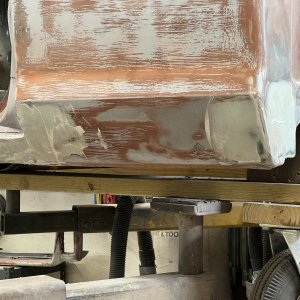
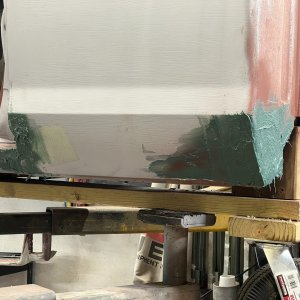
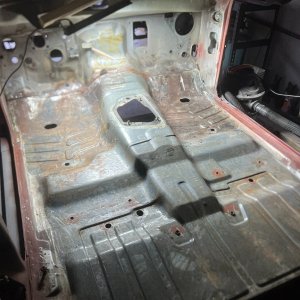
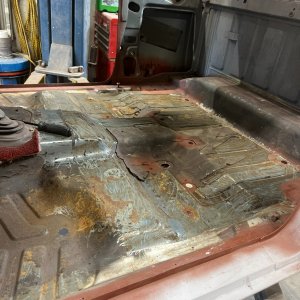
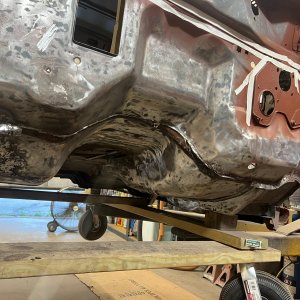
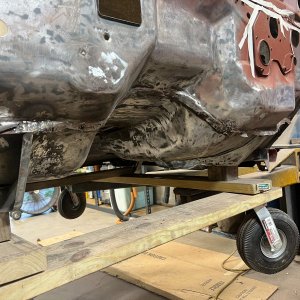
I dealt with water leaks / intrusion / damage in two different campers , a pop-up and a 30' bunkhouse travel trailer.
They are all built like shit with the lowest quality materials you can imagine.
This one looks like it was built like an enclosed cargo trailer. And that is a GOOD thing.
Even if you have to rip the whole floor out, it will be on aluminum farming.
New plywood new vynil done.
Steel framing. The chassis frame is steel, wall frames are aluminum. Hopefully that won't be necessary, but feel much better knowing that it's got metal structure so I don't have to worry about that being rotten. If I do have to replace whole floor, it'll be getting bedliner again like it does now for wear and water resistance properties. I'll have some rugs to roll out over it for walking on.
Same for the walls. Easy AF to add some 2*2 or 2*4 horizontal "braces" between the aluminum studs to create "mounting points" for heavier things, hard foamboard insulation then luan skin. Light and cheap.]
That might happen eventually. I'm thinking that I would like to move the spare tire from the front since it kind of interferes with the galley there. Maybe the inside, maybe the outside over a fender. If I lift it, maybe enough space for it underneath inside the frame rails. I do have idea for hanging a table on the wall, but I think that the existing studs will hold that fine, and it would be partially supported by its own legs. Aside from relocating the spare, I can't think of many heavy things I'd want to mount on the walls. Time and usage will determine how long that lasts.
Expanding spray foam will be your friend.
Only if interior walls come out, and even that'll be iffy. Don't see too many places I'd particularly want to use it for sealing.
The AC where it is is actually a pretty good idea.
Most window units should have a fitting for a drain line.
They make kits to increase airflow behind RV refrigerators that are designed to vent out thru the side of the camper. One of them would probably work well to add negative pressure ventilation to the front storage compartment. All you would have to add (if it's not there already) would be a passive vent / entry point for airflow. A basic residential forced air register with the vents facing down would work. Or a dryer vent installed in reverse (so the flaps open inward when the fans are on and creating that negative pressure).
I'm sure it's got a place to add a drain line, but there isn't one there now. I'll pull it one of these days and investigate, might even go ahead and upgrade it. Considering GA weather and how much I like the AC for sleeping, I wouldn't mind having a slightly overpowered unit.
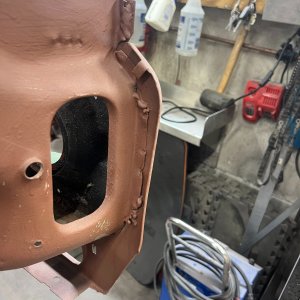
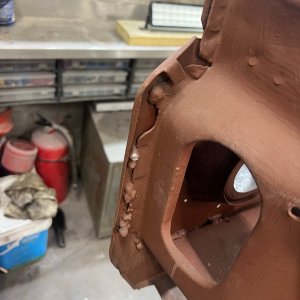
These pics show the AC cabinet better than I can describe. Those fans open out into the space below the trailer. I do need to flip them on and check which direction they are blowing. Outside vented access. Inside the door and the "vent fans". Around the far side of the unit, just to see what was around there.
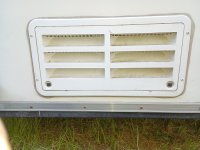
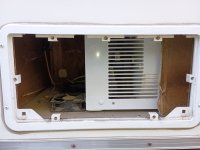
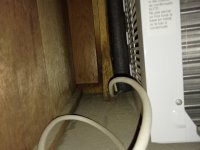
I'm not above creating more ventilation and adding more fans there. Just not sure on the best way to accomplish it.
The shower pan under the sink/galley is a great idea. You could do it even cheaper by using the ones that people place underneath washing machines.
Yeah, I was just saying something like a shower pan. Any sort of drip pan will work if it will fit. I'm not afraid of making one custom for the area. Biggest slowdown to making one is I don't currently weld, and I'd rather weld the corners than rivet and seal. I do have access to a welder, and don't mind buying an aluminum spool gun. Also have a few contacts that may be able to handle that part.
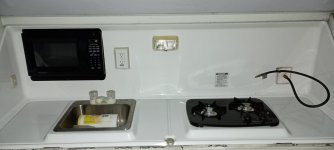
There's also the issue of getting a large enough pan into that area. Turns out that the galley is not a separate panel like I thought. That whole angled front portion is one big fiberglass panel with the hatch mounted to it. If I want to remove the galley for access, the whole panel has to come out. Other way to go would be removing the interior wall in the front. Not looking forward to doing that either. Fortunately if I fix those two potential leak points, I don;t think I'll need to worry about it for quite a while.
For the sleeping area it would be very easy to make a "side folding" Murphy bed attached to the side wall of the box. It could be up and out of the way when you had the ramp/tailgate down, then dropped down when you close up for the night.
That is a consideration. For now, at least the first several outings, it'll probably just be a cot.
What does it have for power? Is it standard 30amp RV?
Lithium Ion batteries and solar are cool ideas but not NECESSARY.
RV 30 amp. Adapter to run off standard 15 amp 110 outlet. 12v battery, allegedly new, but I haven't checked size or date yet. Standard 15 amp 110v is enough to run AC or microwave, likely not both. Several 110 outlets around, not sure if I could run anything on them with the AC running when on 15amp, probably need to test it with a fan. Everything else is 12v.
Completely unnecessary. Lithium is lighter weight for same energy density. They are better about being deeply drained. They have stead output over discharge cycle. They have a longer lifespan. When I need to replace the lead acid battery, it makes sense to replace with a lithium.
No a bettery bank and solar are not necessary. It would be nice if I could possibly run the microwave off of battery power, and have solar for recharge. No running a generator and disturbing the peace. Granted it would only work out during the cooler months when AC wasn't needed. It also isn't worth trading a lot of cargo capacity to gain solar power or battery bank. Much carry a quiet inverter generator in the bed of the truck than give up the cargo capacity.
I would definitely add a standard RV roof vent fan with a cover.
Not going to happen. At least not for the forseable future. The roof is allegedly only a few years old and has no penetrations to leak. I'm not about to create any. If I ever have to pull the ceiling or roof and find bracing for a roof mount, I might consider it. Until then, not happening.
That said, I'm not above replacing the escape window with a vented window. Given the size of this thing there isn't too much worry about not being able to get out of the door. There's not going to be any one in it while traveling to worry about rollovers.
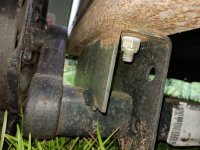
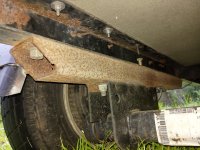
Can't tell much about the axle, but if it were me, since I can't weld...
I'd cut the whole feckin' thing off, buy a complete bolt-awn 3500# utility trailer axle kit and be done with it.
Can't weld yet, but have welder and supplies.
You'd be hard pressed to find an axle on the shelf with the proper spacing for this trailer. I've got the specs ofr the ordered axle, and just the spring spacing makes it a custom order. I'm not certain if the hub spacing is correct, or will be correct for lasrger tires.
Keep going back to timbren axle-less. In adition to the shock absorption proprties, the measurements arent as critical. There really aren't any measurement other than locating them. Basically aligh new spindle locatyion with old spindle location, ensure square, drill holes and bolt units to frame. Wheel mounting surface is automatically located. Since there isn't a strong crossmember on this frame where they will mount, run a square tube between the sides, it bolts in. Locate and mount fenders to clear tires, going to have to do that anyway.


 Where in Georgia are you? I thought you were in VA. That trailer was likely built to fit in that guy's garage, hence the butchered torsion axle. I honestly think you could, and should, do it better. Hard foam insulation. LED lighting. Alumacorr wall panels over birch ply. Redesigned passthrough kitchen with common drain. It could be nice.