Question for Those of You Running Wheel Spacers.


We've all been in the time and money crunch before.

I've seen wheel spacers come undone and it's never pretty. I just don't like the additional points of failure.

I'd suggest getting wheels (even used) that have a 3.75 back space. That's really the aftermarket industry standard for aftermarket Ranger wheels. So an 8 inch wide wheel with 3.75 inch back space will get you 1 3/4 inch wider per side... 3 1/2 inches overall.

It won't fix the staggering front to rear... but i live with it. I just don't trust spacers enough to use them.

I know it doesn't answer your question... but if you "NEED" width to match... just putting them on the rear is better to me then running them on all four corners.
Yeah... Life is expensive and takes time!

I actually ran 2" front and rear on my 06 Z71 Suburban, I was running 35x12.50's on OE 2012 Silverado 18" wheels and needed to push the fronts outward to clear the aftermarket control arms...
 
I think I am going to pull the trigger on 2" rears, seeing how it looks when I get everything back together and if it looks awkward or just "off" I'll order a set of 1" for the front.
 
I have question. How would wheel spacers put any more stress on a wheel bearing, then a 0 offset wheel? Both move the center of gravity outwards. As an electrician. The math seems the same to me.

It doesn't create more stress, it moves where the stress is centered. So, if a set of bearings in a factory setup is right in between the two bearings and a spacer is used, it moves the stress point toward the outer bearing, causing it to handle more of the load and the road forces on the bearings will be different. Think of a lever and moving the fulcrum/pivot point. A teeter totter, the forces are equal as long as the weight is equal on each end. Move the pivot point, and one side is going to have a longer lever arm and generate more force than the short side will with the weight being the same on each side.

Then throw in bearing sets where the inner is bigger than the outer, or pressed in sealed ball bearing sets. It gets even more complicated.

The bearing set in both my hubs have handled the spacers for years just fine. So, my comments are not a bash on them. Only a caution that there can be a problem.
 
I think I am going to pull the trigger on 2" rears, seeing how it looks when I get everything back together and if it looks awkward or just "off" I'll order a set of 1" for the front.
Bumping my own old thread...

Slight change of plans.

I scored a set of Jeep "Gambler" wheels with nearly brand new 31*10*15 MT's on them.

I don't need MT's by any stretch of the imagination, but I'm not buying another set of tires...

From what I have read, the Gamblers need a spacer to keep them from rubbing on the LCA's and shocks.

So I ordered a set of (4) 2" from Titan.

I'mma put it all together but NOT Loc-Tite the front ones until I get an idea how it looks. If it looks goofy, I'll see if 1.25" or 1.5" will give me the clearance I need...

...then throw the extra pair 2" up here for sale. 🤷‍♂️

Question for Those of You Running Wheel Spacers.
 
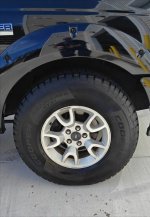
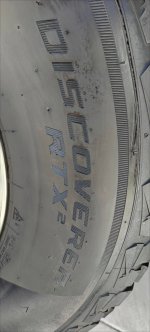
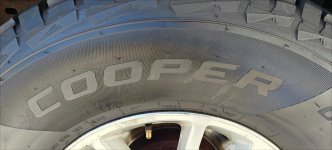
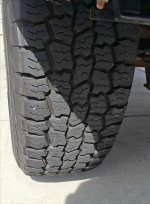
FWIW, my OE stock 16's wearing 265/75 Cooper Discoverer RTX 2's with about 10,000 miles on them will be for sale soon...
 

Attachments

  • Question for Those of You Running Wheel Spacers.
    IMG_20260329_153811.jpg
    150.5 KB · Views: 3
  • Question for Those of You Running Wheel Spacers.
    IMG_20260329_154207.jpg
    107.9 KB · Views: 3
  • Question for Those of You Running Wheel Spacers.
    IMG_20260329_154312.jpg
    163.1 KB · Views: 3
  • Question for Those of You Running Wheel Spacers.
    IMG_20260329_154647.jpg
    163.1 KB · Views: 3
I ran those wheels on my '00 Explorer with 5mm spacers up front and they self clearanced a touch (mostly on the one day I drove it to work without them) but I put almost 50k miles on them that way... have to use stick on weights for balance but worked for me... I didn't want to run spacers unless I needed them and went with the bare minimum...
 
On mine, I run 7 inch wide front rims and 8.5 inch rear rims. They are zero offset rims, so the rears, with wider tires on them, look perfect in the fenders. This is a street truck though. Rims are Cragar Magmaster slotted mags made in 1974. Old School hot rod rims.
 
FWIW, my OE stock 16's wearing 265/75 Cooper Discoverer RTX 2's with about 10,000 miles on them will be for sale soon...
Man if you were closer or I had the green Ranger done I’d be interested in talking about those rims and tires, lol
 
I have question. How would wheel spacers put any more stress on a wheel bearing, then a 0 offset wheel? Both move the center of gravity outwards. As an electrician. The math seems the same to me.

The previous answers to this question have been less than complete, and this is an important question for several reasons.

The short answer: If you put Mustang wheels on the vehicle and add spacers/adapters to allow for the difference in offset such that the center of the tire is at the same location as the stock setup, then there is no change to the loading on the bearings or other suspension components (unless the combined weight of the tire/wheel is significantly different from the stock setup.)
However, if you keep the stock wheels and add spacers such that the center of the tire moves outboard by whatever the thickness of the spacer is, then you can make a very significant difference in the loading of the bearings, spindle, and other suspension components.

The details: The bearings on the front spindles on these trucks are only 2-3" apart - on the 4x4 about 2" and not much more on the rwd. With the center of the tire midway between these bearings in the stock setup the weight of that corner of the truck (~1500-2000 lbs ballpark depending on who is in the cab) is shared between those bearings as you are driving straight down the road. If you put a 1" spacer on a 4x4 or a 1.5" spacer on the rwd truck, that loading is now all on the outer bearing and the inner bearing is just along for the ride. If you put a 2" spacer on a 4x4 truck (or a wheel that moves the tire out 2") then you have the load outside of the outer bearing and that multiplies the load carried by the outer bearing and makes the inner bearing actually carry a load in the opposite direction.
When cornering, there is also a sideways (lateral) load from the tire reacting the force of the truck wanting to continue straight - Newton's first law of motion. Depending on the speed and tightness of the corner, the lateral load can be very significant, and because it is applied as a moment trying to push the bottom of the tire in or out, it can multiply the bearing load by factors of over 10. Also, as you move the tire out, you increase the loading on the ball joints as the leverage is longer - so moving the tires outboard is harder on the ball joints and suspension bushings and arms.

There is a 2nd consideration here that is also important. The stock setup puts the center of the tire in line with the kingpin. (Now I know these trucks don't have kingpins, but the angle of the line between the upper ball joint and lower ball joint is called the kingpin inclination for a reason.) When the vehicle is set up with the center of the tire contact patch on the kingpin line, then the vehicle handles predictably over bumps and ruts in the road. If you move the tire outboard by 2", then the center of the tire contact patch is now outside of the kingpin line by a couple of inches. This makes the vehicle bump steer significantly more and also makes it wander on rutted roads to a significant degree. For an off-road vehicle which is generally operated at lower speeds on crappy roads, this is not a big issue, but for a highway vehicle it makes the vehicle more tiring to drive and requires a lot more attention to keep it pointed in the right direction and to keep the shiny side up. When you also put taller tires on the vehicle, it gets more interesting because now you need to move the tire outboard to keep that tire contact patch in line with the kingpin line. Conversely, if you put shorter tires on, you would need to move the tires inboard.

In my personal experience, if you change things around but keep the tire contact patch within about a half an inch either way from the stock location, then the vehicle still performs pretty much the same in terms of bump steer and road ruts, but if you get much more than that, it gets difficult to drive on poor quality roads (of which there seems to be an abundance...)

On my 01, I have Cobra replica wheels and 1.5" adapters (hubcentric and with the adapter nuts blue loctited on) and this puts the tire centerline slightly inboard of the stock location. I tried 2" adapters, but found that it allowed the tires to rub on the fenders in sharp turns so I went back to the 1.5" thickness. I liked the look better with 2" adapters, but I was not willing to deal with the rubbing. (I have 17x9 wheels and 265/65-17 tires.) It drives fine either way.

Hope these details help make it all make sense.

 

Sponsored Ad

TRS Events & Gatherings

Featured Rangers

Want to see your truck here? Share your photos and details in the forum.

TRS Latest Video

Official TRS Merchandise

Follow TRS On Instagram

TRS Ranger Sponsors


Product Suggestions

Back
Top