Wish I had come upon this thread a little sooner... There's a lot of speculating here
I had seen someone here mention before that they don't use the races that come in a new brake rotor, they use the races that come with the new bearings.
Correct.
This is a big part of why (if not the whole why itself) we see the number of problems we do on the D35... Brake manufacturers putting bearing races into their rotors (usually cheap chinese races too), but not providing any matching cones to go with them (and so has nothing to do with the actual spacing of the bearings).
Obviously this prompts people to source (unmatched) cones from someplace else, and well... We wind up here (and you can't blame the end users either... It's perfectly normal for one to assume since it's there, "it must be ok to use").
I always try to tell people to replace that race with one from a Timken or other quality brand bearing set.
In 35 years (where have they all gone?? lol) of working on these for myself and for friends, we've had exactly one bearing failure among us... It was a friend's rig about 8 months after he decided to take it upon himself to go have brake work done at a shop (brake rotors replaced, new pads, etc.). When I took things apart, sure as shit, the races said "CHINA" and the cones said "U.S.A.".
We put Timken SET-37s on both sides and no issues since (this was maybe 15 years ago).
All of our rigs are on 33-35" tires too.
So yes it is very possible to have the axle be reliable in its stock config, but you can't let the rotor manufacturers sabotage you.
Used to be common knowledge not to mix these parts... (that was one of the first things my granddad told me when I was barely a teenager working on my ATC-70) Apparently that has all gone out the window with the D35 (or maybe was it the D28?).
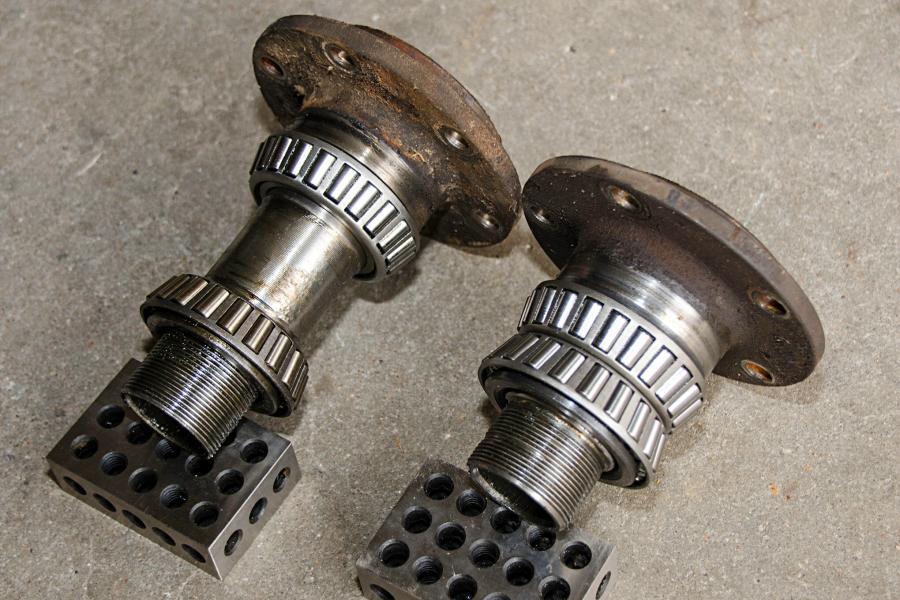
This picture is misleading (and a little annoying):
I don't know who took the pic or where it came from, but I know that it has been floating around on here and on the 'net for awhile...
That is completely NOT how the bearings are on the D35 (yes, they are closer than on a D44, but they absolutely are not right up against each other like that, they are separated by about ⅜").
If I had both a D35 and D44 spindle & some bearings on hand that were loose, I'd take a more-accurate picture, but unfortunately I have neither available at the moment.

But again the spacing is not the primary issue here.
On some of the comments about other stuff:
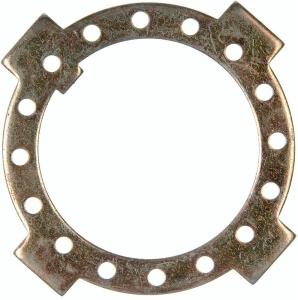
Locknuts and the washer (manual hub setup):
Lately I've been laying a small bit of weld on the inside edge of the lock ring opposite of the tab, then shaping smooth with a Dremel or similar tool.
Aftermarket washers (all that we have today I think) don't fit as tightly around the spindle as the OEM ones did 30 years ago. A little bit of weld tightens up the fit, forcing the tab to rest further down into the groove so that it can't ride up out of the groove as easily and damage the spindle threads (I always put the weld opposite the tab so as not to ruin the temper of the metal on the tab itself).
Then tighten the outer nut to 225ft-lbs (75 above book spec).
Water contamination:
I try to fill the entire bearing cavity with as much grease as I can when I grease them. Obviously the locking hub itself can't be packed full, but I try to fill as much void as I can. This seems to at least reduce (if not completely stop) water from getting in.
This happens because it is a sealed cavity (and can similarly happen to cartridge (D30 or SLA IFS) bearings too).
When the warm hub (from brake heat) gets dunked into water, the sudden cooling creates a vacuum inside the air space within, and that is what sucks water in past the seals.
The most common seal to be breached by water seems to be the axle shaft seal at the back of the spindle, but others such as the wheel bearing seal itself can allow water in as well.
Beyond packing as much grease in as you can, there's not really much else you can do (I don't see any good practical ways to vent that space to the atmosphere with a breather hose).