INFO Dana 35 TTB vs Wheel Bearings


Jim Oaks

Just some guy with a website

Founder / Site Owner
Administrator
💻 TRS Socials
Article Contributor
TRS Event Participant
TRS 20th Anniversary
TRS 25th Anniversary
VAGABOND
TRS Banner 2010-2011
TRS Banner 2012-2015
GMRS Radio License
Joined
Aug 2, 2000
Messages
15,835
Points
7,601
Age
58
City
Nocona
State - Country
TX - USA
Other
2005 Jaguar XJ8
Vehicle Year
2021
Vehicle
Ford Ranger
Drive
4WD
Engine
2.3 EcoBoost
Transmission
Automatic
Total Lift
3.5-inches
Tire Size
295/70/17
I'm trying to gather real world feedback versus online gossip, rumors, and hearsay.

I think the Dana 35 TTB and Dana 44 TTB are good axles, but what sets the Dana 44 apart isn't necessarily the ring gear size but the wheel bearing spacing.

I'm curious to know what your experience has been with the Dana 35 TTB and wheel bearings. I personally had a right front wheel bearing go bad driving on the interstate and had to change it in the parking lot of a parts store. At the time I was doing about 65 MPH on 33-inch tires. This may have resulted from a lack of maintenance. But then, is it normal for a wheel bearing to need so much maintenance?

Have you not had any problems with them and if so, what size tires are you using?

Does it seem like they're a constant wear item that you have to replace, and if so, what size tires are you using and what kind of highway speeds do they see?

Have you had one fail while driving, and again, what size tire are you using and what kind of speeds do they see?

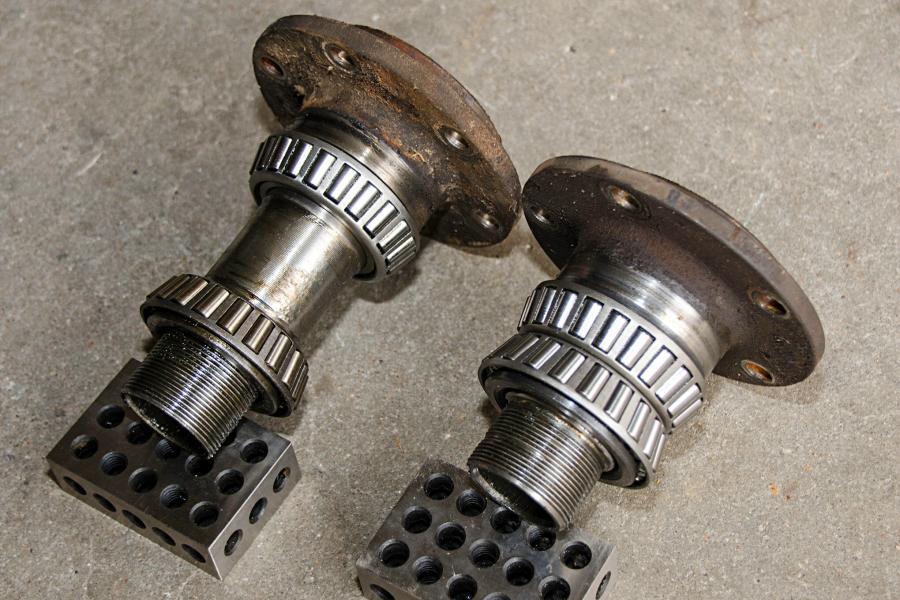
Below is a photo of a Dana 44 spindle (left) and Dana 35 spindle (right) for those that aren't familiar with the difference in wheel bearing spacing.
Dana 35 TTB vs Wheel Bearings
 
I run the D35. For it's originally intended use and loading, I think it's fine. I have been using 35" BFGs on it for 10 years, roughly. Currently, my front axle is carrying in excess of 2500lbs continuously. In my experience, I have replaced very few wheel bearings, considering what I do with the truck, maybe 2 full replacements other than brake rotor replacements, at most. I think that is a good record.

What I HAVE noticed, is that after re-assembly for any reason, I need to do 2 things. 1. I run the preload torque just a tiny bit high due to the larger tires. I use 20-22in-lbs instead of 17in-lbs. 2. After driving 100-200 miles, I re-check the preload. Several times, I have found that it has loosened up. That indicates that the bearings have moved "settled in" so-to-speak. I do the same procedure evry time and have been doing it for many years. But sometimes, you just don't get the outer races perfectly seated on the first go-around. Always double check after druving a bit.

Is that photo new? Or has it been on the site forever? I knew the D44 had wider bearing spacing. But I don't recall seeing that image showing the difference. Could just be poor memory. That makes the advantage incredibly obvious to anyone who understands bearings and mechanical design. That is more difference than I thought it was. I have often thought about swapping to the D44 spindles and outer assemblies or complete D44 axle assemblies. But, since my experience with the D35 has been so good, I just haven't thought it worth the trouble. It is in the back of my mind that after my V8 swap, I will need to re-evaluate front suspension and maybe upgrade the axle in some way.

But, overall, I have been very happy with the D35.
 
Last edited:
I have mixed feelings about the D-35. After shattering an axle shaft in it on 35” tires with no locker that is. Of course, now I’m aware there was a mechanical interference that likely was the culprit but it still left me contemplating options. The last like two years have been the most I’ve driven the Choptop with the 35” tires and D-35 since I originally got the truck and worked my way up to that configuration.

I did find a bad bearing and race when I last overhauled the front axle but it looked more like a possible part defect that I only noticed when I cleaned the grease off things rather than a wear issue. No other issues noted.

My 92 Ranger had 30” tires and the D-35. For the like two years I ran it before someone decided to hit me I didn’t have any issues with the bearings in the front.

I’ve had more issues with bearings in the rear axles and the unit bearings on the front of the 98-11 trucks than the D-35. Didn’t really have any problems with the bearings in the D-28, I had far more trouble with the U-joints and spindly shafts with those.
 
I thought half the problems were down to
  • Inner ring way too tight (didn't actually check rotational preload)
  • Outer ring too loose (backs off doing truck stuff)
But those shouldn't be unique to the D35 vs other spindles, so maybe not.
 
I thought half the problems were down to
  • Inner ring way too tight (didn't actually check rotational preload)
  • Outer ring too loose (backs off doing truck stuff)
But those shouldn't be unique to the D35 vs other spindles, so maybe not.
I've seen many people have those issues. Those are both human error issues and not really design problems. Neither will happen if installed properly. I guess you could say the axle is particular about being assembled properly. But, isn't that true of almost any machine?
 
I have been towed from the woods from a squeaking bearing on my D35 with 35" tires before and changed my share of bearings in the 16 years I've been running it but for the most part I put that on general neglect... I don't drive the thing more than 1000 miles a year heck the tires are 15 years old and at 50% wear... I don't have the bottom end torque even with 5.13 gears to do rock crawling so I don't and stay off the throttle if the front end is going to be off the air and haven't broken anything yet... With my neutral backspacing on the wheels (or close enough) the bearings seem fine as long as water doesn't get in them...

I imagine the larger spacing between the bearings on the D44 setup would tolerate more schenanigans before getting cranky... On my Explorer I'm going to skip that setup and go to D60 stuff, if I get a wild hare I will still have extra D44 TTB parts I could modify the Ranger one day...
 
I haven't had a problem that wasn't caused by my own stupidity or laziness. (Not changing the inner races in the rotors or using the cheapest wheel bearings I could find.)

I do think the bearings being so close together limits high offset wheels that everybody seems to like these days. I hear of lots of failures of unit bearings on newer full size trucks cause of the same issue. Seems every Facebook reel of someone complaining about shitty wheel bearings has a set of 22" wheels sticking a foot outside the fender.
 
I know @Shran had a problem with one on his Explorer during a trip not that long ago.

I had seen someone here mention before that they don't use the races that come in a new brake rotor, they use the races that come with the new bearings.

I have a set of AVM Extreme hubs for my Dana 35 and I have no doubt the hubs and shafts will hold up to a 33" to 35" tire just fine.

I also have a Dana 44 TTB that I could use for a knuckle / hub swap for the better bearing spacing, but that would require changing the wheels and using rear wheel adapters just to get better wheel bearing spacing. Is it really worth it? I'd also need new hubs because the D44 still has auto hubs.
I'm in a unique situation because the speed limit on every road in and out of where I live is 75 MPH. If I'm going to Home Depot or Lowes, it's 30-minutes to an hour depending on which one I go to and pretty much 75 MPH the whole way there. Actually, anywhere I go if I leave town is 75 MPH for 30-90 minutes. In Ohio, it was a 55 MPH drive. I would say that 75 MPH puts more strain on a wheel bearing than 55 MPH does. And yes, I realize that both axles use the same bearings.

I've heard people say that their Dana 35 TTB likes to eat wheel bearings or that they don't like larger tires. But how much truth is there to any of it? How much is a mechanical design flaw, and how much is poor maintenance? Did the bearing fail because of poor spacing, or because it had been exposed to mud and water and not cleaned and re-greased?

Last fall @Curious Hound drove his Ranger from South Carolina to Colorado and back loaded down with camping gear and I don't recall him having any wear issues with his front bearings. I don't know if he's checked them since then.

I know @BlackBII created a Lock Nut Mod to keep his outer wheel bearing from coming loose. @Curious Hound mentioned having to retighten his after 100 miles. Is the problem with Dana 35 locknuts the spacing, or the fact that the locknuts come loose? Is the spacing playing a role in the lock nut coming loose?

If I Do a Search On Bearing Spacing I Get:

The spacing between the inner and outer wheel bearings, often referred to as the bearing spread, is a critical design factor that determines how effectively a hub can handle the leverage (moments) exerted by the wheel.

Load Distribution and Leverage
  • Moment Reaction: A wider spread creates a larger "moment arm," which significantly reduces the reactive load each bearing must carry to counter the same wheel force.
  • Lateral Stability: Greater spacing minimizes the "slack" or angle of play at the wheel's edge, leading to better steering control and reduced vibration.
  • Offset Impact: If the wheel's centerline is far from the bearing's center, it creates a heavy cantilever effect; narrow bearing spacing under these conditions leads to rapid fatigue and early failure.
Longevity and Failure Factors
  • Reduced Stress: Increasing the distance between bearings effectively lowers the torsional and radial stress on the rolling elements, extending the Standard Service Life of roughly 75,000 to 150,000 miles.
  • Alignment Retention: Proper spacing ensures that the inner and outer races stay aligned; if bearings are too close (pressed together), they may suffer from "slop," leading to uneven contact patterns and pitting.
  • Heat Dissipation: A wider spread allows for better heat distribution throughout the hub, preventing the localized overheating that can degrade lubricant and damage seals.
The "Center" Rule: For maximum longevity, the wheel's load should ideally be centered between the two bearings. Using wide wheel spacers or high-offset wheels pulls this load away from the center, increasing the leverage on the bearings and shortening their lifespan.
 
@Curious Hound mentioned having to retighten his after 100 miles. Is the problem with Dana 35 locknuts the spacing, or the fact that the locknuts come loose? Is the spacing playing a role in the lock nut coming loose?
Perhaps I stated it poorly. My locknuts do not get loose. When installing the bearings, especially new races in the rotor, the initial high torque part of the procedure is there in order to make sure the races are firmly seated against the shoulders in the rotor. If, for any reason, they do not get firmly seated during this process, they WILL complete the seating process over the first hundred or 2 hundred miles of use. Then, there will be play in the assembly. The reason I go back and double check is to remove any play that may have come from this process due to me not getting it perfect the first time. Unfortunately, I sometimes err on the loose side when seating the bearings because I have a fear of overtightening and damaging them.

The spacing between the inner and outer wheel bearings, often referred to as the bearing spread, is a critical design factor that determines how effectively a hub can handle the leverage (moments) exerted by the wheel.
This is absolutely the key to why that D44 assembly is so much better for larger tires and heavier use.

The "Center" Rule: For maximum longevity, the wheel's load should ideally be centered between the two bearings. Using wide wheel spacers or high-offset wheels pulls this load away from the center, increasing the leverage on the bearings and shortening their lifespan.
This is paramount to the whole design. It further exemplifies why the wider spacing in the D44 is so important. Wider spacing makes it easier to keep the forces from the wheel centered. It is much more forgiving of wide tires/wheels, wheel spacers, running tire edges up canyon walls, etc.

I would say that 75 MPH puts more strain on a wheel bearing than 55 MPH does.
Speed contributes to heat. Heat breaks down lubricant. Destroyed lubricant causes bearing failure.

One more thing. The locknut assembly is not great. If assembled properly, it should/will not loosen on its own. The weakness that I have seen is in the tabbed washer. 2 points here; 1. If the tiny pin in the washer is gone, it can not seat in a hole in the inner nut and prevent the inner nut from spinning in either direction - loose or tight. The assembly can be properly tightened without this pin. But it is more difficult to do. 2. If the tab is worn or the washer gets stretched out of round (I've experienced this), the tab will not prevent the nuts from turning and becoming loose or tighter. IT IS BEST PRACTICE TO USE A BRAND NEW TABBED WASHER EVERY TIME. ( BUT I don't) The tabbed washer is critical to keeping the nuts from spinning.
 
Last edited:
In the past I've had issues with the inner bearing races eating the rotor to the point that you can just grab them and pull them out. Wheel bearing nuts would stay locked together and locking washer didn't spin. I've remedied this by switching to a higher quality rotor and running a bit more bearing preload.
 
As long as a normal backspacing is used on the wheels and not the current trend of looking completely dumb I'm pretty sure the wheel bearings aren't going to be too short of a lifespan, probably lower life than if at the D44 spacing but for normal use I don't think I would lose sleep about it...
 
I’ve been reluctant to change to the D-44 outers on the Choptop simply because then I have to run adapters or do something else on the rear. Of course, I’m also looking at going to 1-ton axles on the F-150 rebuild which would give me a full set plus of Alcoa alloys and a set of full size axles and no particular plans for them. So, this may get re-visited.
 
It'd bee cool if there was a was a way to run the D44 spindle but keep the stock locking hubs and wheel pattern. I wonder if it would be possible to machine a way to make that happen? It would have to move the wheel mounting surface father out. Would probably end up negating any advantages of the wider spacing. IF you had a custom deeper locking hub, then you might get somewhere...
 

Sponsored Ad

TRS Events & Gatherings

Featured Rangers

Want to see your truck here? Share your photos and details in the forum.

TRS Latest Video

Official TRS Merchandise

Follow TRS On Instagram

TRS Ranger Sponsors


Product Suggestions

Back
Top