- Joined
- Jun 13, 2024
- Messages
- 7
- Points
- 1
- City
- SLC Utah
- Vehicle Year
- 1986
- Engine
- 2.3L
- Transmission
- Manual
I've had issues with this Ranger losing power when trying to accelerate especially up hill. It also would have whitish smoke come from the engine block after running for a little bit, especially after higher RPMs. I ran a set of compression tests too, and cylinder 3 was always showing low. After looking around and reading, I thought I had a head gasket issue, so I decided to tear it down and replace the gasket. I got a kit from RockAuto and started to work two days ago.
Man, getting to the head gasket is hard enough! Plus some of the plastic covers just broke due to how brittle the plastic is. We had a similar issue when we replaced the injectors. I've been taking A LOT of pictures with my phone, using quart plastic bags for bolts, trying to keep track of everything....
First problem I found was that the valve cover gasket was broken right where I've seen the most wetness on the block (just off of cylinder 1). There are even parts of the gasket inside the area.
When I reached the head gasket, though, it seemed pretty solid and was hard to break the seal. However, as can be seen in the attached image, one of the valves on cylinder 3 shows either rust of burn. I've included pictures of both the discolored valve and the one that looks normal, as well as both one of the head and the block after removal.
As to behavior prior to this effort, when she was parked and running, we got her to a point where she idles fine. Slowly increasing RPM generally shows the same, although she can seem to misfire periodically. Her engine block gets "wet" while running. At idle, there is very little of that, add RPMs and get her fully warmed up and the block will show it as will the exaust manifold after a while, leading to a little bit of what appears to be that white smoke mentioned above. Even at that point, there isn't a lot of it, which makes the color a little hard to judge. Same with smell. The best I could figure was that the smell was a bit sweet like coolant. No discoloration in the oil or coolant.
The main issue always came when trying to accelerate up a hill. There, she would both lose power, and move to stalling. This is why I believed that the head gasket was partially compromised. Enough so that when the coolant moved to a higher pressure (which I am assuming is the case with higher RPM as the pump moves faster), it would be under enough pressure to move into one or more cylinders and cause the vehicle to run rough, lose power, and move to stall.
Even so, breaking the seal of the head gasket to pull it out may have led to the liquid we are seeing in the pictures. In order to get it clear, I also had to pull it forward. While not clear in the pictures, the pistons themselves all seem intact - although the visible cylinder walls (2 & 3) appear to show some rust inside, possibly as the vehicle has spend significant time sitting. It may be a tell of other damage though. Likewise, the gasket itself appears to have uniform thickness. I don't see anywhere that is worn down.
Based on this, I do believe this is a burnt valve? The damage is affecting the seal leading to low compression in the affected cylinder?
If this is the case, what course of action should I take? Should I replace all the valves and items such as seals, or is there more to look at before getting such items and trying to fix it - such as where the debris I found under the valve cover could have been?
Further, am I wrong in my assessment of the head gasket as having been intact, or it there evidence of water or even oil intrusion as I originally thought?
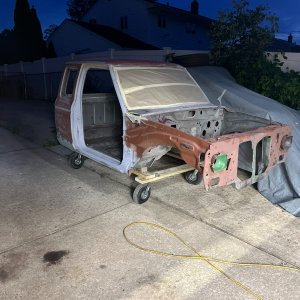
As a further note, this is a "project car" my neighbor and I have been learning on before we move to an '86 that I drove in high school. I would rather make mistakes here and learn from them before moving on to my old one - which I know will take a bit of work as her present body color appears to be "rust, with a bit of original red paint". Yet neither is in immediate need. I just want to get this one done a bit quicker as we might be able to use her as a backup if she can be made to move reliably again.
Man, getting to the head gasket is hard enough! Plus some of the plastic covers just broke due to how brittle the plastic is. We had a similar issue when we replaced the injectors. I've been taking A LOT of pictures with my phone, using quart plastic bags for bolts, trying to keep track of everything....
First problem I found was that the valve cover gasket was broken right where I've seen the most wetness on the block (just off of cylinder 1). There are even parts of the gasket inside the area.
When I reached the head gasket, though, it seemed pretty solid and was hard to break the seal. However, as can be seen in the attached image, one of the valves on cylinder 3 shows either rust of burn. I've included pictures of both the discolored valve and the one that looks normal, as well as both one of the head and the block after removal.
As to behavior prior to this effort, when she was parked and running, we got her to a point where she idles fine. Slowly increasing RPM generally shows the same, although she can seem to misfire periodically. Her engine block gets "wet" while running. At idle, there is very little of that, add RPMs and get her fully warmed up and the block will show it as will the exaust manifold after a while, leading to a little bit of what appears to be that white smoke mentioned above. Even at that point, there isn't a lot of it, which makes the color a little hard to judge. Same with smell. The best I could figure was that the smell was a bit sweet like coolant. No discoloration in the oil or coolant.
The main issue always came when trying to accelerate up a hill. There, she would both lose power, and move to stalling. This is why I believed that the head gasket was partially compromised. Enough so that when the coolant moved to a higher pressure (which I am assuming is the case with higher RPM as the pump moves faster), it would be under enough pressure to move into one or more cylinders and cause the vehicle to run rough, lose power, and move to stall.
Even so, breaking the seal of the head gasket to pull it out may have led to the liquid we are seeing in the pictures. In order to get it clear, I also had to pull it forward. While not clear in the pictures, the pistons themselves all seem intact - although the visible cylinder walls (2 & 3) appear to show some rust inside, possibly as the vehicle has spend significant time sitting. It may be a tell of other damage though. Likewise, the gasket itself appears to have uniform thickness. I don't see anywhere that is worn down.
Based on this, I do believe this is a burnt valve? The damage is affecting the seal leading to low compression in the affected cylinder?
If this is the case, what course of action should I take? Should I replace all the valves and items such as seals, or is there more to look at before getting such items and trying to fix it - such as where the debris I found under the valve cover could have been?
Further, am I wrong in my assessment of the head gasket as having been intact, or it there evidence of water or even oil intrusion as I originally thought?
As a further note, this is a "project car" my neighbor and I have been learning on before we move to an '86 that I drove in high school. I would rather make mistakes here and learn from them before moving on to my old one - which I know will take a bit of work as her present body color appears to be "rust, with a bit of original red paint". Yet neither is in immediate need. I just want to get this one done a bit quicker as we might be able to use her as a backup if she can be made to move reliably again.