
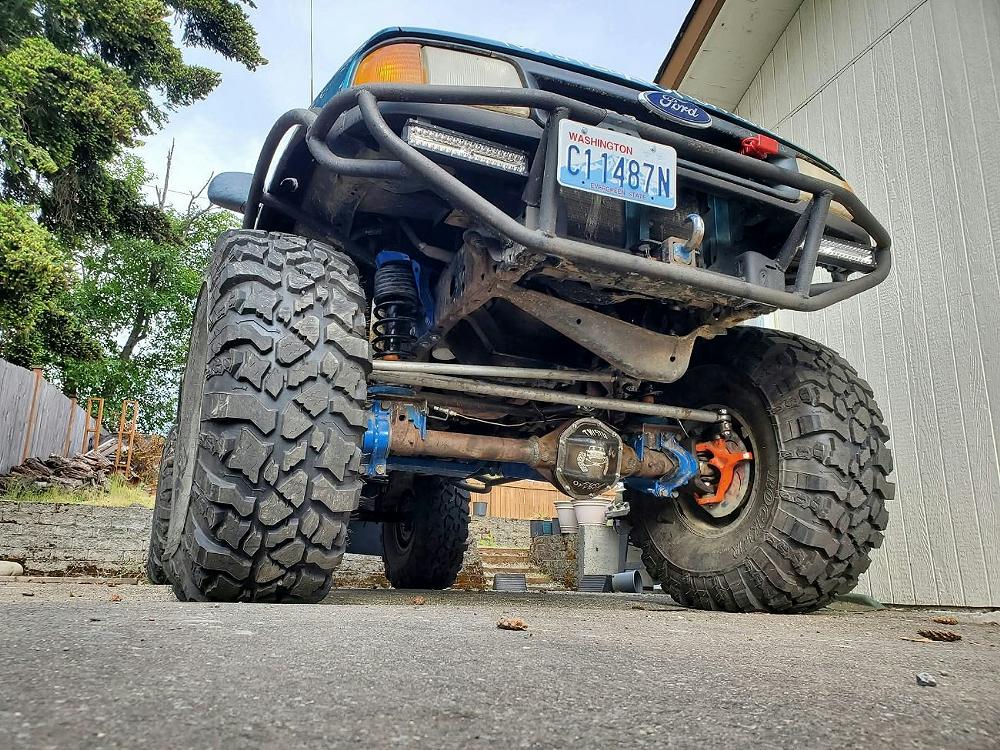
Dana 44 Guide for Ford Ranger Owners
The Dana 44 is one of the most popular front axle upgrades for Ford Ranger and Bronco II owners. Whether you are considering a Dana 44 TTB upgrade, a Dana 35/44 hybrid, or a full solid axle swap (SAS), this guide consolidates decades of technical articles, real-world builds, and fabrication tips to help you choose the right setup for your truck. From strengthening your factory Dana 35 to installing a full Dana 44 from an Early Bronco or full-size Ford, this page will point you to the most relevant resources for your Dana 44 project.
This is not a step-by-step install guide. Instead, it is a roadmap designed to help Ford Ranger owners choose the right Dana 44 solution for their vehicle, driving style, and fabrication skill level.
What Is a Dana 44 and Why Ranger Owners Upgrade
The Dana 44 is a medium-duty axle produced by Dana-Spicer and used in a wide range of Ford, Jeep, and GM vehicles. Compared to the factory Dana 28 or Dana 35 found in many Rangers and Bronco IIs, the Dana 44 offers:
- Larger axle shafts
- Stronger spindles with better wheel bearing spacing
- Stronger locking hubs
- The solid axle provides better articulation than TTB
- Improved aftermarket support
For Ford Ranger owners, the Dana 44 is appealing because it can be used in several different ways. Some upgrades involve adding Dana 44 TTB components to the Dana 35, replacing the Dana 28 or Dana 35 completely with a Dana 44 TTB, or converting the truck to a Dana 44 solid front axle (SAS). Of all of these, the solid axle swap (SAS) is the most popular.
Dana 44 Solid (Live) Axle
Ford started using Dana 44’s under the front of light duty pickups in 1959. Ford began using the high-pinion (reverse rotation) Dana 44 as early as 1966. By 1973, it became the standard configuration for 4×4 F-150 models. The 1971-1977 Ford Bronco used a low-pinion standard rotation Dana 44 and switched to the same reverse rotation Dana 44 used in the F-150 for the 1978-1979 Ford Bronco.
- The 1966-1975 Dana 44’s all had drum brakes
- The 1966-1972 Dana 44’s all had small 5-260 U-joints
- The 1971-1977 Ford Bronco Dana 44’s have small 5-260 U-joints
- The 1971-1975 Ford Bronco Dana 44’s have drum brakes
Check Out:
The Dana 44 TTB
The Dana 44 Twin Traction Beam (TTB) was born from Ford’s desire to revolutionize the 1980s truck market by combining the legendary durability of a solid front axle with the refined ride quality of independent suspension. The system uses two independent, stamped-steel axle beams that pivot near the opposite side of the vehicle’s frame, creating a “scissor-like” action. The driver-side beam houses the Dana 44 differential, while the passenger-side axle shaft passes through a window in the opposite beam. This arrangement is connected by a central universal joint and a slip yoke, allowing the shafts to change length and angle as each wheel moves independently over obstacles. To maintain stability and prevent the wheels from moving forward or backward, radius arms extend from the beams to the frame.
Because the beams are quite long, they allow for a significant amount of vertical wheel travel, which has made them a favorite for high-speed desert racing, though the design does cause the wheel camber to change noticeably as the suspension compresses.
Ford used the Dana 44 TTB configuration under the 1980-1996 Ford F-150s and Broncos.
Check Out:
Dana 35 vs Dana 44 Axle Specifications
The following table compares key specifications between the Dana 35 TTB and Dana 44 TTB commonly used in Ford Ranger upgrades:
| Specification | Dana 35 TTB | Dana 44 TTB |
| Torque Rating lb.-ft | 4,000–4,500 | 6,200 |
| Left Axle Shaft Diameter | 1.16″ | 1.31″ |
| Right Axle Shaft Diameter | 1.36″ | 1.37″ |
| Axle Shaft Splines (to diff) | 27 | 30 |
| Stub Shaft Diameter | 1.16″ | 1.25″ |
| Stub Shaft Splines | 27 | 19 |
| U-Joint (post-1973) | 5-760 / 5-297 | 5-760 / 5-297 |
| Ring Gear Diameter (4.56) | 7.562″ | 8.500″ |
| Ring Gear Bolt Count | 8 | 10 |
| Brake Rotor OD | 11.264″ | 11.713″ |
| WMS-WMS Width (TTB) | ~59.5″ | ~65″ |
| Typical Wheel Bolt Pattern | 5×4.5″ | 5×5.5″ |
Notes
- Axle strength is influenced by spline count and stub shaft diameter, not just shaft diameter.
- The Dana 35 & 44 shafts have a similar diameter (1.36″ vs 1.37″), but the Dana 35 shaft tapers down to 1.16″ diameter with 27 splines at the carrier and the Dana 44 tapers to 1.31″ with 30 splines.
- The Dana 35 and Dana 44 use the same 5-760 U-joints.
- Changing hubs may alter the wheel bolt pattern, requiring matched rear wheels or adapters.
What Makes The Dana 44 Stronger
The components below help make the Dana 44 45% to 50% stronger than the Dana 35:
Larger Ring Gear: The Dana 44 features an 8.5-inch ring gear, providing nearly an inch more surface area than the Dana 35’s 7.62-inch gear, which significantly improves torque capacity.
Beefier Axle Shafts: The Dana 35 and Dana 44 axle shafts are essentially the same diameter (1.36″ vs 1.37″) except that the Dana 44 shaft tapers down slightly to 1.31″ at the differential splines and the Dana 35 shafts taper down from 1.16″ at the differential. The axles are only as strong as the smallest part of the axle (torsional strength).
Reduced Wheel Bearing Stress: Wider spacing acts as a longer lever to counteract side-loading forces. This significantly reduces the radial and thrust loads placed on the individual bearings, leading to increased longevity and reliability, especially in heavy-duty or off-road conditions.
Stronger Locking Hubs: The Dana 44 hub is larger and more robust and uses larger internal components that add to its strength. The larger hub body helps prevent the hub from “bursting” or cracking under extreme loads or when subjected to the side-loading forces common with large off-road tires
Wheel Travel vs Articulation
While the Twin Traction Beam (TTB) is renowned for high-speed desert racing due to its long wheel travel, Ford Ranger owners seeking technical articulation (slow-speed “flex”) often prefer a Solid Axle Swap (SAS). Here is the difference between wheel travel & articulation:
- Wheel Travel (TTB Strength): TTB excels at vertical travel, meaning it can absorb massive bumps at high speeds by moving both wheels up and down significantly.
- Articulation (Solid Axle Strength): In a solid axle setup, when one tire is forced up by a rock, the axle housing acts as a lever, physically forcing the opposite tire down. This mechanical “push” keeps the drooping tire firmly planted against the ground for maximum traction—something the TTB cannot do because its beams are independent.
While desert racers use TTB because they prioritize speed and bump absorption, rock crawlers choose the Dana 44 for its ability to handle high-torque, low-speed stress. The solid Dana 44 offers larger ring gears (8.5″) and stronger axle shafts than the factory Ranger Dana 35 TTB, making it much safer to run 35-inch or larger tires without snapping components.
Why This Matters: Knowing how you’re going to use a Dana 44 will decide which type of Dana 44 you’ll need.
The Dana 35 / Dana 44 Hybrid
The Dana 35 / 44 Hybrid consists of replacing the Dana 35 TTB steering knuckles, outer stub shafts, spindles and hubs with the steering knuckles, outer stub shafts, spindles and hubs from a Dana 44 TTB. This gives you a stronger stub shaft, hubs, and a better wheel bearing spacing than you had on the Dana 35 TTB. The wheel bearings are actually a common failure point on the Dana 35 TTB even though the Dana 35 TTB and Dana 44 TTB use the same wheel bearings. This modification makes the Dana 35 TTB 25% to 30% stronger at the outer shaft.
Limitations: While the upgraded 19-spline outer shafts and larger bearings can technically support the rotating mass of a 36-inch tire, it’s still limited to the torsional strength of the 1.16″ (27-spline) inner axle shaft going in to the carrier and 7.56″ ring gear. For that reason, it is best suited for a 35-inch tire.
How To Do This Swap:
Dana 44 Knuckle – Locking Hub Conversion
Beefing Up The Ford Ranger Dana 35 TTB
Should You Replace A Dana 35 TTB With A Dana 44?
Retain Your Dana 35 TTB Steering Knuckles:
Dana 44 Spindle & Hub On Dana 35 TTB
The Mappyjack Dana 44 Spindle & Hub Conversion
Dana 44 TTB Swap
There is a reason Ford replaced solid axles with independent axles – ride quality. There’s also a reason the TTB suspension finds it’s way in to a lot of high speed off-road race vehicles – wheel travel. The TTB is often chosen over the newer SLA (Short arm Long Arm) suspensions because the long beams are able to provide more wheel travel, dollar for dollar.
The problem that you run into with the Dana 44 swap is that the Dana 44 TTB is 5.5″ wider (65″) than a Dana 35 TTB (59.5″) and the mounting holes where the beams pivot are 2-inches narrower on the Dana 44 TTB than the Dana 35 TTB. That means if you mount the beams in the Dana 35 TTB brackets, the passenger side axle shaft will be too long.
There are four ways to make this swap possible:
Option 1: Mount the beams in the Dana 35 brackets and shorten the passenger axle. This will give you a 63″ width.
Option 2: Drill a new hole in the Dana 35 TTB brackets 1″ inward and mount the beams. This retains the 65″ width and stock axle shafts.
Option 3: Autofab and Giant Motorsports make a bracket kit to mount the Dana 44 TTB into a 1983-1997 Ford Ranger 4×4. Giant Motorsports actually sells this as a complete kit, where Autofab just sells the brackets.
Option 4: Extend the Dana 44 beams 1″ at the pivot end and bolt them into your Ranger’s brackets.
All of these options are going to leave you with a front axle that’s wider than the rear, so plan on swapping to a full width rear axle.
Check Out:
Should You Replace A Dana 35 TTB With A Dana 44?
Dana 44 Solid Axle Swap (SAS)
The Dana 44 is the most popular solid axle swap done on the Ford Ranger with the 1971-1977 Ford Bronco Dana 44 being the most popular axle choice. The reason is that the Early Bronco Dana 44 has a 58″ width which matches the Dana 28 TTB. The problem with these axles is that they have a 5-260 U-joint which is smaller than the Dana 35 TTB, and only the 1976-1977 axles have disc brakes. There are companies that make replacement axles that use the larger 5-760 U-joints.
The other choice is the 1976-1979 F-150 or 1978-1979 Bronco Dana 44. These will give you disc brakes and 5-760 U-joints. The problem you’ll run into with the full-size axle is that the coil spring spacing on the axle is roughly 6.5″ wider than the Ford Ranger coil spring spacing. To overcome this, you need to either move the upper coil bucket further out, move the C-wedges on the axle inward, or a combination of both. Other options include using coil overs which don’t have to sit perfectly vertical like a coil spring does or narrowing the Dana 44.
Both of these axle choices use a radius arm and coil spring setup but will need a trac bar to control lateral (side-to-side) movement of the axle under the vehicle. This will require a custom trac bar mount, or a James Duff trac bar mount.
Speaking of coil overs, you can build a whole custom link suspension with coil overs and not use any stock suspension components, but I suspect if you’re considering that you’re beyond needing any of this information.
Finally, I’ve seen people choose to simply mount the front axle with leaf springs instead of coils.
Check Out:
Can I Make A Dana 44 Stronger?
To maximize the strength of a Dana 44, you must address three primary failure points:
- The housing
- The axle shafts
- The steering geometry.
The most effective approach involves welding on a steel truss to reinforce the tubes and “C” gussets to prevent the knuckles from bending under the leverage of large tires. Internally, replacing factory shafts with 4340 chromoly or RCV constant velocity (CV) shafts can provide a massive jump in torque capacity, often doubling the strength of OEM components. For serious builds, additional upgrades like heavy-duty ball joints, a thick nodular iron differential cover for housing rigidity, and high-quality lockers (e.g., ARB or Ox) are essential to prevent internal mechanical failure during high-stress maneuvers like rock crawling.
Building a Dana 44 has become a highly refined process, but you should expect a shift in the axle’s “weakest link” once it is reinforced. While a fully trussed and “shafted” Dana 44 can reliably handle 37-inch tires on the trail, the increased durability often exposes the limits of the ring and pinion gears, which remain small compared to larger axles. You can expect much higher confidence in high-torque situations, but you should also be prepared for accelerated wear on your vehicle’s steering box and unit bearings due to the added weight and rotational mass. Ultimately, these upgrades turn a standard Dana 44 into a robust mid-range axle that performs significantly better than stock but still requires a “light foot” compared to a one-ton Dana 60 swap.
Frequently Asked Questions About Dana 44 Swaps
Why choose a solid axle Dana 44 instead of a Dana 44 TTB?
In a solid axle setup, when one tire is forced upward by a rock or obstacle, the axle housing acts as a lever and physically pushes the opposite tire downward. This mechanical leverage helps keep the drooping tire firmly planted on the ground, improving traction and stability on uneven terrain. A Dana 44 TTB cannot provide this same effect because its beams operate independently, limiting how much force is transferred to the opposite tire.
Is a solid axle Dana 44 or Dana 44 TTB better for high-speed off-roading or desert racing?
For high-speed off-roading and desert racing, a Dana 44 TTB generally performs better. Twin Traction Beam suspensions excel at vertical wheel travel, allowing each wheel to move up and down through a greater range independently. This ability to absorb large bumps, whoops, and uneven terrain at speed helps maintain control and stability in desert environments, where suspension travel and shock tuning are more critical than maximum articulation.
Will a Dana 44 change my wheel bolt pattern?
It can, depending on which Dana 44 you use. Many Dana 44 axles—especially those from Early Broncos and full-size Ford trucks—use a 5 on 5.5-inch bolt pattern instead of the Ranger’s factory 5 on 4.5-inch pattern. Dana 44 TTB swaps and knuckle conversions may also change the bolt pattern if Dana 44 hubs are used. In some cases, custom hubs or rear axle modifications are required to maintain matching front and rear wheel bolt patterns.
Is a Dana 44 always a solid axle?
No. Ford used the Dana 44 in both TTB and solid axle configurations.
How large of a tire can I run on a Dana 44?
A Dana 44 can safely hand a 35″ tire, and a well-built Dana 44 can handle a 37″ tire, but I’d suggest seriously considering a Dana 60 for a 37″ or larger tire, and definitely for anything over 37″
Do I need a Dana 44 for off-roading?
Not always. Many drivers are better served by upgrading key Dana 35 components depending on their usage.
Need More Inspiration?
Check out our Ford Ranger Solid Axle Swap Featured Vehicles:
Or visit our:
4WD Suspension and Frames Forum
Start Here Before Your Dana 44 Project
If you are planning any Dana 44-related upgrade, this guide should be your starting point. Each linked article goes into greater technical detail, including parts lists, fabrication notes, and real-world experience.
By understanding the different Dana 44 options available for Ford Rangers, you can make informed decisions and avoid costly mistakes before turning the first wrench.
Related Article
1983-2011 Ford Ranger Off-Road Builders Guide
About The Author
Jim Oaks is the founder of TheRangerStation.com, the longest-running Ford Ranger resource online since 1999. With over 25 years of hands-on experience building and modifying Ford Rangers — including magazine-featured builds like Project Transformer — Jim has become one of the most trusted authorities in the Ford Ranger off-road and enthusiast space.
Since launching TheRangerStation.com, Jim has documented thousands of real-world Ranger builds, technical repairs, drivetrain swaps, suspension modifications, and off-road adventures contributed by owners worldwide. TheRangerStation.com has been referenced in print, video and online by enthusiasts, mechanics, and off-road builders looking for practical, and experience-based information.