
What will they do for my motor?
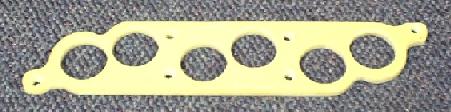
They are used to insulate the upper manifold { Plenum } from the heat of the lower manifold / engine so that the upper manifold { Plenum } will remain cooler.
If the upper intake manifold { Plenum } is cooler, it will transfer less heat to air passing through it. Hence, {For every 7 degrees F you can lower the air temperature 1% horsepower is realized}
50 degree lower air temp = 7.15% more horsepower. 145HP X 7.15% = 10.36 HP increase.
The air going into the cylinders is cooler and denser, resulting in a potentially more powerful air/fuel mixture in the cylinders & a crisper throttle response.
How are they made?
Plenum spacers are usually made from 1/2″ or 3/8″ material. The thicker the spacers are (up to a point, of course) the greater their insulating capacity and the more benefit they will provide.
There is a point of diminishing returns, of course. Check to see if your EGR Tube from the exhaust manifold will be long enough to properly mate up with the EGR Valve located on the Plenum.
If spacers thicker than about 1/2″ are used, the plenum may be raised so high that you could have trouble getting your hood closed.
No matter the thickness of the spacers, you will need bolts of the correct length and two upper intake manifold gaskets.
The spacers can be made by getting an upper intake gasket to use as a template. Use the template to cut out the spacer material. You may want to seriously consider having a shop that works with G10 (phenolic) cut them out for you.
Aluminum can be used as well.
Make sure you use a respirator and work outside. Phenolic is basically fiberglass encased in a plastic resin that can damage your lungs.

About The Author

Jim Oaks is the founder of TheRangerStation.com, the longest-running Ford Ranger resource online since 1999. With over 25 years of hands-on experience building and modifying Ford Rangers — including magazine-featured builds like Project Transformer — Jim has become one of the most trusted authorities in the Ford Ranger off-road and enthusiast space.
Since launching TheRangerStation.com, Jim has documented thousands of real-world Ranger builds, technical repairs, drivetrain swaps, suspension modifications, and off-road adventures contributed by owners worldwide. TheRangerStation.com has been referenced in print, video and online by enthusiasts, mechanics, and off-road builders looking for practical, and experience-based information.