Interesting... there's a parallel 4 link kit incoming as well that he's indicated he's currently working on.
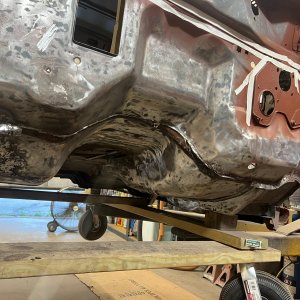
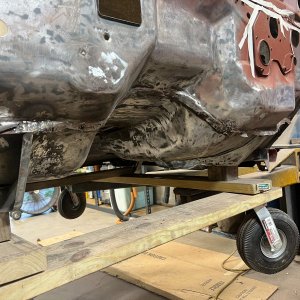
The triangulated 4 link would be better than the parallel, but requires ditching the stock fuel tank. Triangulated alleviates the need for a watts link or panhard bar, but is harder to adjust. Allegedly isn't as good for articulation either (not that you'll be doing much of that), but I see a lot of offroaders building triangulated setups.
Parallel is easier to adjust, but more complex in requiring the additional linkage to control lateral movement of the axle.
If you're like me on the 85 you'd want to keep the stock tank(s). The thing to check into for Rick's incoming kit is if the links are going to be inside or outside the framerail. If inside the rails, then it's no better than a triangulated setup due to losing the tank and requiring the extra hardware.
3 link is better than the current leaf springs and traction bars IMO, and I'm presuming parallel 4 link with a watts is better again. But I'll be honest, I'm in unfamiliar territory here.
I don't think a three link is going to be leaps and bounds better if you are keeping leaves.
It is basically the same thing as traction bars with addition of the extra bar on the top.
I am assuming you are keeping leaves if you don't need a panhard/watts to locate the axle.
The style of 3-link that Rick builds offers the same axle centering ability as a triangulated 4-link, no additional linkage needed. I have seen three links where the upper link only has a single attach point at the frame, that would require an additional linkage unless you triangulated the lower links.
Not much point in doing the work of a link setup if you're going to leave leaf springs. Most likely the fixed mounting to the leafs would create binding if combined with links. I have seen slider setups that replace the spring perch and plates to use with links, but I don't see much point in that when a set of coil overs or air bags will handle any load of a truck build like this and ride/handle better doing it.
I've always wondered why all the pics I see of a watts are vertically oriented. Why not horizontal? Using the right type endlink should work. And easier to attach to the frame. Just a thought.
vertical... horizontal... Are you sure you're thinking about the right thing?
Panhard bar is like the track bar on a 4x4 truck with a solid front axle. Needs to be long as possible to reduce induced lateral movement during suspension travel. That pretty much dictates a horizontal configuration attachiong to the frame on one side and axle on the other.
Watts link is much the same, except that it elimintates the induced lateral movement by using a bellcrank between two links instead of a fixed end at the axle. Still best for the links to be as long as possible/practical for best performance, as it reduces the ammount of travel required by the bellcrank.
That bellcrank pretty much has to be vertical for the watts link to work. If you tried to use a watts link without a bellcrank, effectively a panhard bar to each frame rail, the suspension would bind due to the two links fighting each other. If you made the bellcrank of the watts link horizontal, you'd effectively have the same issue (be similar to a rack and pinion steering). For the bellcrank to be horizontal the links would have to be vertical, but that wouldn't work for centering the axle, and I imagine it would effectively prevent suspension compression. Not to mention if the links were vertical, where would attach the lower one?
That's probably about as clear as mud isn't it?
I've read interesting stuff to that effect as well with watts vs panhard... apparently watts is not always the answer to axle location issues.
IMO, it depends on what you're trying to do.
If rear suspension articulation will be minimal, the panhard bar will do the job while being cheaper, easier, and lighter. The problem with a panhard is when the suspension as a whole will be moving up and down a lot. Think of a squatting drag car, a truck on air bags. Those setups have a lot of suspension movement. Since both ends of the panhard bar are fixed mounts the axle end is going to move through an arc as the suspension moves, pulling the axle off center if it moves a lot. By making the bar as long as possible/practical you reduce the effect. Might result in different handling on left vs right cornering depending on where it's attached, and how much it's articulating.
If the rear suspension is going to be moving a lot, the watts links should be the better choice. Virtually eliminates the lateral movement that the panhard bar induces, which doing the same job of centering the axle. Tradeoff is it's more expensive, more complex, and heavier. For most installations it will also require removing the watts link to service the rear differential, atleast for anything requiring cover removal. If you go this route, I'd definitely invest in a diff cover that has drain and fill provisions. I'd recommend that anyway.