• Welcome Visitor! Please take a few seconds and Register for our forum. Even if you don't want to post, you can still 'Like' and react to posts.

Please settle this question


I won't be surprised if you don't find a solenoid or other type of electrical valve. My '89 has nothing but hard plastic and rubber tubing from the canister to the throttle body, and I am also the original owner. PCV tube is routed to the same area. Some of the years may have had check valves to keep the gas fumes in the canister until the engine was running, but these years didn't have electronic purge valves operated by the computer. One of the photos looks like it could be a vacuum operated valve. I don't have one of those either.

If you still have the emissions sticker on the core support near the hood latch you may may be able to show the emissions tech the vacuum diagram and convince them these early rangers did not have purge valves.

If you have the 1983-1992 Ranger and BII Haynes manual, check out section 6.6. Third paragraph reads as follows. "Vapor trapped in the gas tank is vented through a valve in the top of the tank. From the valve, the vapor is routed through a single line to a charcoal canister located ... near the radiator, where it's stored until the next time the engine is started. When the engine is started, the vapors are routed to the carburetor or FI system, to be burned in the engine." No mention of a purge valve.
 
Last edited:
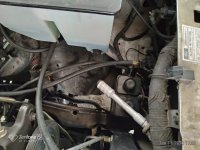
The emissions technician said the failure is confined to the fuel evaporative system anywhere from gas tank to charcoal canister in engine bay.
I visually inspected this entire segment, including top gas tank connection points, and the only thing I found so far was cracks in the rubber fuel tank filler neck.
This means the evap system is leaking. They crimp the hose from the canister to the throttle body, pressurize the tank with a special gas cap and then check if the pressure holds. If it doesn't hold pressure you fail the test. The cracks in the filler tube could be the problem. You can sometimes pinpoint the leak by sniffing through a hose and putting the other end up to the lines and fittings.
 
Thanks Longbed also for your responses

I looked over the fuel evaporative system including the engine bay again today, I addition, I looked under the truck in the area of the fuel tank. I still see no evidence of my truck ever having a vapor canister purge/valve solenoid.

I installed the new fuel tank filler neck today. I'll wait a little bit longer to see if I can rig up some type of low psi
vapor leak test before I replace anything else.

I attached a photo from my engine bay. See that 90 degree turn rubber elbow on top of my vapor canister? I'd like to replace that also due to old age. Any idea where I can buy that?

P_20260111_105037.jpg
 
Just use 2 pieces and plastic elbow like the other line in that picture.
 
I see what you're saying. Use the hard plastic elbow. (not curved elbow)
Both ends are different diameters. Looking online. Didn't find anything yet
 
Last edited:
I broke that plastic elbow while trying to replace the lines on my truck. Had to super glue it together to get the smog check done. It looks like someone has already replaced your evap hoses with fuel line hoses. The evap line is more pliable, probably the same material the elbow tube is made of. I could not find it locally and haven't done a wider search for it yet. You'll probably have a hard time finding non-standard pieces like the two-size plastic elbow. Here's a bunch of Dorman vacuum lines and fittings on Amazon. That might have a replacement for the rubber elbow. You'll have to improvise. My leak was down by the fuel filter where the line changes from flexible tubing (I think the fuel line, return line and the evap line are all one piece) to the hard plastic line that runs into the engine bay. I rigged up something with gas line to join the two without leaking.

I had a thought after sending my posts last night. Did your smog technician know enough to crimp the line to the TB? The way you described the problem as "anywhere from gas tank to charcoal canister" suggest s/he did, but if they didn't because it's not needed when there's a purge valve, that would explain why the system won't hold pressure. My smog tech has these locking pliers that look like sheet metal snips, long handles so it can reach into tight places.
 

Sponsored Ad


Sponsored Ad

Event Coverage

Events TRS Was At This Year

TRS Events

Member & Vendor Upgrades

Become a Supporting Member:

Or a Supporting Vendor:

Recently Featured

Want to see your truck here? Share your photos and details in the forum.

TRS Latest Video

TRS Merch

Follow TRS On Instagram

TRS Ranger Sponsors


Sponsored Ad


Sponsored Ad


Product Suggestions

Back
Top