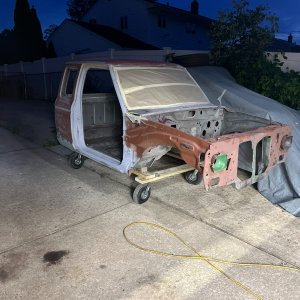
Gather round my children…
@ryan445: How nice is the paint on your vehicle? There is no worry about the magnet mounts blowing off in the wind. My concern with magnet mounts is they invariably attract a little bit of metallic dust and they turn into little sanding pads on the paint on your roof, if you put rubber insulators down.
I’m actually a fan of gutter mounts if your vehicle is old enough to actually have gutters. A couple thoughts. If you hunt around garage sales and Craigslist and such, you can find some of the clamp on roof racks everybody had back in the 60s to put their luggage in Christmas toys up on the roof of their station wagon. It’s basically a bar that sits on two risers that rest in the gutter that look a little bit like a sand pail shovel, and then there’s a flat plate with a hook edge that hooks under the gutter that bolts through that sand pail shovel. If you use some security head bolts, even just Allen head, it’s pretty hard to steal.
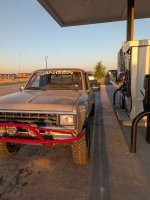
I’m about to do my F250, and I’m going to put a pile of junk up there like I’ve done on my other trucks, but I’m going to fabricate the gutter mounts. If you scratch around, you could find some 1/8 inch Aluminum, whether it’s diamond plate or flat. My favorite for projects like this is to simply buy an old truck bed toolbox. You can find them around here all day long for $30, and it’s actually a ton of Aluminum. Sometimes the corners or the angles and such are just right if you cut them out of the box to do whatever you need to do, like those gutter clips. And you can work Aluminum with woodworking tools very easily.
When making the risers, shape them out with a piece of cardboard first. The assumption that the gutters are straight and level is a bad assumption. Use a piece of cardboard to get the curvature and touch points straight, so the bar across the top will sit level and square to the ground. Slit some vacuum tubing to sit underneath those risers so they don’t grind it into the caulk in the gutters. For my F250, I’m planning on using something that’s probably going to be 12 or 15 inches long along the gutter, but it will only sit on about two or 3 inches in the front or in the back. If you’re just running a single bar it’s not an issue. I’m actually a fan of running double bars, or actually using something that has 4/4 that I can put a flat plate on. But again, I throw a bunch of junk up there, see my build threads. Again, when you make your clamps, use some kind of security bolts, and I always put a touch of E 6000 on the threads so they don’t vibrate loose, even with nylok nuts.
For the cross bars, you can find the roof rack bars from a Hondas or whatever SUV all over the place for little or no money. The beauty of them as they are already completely weatherproof, they’ve got finished ends, they’re usually aluminum so it’s easy to drill holes for whatever you want to mount, and you can hide wires down the center of them if you don’t want to see the wires. You can usually take the plastic ends off pretty easily and then cut them to the length you want and then put them back (with a dab of…). The cross-section is like a squared off letter “C” with the opening facing down. Once you have everything wired the way you want, run your air hoses to the air horns, etc., you can cut some short rectangles of aluminum or even plastic that you can slide into one side and then the other, and pull over to the center to hold the wires up. Once you figure it out, the last time you push the wires up, put a dab of E 6000 on each side where it touches the rail, and it will stay there forever.
If your fabricated risers are more than 2 1/2 or 3 inches tall, I would shape them wider than the side view, and fold down the edges on each side, mostly so they don’t vibrate and get fatigue cracks.
As far as penetrating the roof, after many years, I’m no longer afraid of punching a few holes. Like anything, you just have to plan for it and do it correctly. Most people punch a hole, don’t line up what needs to be bolted down, they stick a little caulk on it, and then they’re surprised when it leaks. I don’t care how solidly you mount “it,” whatever “it“ may be, it’s going to vibrate pretty good in the wind, and will want to break the seal on the mounting points. Soooo…
Whatever is going to be touching the roof on the outside, drill the holes a hair larger than whatever bolt you’re going to use. You don’t want any motion. Or just use larger bolts. Buy or fabricate some super thin fiber or neoprene washers to put under the heads of the bolts. You could get some old-fashioned faucet washers, drill the hole larger, and then sand them down flatter.
Drill the holes in the roof, pretty precisely without any extra room. From underneath use a one inch or larger diameter fender washer, and a nylok nut. The roofs on everything are super thin, so you have to beef up the pinch point No nuts, and lock washers. And do I have to say use stainless steel or brass screws and nuts?
Here’s the critical thing. Between the bracket and the roof of the vehicle, get some high density foam that’s maybe a quarter inch thick. A lot of of the machine tool packaging material is high density foam. The beauty of it is you can cut it up and shape it like a piece of balsa wood with a bandsaw or such. Make a pad that’s maybe 1/8 inch smaller on each side than the foot of your riser, again with the holes drilled fairly precisely. 1/4” thick.
Depending on where you’re going to put it on your roof, you can usually take down the inside molding around the headliner, and reach in from the sides. without having to remove that headliner.. If your truck has a double roof, most do, have a double roof, you can drill a pilot hole from the top down through both layers. Then use a hole saw from the bottom to open a big enough hole for the fender washer and the nut (only through the bottom layer) And you can cut off the bolt so the end of it is in between the two roofs so you don’t have something to stick in your head if you have an accident. If you don’t have a wholesale big enough for the fender washers, instead of using a washer, you can cut a rectangular piece of the aluminum and drill a hole in it, so you can slide it in from one side and then center it, using it to spread the load through the sheet metal. If you don’t have a headliner (my 87 does not have a headliner, and you just see the bottom layer of metal) you can make the bottom holes the right size for some plastic caps like they use around the truck to hide the screws on the interior. And guess what? You can hold them in place with some E 6000 and a piece of masking tape, and then pull the tape off in a few hours.
You may have noticed I’m a fan of E 6000. It’s like the glue version of rust oleum. One of the reasons I like it for anything around a vehicle, is if you want to change anything, you can carefully peel the glue off without damaging any of the paint or finish. On nuts and bolts, you can use it like thread lock. It will keep the nuts and bolts from vibrating loose, but you can easily spin the nuts off the bolts with wrenches.
Assembly: once you put it together and you like the way it is, take it apart one more time,. Maybe with a little artist brush from Hobby lobby, put the E 6000 under the bolt head, under the rubber or fiber washer, all over and under the mounting plate, all over the top and bottom of the high-density foam, on top of the fender washer on the inside, and then tighten the bolt up. You want to mash the high density foam down without tightening it’s so hard that it might cut the vinyl. Depending on how nice your paint is, you may want to use some masking tape and news paper or plastic sheet to keep from getting glue all over the roof. If you do get the E 6000 on the roof, you could buff it off with a dry rag while it’s still gooey, or peel it off when it cures.
Depending on how your gizmos are wired, you may end up isolating the whole bar with this procedure, so you may need to run a ground wire up there or put a separate ground lug somewhere. You could probably put a crimp eyelet with a short wire from a couple of the mounting screws on the backside and inside side. But after you put the E 6000 and bolt it all together, before it all sets, I would check the continuity. I’d do it on at least a couple screws so if one dies, you’ve got a second option. When you check the continuity, maybe use something like an old-fashioned incandescent headlight bulb or backup light bulb so you know you’ve got a very good contact.
If you use current connectors, get the ones made out of the shrink tube, so you can heat them and seal them from the weather.
I’m planning on posting what I build the light and horn and whatever rack on the roof of the F250, but that might be a while. If there’s something specific you’re thinking about, I could maybe scratch up a drawing or take a picture of something I’ve done if that will help.