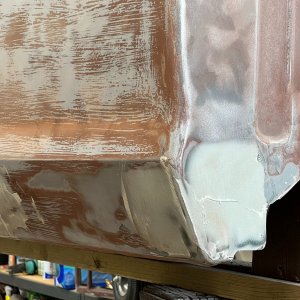
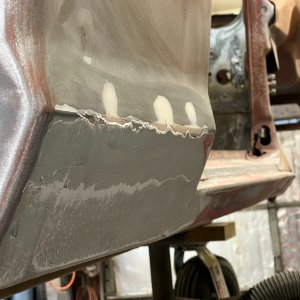
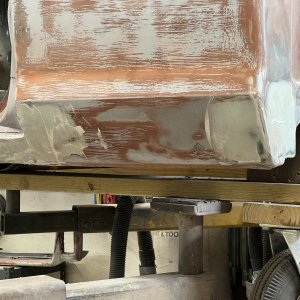
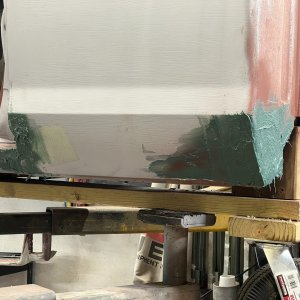
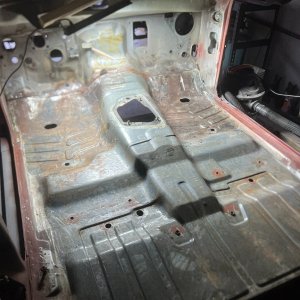
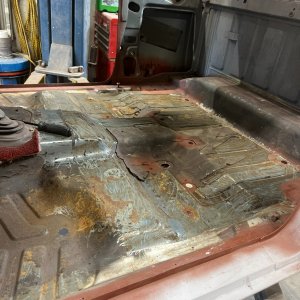
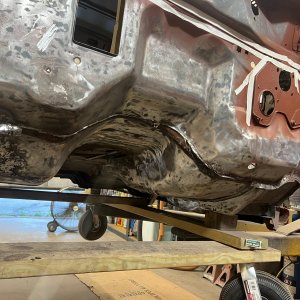
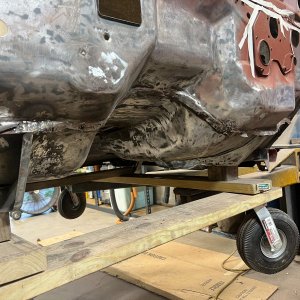
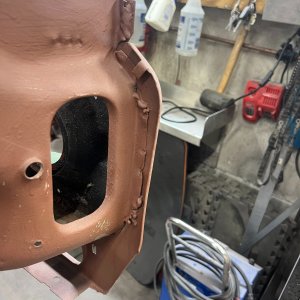
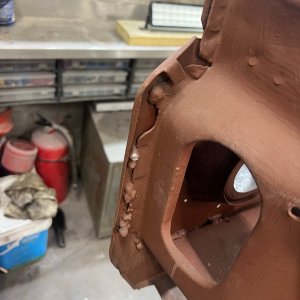
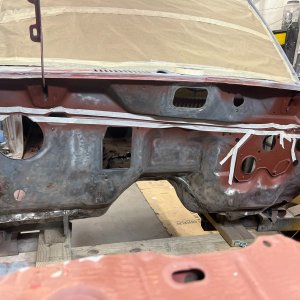
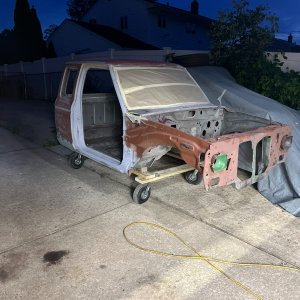
OK, as before I remembered something to write first. Even if you do everything correct, you can still mess up the filler. This is done by allowing it to get wet. Because moisture can travel through the filler using the talc . . you can get surface rust under the filler. This will ultimately cause it to fail. If a shop pushes the vehicle outside for extended time with exposed filler, this can happen. Also, not cleaning bare metal well enough to remove surface rust before any work goes on will cause the same result. Again, not the filler's fault. But there are all things you need to be careful with.
OK, so how to use the filler correctly. Couple basics . . have the surface prepped and ready to receive filler.Clean, sanded, no rust, nothing loose etc,etc.
One that I think is very important . . push it firmly into voids. I always wipe the filler on pushing very hard at first. Almost no filler is left on the panel I am pushing so hard. But what it does is makes sure filler is pressed tightly into all voids so that there are no air pockets. Then come back and apply it normally with the second "wipe" across the area. If you have to add a second coat, make sure the first coat is sanded well for "tooth" again. Filler has two different common colors that the hardener can come in. Those are the typical red and then blue. By alternating the colors, you can tell when you have sanded into another layer much easier. Have a clean and flexible squeege. I like to clean my tools as soon as I am done using the filler. Some will allow it to harden, then remove. But make sure your tools are clean for the next application. I will sand the first coat with a coarse piece of sand paper.I may start with 40 or 50 grit in most places that are more than just a skim coat. I rough into shape with the coarse paper. Coarse paper allows you to flatten the area better. Finer paper will follow the existing shape and not flatten as well. First application, I'm not worried at scratches in the filler, I want to know if the area is flat. The second coat then will be handles slightly different. I may use a different filler, one of my general purpose fillers and I may tint it differently with colored hardener. I will sand with 80 grit feathering more than I did with the 40 grit. After the 80 grit, it should look damn close to be correct. If not, you may have a high spot or other problem. Go back and solve that problem before moving on. If all is well, next step is a light sanding with 120 grit. The shape should be there, you are just getting rid of the 80 grit scratches. This is tricky because you want to stop the 80 grit sanding just a bit early so you still have some filler to sand off with the 120 grit. This is where experience pays off for sure. Now, if you are going to use polyester primer, you are done with the filler process here. Matter of fact, many will stop at the 80 grit when polyester primer is being used. I like to sand my poly primer with 120 grit and a guide coat to see that all is perfectly flat. I finish up my filler sanding or polyester primer sanding with some 180 grit. This is a quick step and it doesn't take much to get the 120 marks out. You should be ready to apply your choice of urethane primer or epoxy primer. More blocking after that and finally ready for paint.
In a nutshell, that's how it's done. Now something I didn't touch earlier. When you have rust to repair, filler is probably going to be used in some manor. But how it is used makes all the difference. If you throw filler in a hole, you will get 6-12 months before something starts to happen negatively. The next step up would be to fiberglass the hole, then smooth it with filler. Again, it will not last permanently, but it's better than just filler. another step better would be adding apiece of metal with rivets or screws etc. Then covering with filler. Again, eventually it will fail. The edge of the metal, not being held as tightly as it needs to be, will eventually crack the filler. Sometimes fiberglass is applied over the edge, this buys a bit more time, but . . you know what's going to happen. Best method is to weld in a new piece of metal. You cut out the rust completely and weld a patch. Hopefully you did it correctly so you do not warp the metal. I pay extra attention to making sure my welds are complete. I do not leave any part not welded. This is difficult to get it all, but it's important to not allow moisture in.I like going a step farther and sealing the welded bead. After grinding, I seal the weld with a urethane primer product. At that point, I know for sure there is no moisture getting through from the backside. I then apply my filler with total confidence that it will live for the lifetime of the vehicle. There is no reason it will fail. We want the filler to be as thin as possible, so the better bodywork you do the less filler is needed. Keep it in the 1/8" thickness range and you will never have a problem.1/4" is considered acceptable, but not what you strive for., You should be able to get your bodywork much closer than that. But it reality, you do have to consider the vehicle you are working on. Is it worth this trouble? Restoring a collector car, yes it is. Straighten out a spot on your '85 Civic that your daughter will be driving . . well you have to make the call.I have seen very thick areas last a long, long time and I can only assume all the steps were done correctly along the way. But typically we want it at about 1/8". I know I did not cover everything or every situation. That would be called a book

But I tried to hit the most common situations and how to do it correctly. I can't over state the importance to good bodywork and not just applying filler to cover everything up. But realize that is where the bad reputation for filler has derived. If you use it correctly, it's as good as everything else on your vehicle.