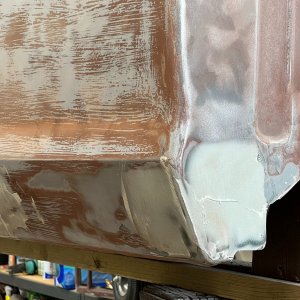
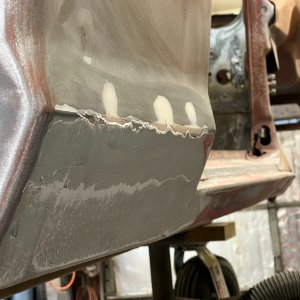
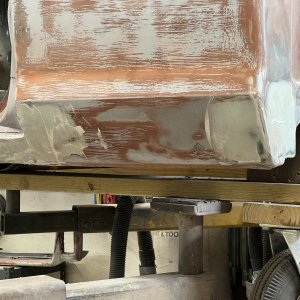
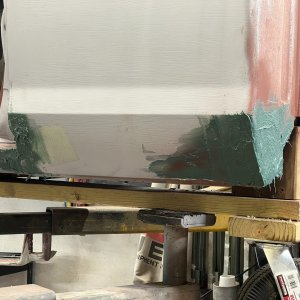
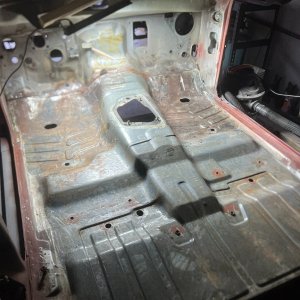
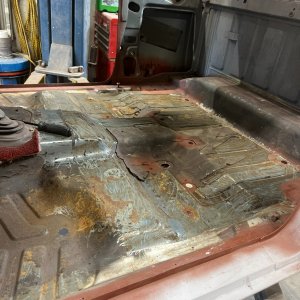
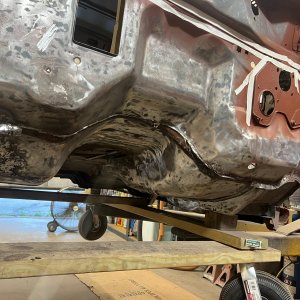
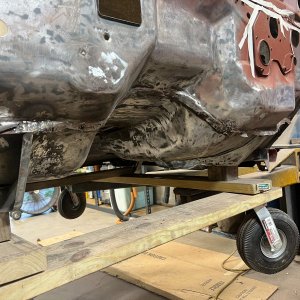
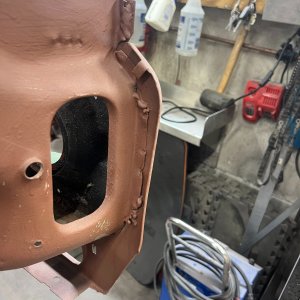
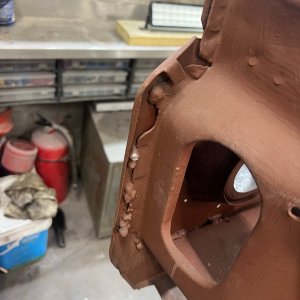
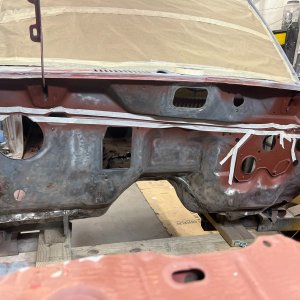
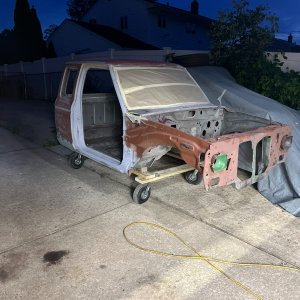
Finally got a Bronco II


No, I refuse to use non-metal stuff on metal components. Every application both self installed and professionally installed Bondo will fail eventually. If you are going to do a restoration either do it properly or don't touch it. I've seen several Bondo restores and the outcome is horrible after a few years.

So since you are a professional, how's this bondo "professionally" applied so it never fails. A professional would know to use the proper tools, equipment, and parts to do a professional job, not play with play-do on someones vehicle.

Even the local body shops where I live will absolutely not use bondo on any of their repairs.
 
Properly applied filler WILL NOT fail and will last as long if not longer than leaded seams. I will not go any longer on the subject to save the rest of the people here from this strife . . but you truly are incorrect. Sorry that you feel "filler" is a bad word. The hillbillies and flash in the pants guys might use it incorrectly, but it is a good material. I have metal working skills that allow me to remove small dents with no filler. And when that is best, thats great. But there are many times with some properly applier filler is needed and is the best choice. And . . ummm, it's used on new cars too, you know . Or maybe you didn't? But I'm done, I don't teach anymore so I shouldn't try to here either.
 
Properly applied filler WILL NOT fail and will last as long if not longer than leaded seams. I will not go any longer on the subject to save the rest of the people here from this strife . . but you truly are incorrect. Sorry that you feel "filler" is a bad word. The hillbillies and flash in the pants guys might use it incorrectly, but it is a good material. I have metal working skills that allow me to remove small dents with no filler. And when that is best, thats great. But there are many times with some properly applier filler is needed and is the best choice. And . . ummm, it's used on new cars too, you know . Or maybe you didn't? But I'm done, I don't teach anymore so I shouldn't try to here either.

I've never been around any body shops, I just see the crap falling off vehicles around town.

How's the stuff work anyhow? Do you mix it up like paint, or is it like a putty that you apply and it just hardens? I've heard there's actually a new bondo product out that you use a mesh type material kind of like patching a hole in a wall, then apply the bondo and the mesh strengthens the repair. All I see are vehicles running around where its falling off, flaking, etc. Is there a special process you have to use? Any videos out there you know of that shows how to use it? Is it something that I could cut out rust areas and fill in? As far as I can tell my Bronco 2 is past being able to easily fill in with Bondo anyhow.

Below is a picture of the worst of my problem. In your opinion is it really something to waste money on bondo, because I've been told to do it, it would take new body panel pieces in those areas, that bondo wouldn't work due to the areas that are affected by the rust.

Finally got a Bronco II
 
You are making such bold statements about filler and you don't know anything about it?? Bill . . . . . . . . . I don't have time right now, but I'll be back to inform you.
 
Sounds to me like you don't have a clue, after asking how it works more than once you can't seem to answer, you can't simply state that which leads me to believe you don't have a clue either. All I know is from first hand seeing the results of bondo falling off, cracking, breaking apart, etc. How the hell would you know if I know anything about it or not? From the results I've seen I won't touch the stuff. And given how you have answered me on this I don't think you have a clue either.
 
How's the stuff work anyhow?
Even the local body shops where I live will absolutely not use bondo on any of their repairs.
Is it something that I could cut out rust areas and fill in?
How the hell would you know if I know anything about it or not?

This is good stuff. Carry on.

a one second search on google.

http://www.youtube.com/watch?v=d70tR5EzV3Y
http://www.youtube.com/watch?v=eygKDon4z7M
http://www.hotrod.com/techarticles/body/hrdp_0805_how_to_use_body_filler/viewall.html
http://www.mig-welding.co.uk/body-filler.htm
http://www.hotrodders.com/articles/basic_bodywork.html
http://autorepair.about.com/od/fixityourself/ss/bondo.htm

"Bondo" isn't made to span huge rusty holes, period. Don't care if you use fibreglas matting, drywall mesh, cardboard or plywood, to span the chasms, it won't work. Cut the rusty shit off and replace with new steel. Or cut the rusty shit off and leave it, or even leave the rusty shit on, just don't use "Bondo" to fill holes.
 
Last edited:
Bill do you have a clue? Jesus! I said I didn't have time and would come back. I really am a busy man . so for anyone else that really wants to learn. And let me start with this, since at least one person here is clueless . . . . I'm 53 years old ( don't know what or who I'm dealing with here). I have run my restoration business for well over 20 years. I have a degree in Industrial Education and have taught Auto, Engineering, and Architecture, among many others ( electricity, machine, wood ) in my 30 years of teaching. I retired to do restoration work only. I place this caveat for Bill who thinks I know nothing.
Filler ( bondo ) is a thermal setting polyester resin product. Once it sets, it cannot revert to it's original state, thus it's thermo setting designation ( as opposed to thermoplastics ). But what is added to the filler is what gives it's personality. Typically it is talc. Talc can be added in different amounts and particle size. So even though most filler are about the same, the recipe may very well be different. Many people have their favorites, as some have more adhesion, some are heavier, some lighter, some sand easier, etc , etc ,etc. Some fillers add "real" metal particles to it. But all in all, not much difference until you know exactly what you are using and what you want to accomplish. Now this polyester resin is the same resin that fiberglass is made with. So whether its a Corvette, or a truck cap, or your bathtub, same polyester resin. Now all plastics are waterproof in the molecular state. But when you inject talc or other "fillers" into the recipe, you are now adding material that may react differently with water. So typical filler will swell from moisture. It isn't the plastic, it's the talc.For that reason, if you expose it to moisture, it will swell, bubble, breakdown, whatever you want to call it. So many times when it is misused, this is exactly what happens to it. People give it a bad name, because it was used incorrectly. Don't blame it, blame the hillbilly who used it incorrectly. You could name thousands of things that used wrongly that will fail. True?? More later, have things to do.
 
How's the stuff work anyhow?
Even the local body shops where I live will absolutely not use bondo on any of their repairs.
Is it something that I could cut out rust areas and fill in?
How the hell would you know if I know anything about it or not?

This is good stuff. Carry on.

a one second search on google.

http://www.youtube.com/watch?v=d70tR5EzV3Y
http://www.youtube.com/watch?v=eygKDon4z7M
http://www.hotrod.com/techarticles/body/hrdp_0805_how_to_use_body_filler/viewall.html
http://www.mig-welding.co.uk/body-filler.htm
http://www.hotrodders.com/articles/basic_bodywork.html
http://autorepair.about.com/od/fixityourself/ss/bondo.htm

"Bondo" isn't made to span huge rusty holes, period. Don't care if you use fibreglas matting, drywall mesh, cardboard or plywood, to span the chasms, it won't work. Cut the rusty shit off and replace with new steel. Or cut the rusty shit off and leave it, or even leave the rusty shit on, just don't use "Bondo" to fill holes.

Thank you, that's all I was trying to get an answer to. Some people can't seem to comprehend that an easy link, or answer is all that was needed instead of telling someone they have no clue, don't know what they're talking about etc. etc. I've seen the aftermath of bondo repairs, it looks like a pre-schooler worked on the car.
 
Bill do you have a clue? Jesus! I said I didn't have time and would come back. I really am a busy man . so for anyone else that really wants to learn. And let me start with this, since at least one person here is clueless . . . . I'm 53 years old ( don't know what or who I'm dealing with here). I have run my restoration business for well over 20 years. I have a degree in Industrial Education and have taught Auto, Engineering, and Architecture, among many others ( electricity, machine, wood ) in my 30 years of teaching. I retired to do restoration work only. I place this caveat for Bill who thinks I know nothing.
Filler ( bondo ) is a thermal setting polyester resin product. Once it sets, it cannot revert to it's original state, thus it's thermo setting designation ( as opposed to thermoplastics ). But what is added to the filler is what gives it's personality. Typically it is talc. Talc can be added in different amounts and particle size. So even though most filler are about the same, the recipe may very well be different. Many people have their favorites, as some have more adhesion, some are heavier, some lighter, some sand easier, etc , etc ,etc. Some fillers add "real" metal particles to it. But all in all, not much difference until you know exactly what you are using and what you want to accomplish. Now this polyester resin is the same resin that fiberglass is made with. So whether its a Corvette, or a truck cap, or your bathtub, same polyester resin. Now all plastics are waterproof in the molecular state. But when you inject talc or other "fillers" into the recipe, you are now adding material that may react differently with water. So typical filler will swell from moisture. It isn't the plastic, it's the talc.For that reason, if you expose it to moisture, it will swell, bubble, breakdown, whatever you want to call it. So many times when it is misused, this is exactly what happens to it. People give it a bad name, because it was used incorrectly. Don't blame it, blame the hillbilly who used it incorrectly. You could name thousands of things that used wrongly that will fail. True?? More later, have things to do.

Wow, while you took 3-4 messages to just answer my simple question leads me to believe you might have read the label on the can. LOL.

So is there something other than bondo that people use for repairs? Sounds to me like there must be because what I see must not be bondo from your explanation of how it works and turns out.

From what I gathered from this post from you and the mod's post I'd be better off with my problem to replace body panels.

Thanks Pete's, sorry for the BS in the past posts just trying to figure out what it is I'm seeing on these repairs, as from your explanation of bondo the chipping, cracking and such shouldn't happen with bondo. You should move to Idaho and teach auto body work, you would laugh at some of the stuff I see running around the Boise area. And, yes you are right I DO NOT HAVE A CLUE when it comes to auto body work, that's why my question was asked about using bondo, and the results I have seen being horrible. Sorry wasn't trying to be an ass to you, sorry if it came out as such. I seriously appreciate all of the advice here and everyone's ability to give a good sense of direction even if not 100% sure.

Thanks again everyone, and sorry to those who I stupidly offended, I was wrong, and I apologize.
 
Last edited:
Now I will add more. I want to say something more about materials before I move on to application. There really are lots of "recipes". And even though you can find many types that are just like others, there are a few different traits. Some of the best fillers for grip or the foundation, are very porous. Therefore, it's good to use another type on top to eliminate the pores. Otherwise you get some holes that either stay there or must be filled in with primer. Its better to fill then in with filler. On the other end of the spectrum as the "creamy" fillers. They are runny in comparison, but are not as porous and are used for skimming the top layer. They usually sand well and leave a nice finish. And then plenty of fillers that are in between. I keep three around, one I like best for the base, one I use for general work and then a creamy one for last. You may not use them all in one situation, but sometimes you do. OK, not something akin to filler but isn't called so . . polyester primer. If you watch car shows on TV, you have seen plenty of it used. It sprays from a paint gun and is called a primer, but chemically it is filler. Some people call it "spray filler". But it goes by many names on the market. It really is a great primer to use. It contains no isocyanates, goes on thick and can cover some otherwise "bad" areas or can make your so-so bodywork actually come out good. It needs to be covered by another primer before painting, but it blocks out easily and very smooth. Many people are able to get a panel straight using polyester primer whereas they could not with typical filler. When you watch Overhaulin or such shows and you see 8 guys sanding a car in the middle of the night to get it ready for paint, it's polyester primer that has been applied and they are sanding. The downside from my point of view is that it is messy. Cleaning the gun is a PITA. I use it when I need it, and I do not when I don't . . just because of the mess.

OK . . . application. So much to write here. Let me hit a few "incorrect" ways to use filler. These are easiest to list . Do not fill in a rust hole with filler. The moisture from the backside, at the least, will cause it to bubble and fail. Do not apply it over tape, that is covering a hole. It will eventually fail. If you use screen to fill the hole, then apply filler, it will eventually fail.So basically, it isn't to fill holes, especially where moisture will get to the backside. Next, do not apply it over rust. The rust will cause the adhesion to fail and the filler will lift off or crack. If it cracks, it will crack the paint as well. Then just adds more moisture into the mess and it doesn't get any better. Don't apply filler over unsanded areas. It is best when a "tooth" is there for it to have more surface area to adhere. Tooth is the word meaning scratches. It needs some good scratches. Filler likes good clean metal, but will adhere to primer if the primer is scratched up. This is useful when doing final blocking and you find some slight depressions or low spots. I like using epoxy primer and filler works well with epoxy. Many people will shoot polyester primer when there are low spots, but remember that poly primer is just filler. No real difference except the application. All these things to avoid, I see all the time. When working on old cars, you see all this "mistakes". Whether they were done by an owner that didn't know better of a shop just doing a "quickie" and could care less . . you see them. And this is why people think badly of filler. When it's done correctly, you never know it there. So then how can you applaud it?? That's my point, it is used all the time, even on new cars. You don't even know it's there. I have filler on a car I have owned for 37 years. You wouldn't know it's there. So I guess that brings us to the correct way to use it. Well that will be for the next installment . . time for me to play. :icon_bounceblue:
 
Thanks for the info you've provided so far. Definitely something that I won't be able to use on my issue, but good to know for the small stuff later on in the bronco 2 restore.
 
Went out today and bought a replacement tailgate for the B2 (from an '89) from a guy on craigslist. Didn't really need it, but it was 20 bucks and figured it could come in handy later for parts or for a wholesale replacement if something goes awry.

Also went to the scrap yard and ripped off some tailgate latches, striker plates, and handles from first-gen Explorers. Plan to do the tailgate handle swap and change out the latches too. Tailgate isn't latching tightly....I've adjusted both strikers to all possible configurations and nothing is helping, so I think the latches might be at fault. The handle assembly is shot....I did the fix listed in the tech library (shimming the handle assembly so it is longer) and it didn't help. The bigger more robust Exploder handle will serve me better I think.

Once I pay down some credit card expenses in the next week, next phase is front end parts. Going to begin with upper and lower balljoints, new wheel bearings and a brake job. Probably will end up getting new various seals and whatnot too. Then comes a new muffler and tailpipe. After that I'll feel a lot more confident in taking this baby out and about.
 
OK, as before I remembered something to write first. Even if you do everything correct, you can still mess up the filler. This is done by allowing it to get wet. Because moisture can travel through the filler using the talc . . you can get surface rust under the filler. This will ultimately cause it to fail. If a shop pushes the vehicle outside for extended time with exposed filler, this can happen. Also, not cleaning bare metal well enough to remove surface rust before any work goes on will cause the same result. Again, not the filler's fault. But there are all things you need to be careful with.

OK, so how to use the filler correctly. Couple basics . . have the surface prepped and ready to receive filler.Clean, sanded, no rust, nothing loose etc,etc.
One that I think is very important . . push it firmly into voids. I always wipe the filler on pushing very hard at first. Almost no filler is left on the panel I am pushing so hard. But what it does is makes sure filler is pressed tightly into all voids so that there are no air pockets. Then come back and apply it normally with the second "wipe" across the area. If you have to add a second coat, make sure the first coat is sanded well for "tooth" again. Filler has two different common colors that the hardener can come in. Those are the typical red and then blue. By alternating the colors, you can tell when you have sanded into another layer much easier. Have a clean and flexible squeege. I like to clean my tools as soon as I am done using the filler. Some will allow it to harden, then remove. But make sure your tools are clean for the next application. I will sand the first coat with a coarse piece of sand paper.I may start with 40 or 50 grit in most places that are more than just a skim coat. I rough into shape with the coarse paper. Coarse paper allows you to flatten the area better. Finer paper will follow the existing shape and not flatten as well. First application, I'm not worried at scratches in the filler, I want to know if the area is flat. The second coat then will be handles slightly different. I may use a different filler, one of my general purpose fillers and I may tint it differently with colored hardener. I will sand with 80 grit feathering more than I did with the 40 grit. After the 80 grit, it should look damn close to be correct. If not, you may have a high spot or other problem. Go back and solve that problem before moving on. If all is well, next step is a light sanding with 120 grit. The shape should be there, you are just getting rid of the 80 grit scratches. This is tricky because you want to stop the 80 grit sanding just a bit early so you still have some filler to sand off with the 120 grit. This is where experience pays off for sure. Now, if you are going to use polyester primer, you are done with the filler process here. Matter of fact, many will stop at the 80 grit when polyester primer is being used. I like to sand my poly primer with 120 grit and a guide coat to see that all is perfectly flat. I finish up my filler sanding or polyester primer sanding with some 180 grit. This is a quick step and it doesn't take much to get the 120 marks out. You should be ready to apply your choice of urethane primer or epoxy primer. More blocking after that and finally ready for paint.

In a nutshell, that's how it's done. Now something I didn't touch earlier. When you have rust to repair, filler is probably going to be used in some manor. But how it is used makes all the difference. If you throw filler in a hole, you will get 6-12 months before something starts to happen negatively. The next step up would be to fiberglass the hole, then smooth it with filler. Again, it will not last permanently, but it's better than just filler. another step better would be adding apiece of metal with rivets or screws etc. Then covering with filler. Again, eventually it will fail. The edge of the metal, not being held as tightly as it needs to be, will eventually crack the filler. Sometimes fiberglass is applied over the edge, this buys a bit more time, but . . you know what's going to happen. Best method is to weld in a new piece of metal. You cut out the rust completely and weld a patch. Hopefully you did it correctly so you do not warp the metal. I pay extra attention to making sure my welds are complete. I do not leave any part not welded. This is difficult to get it all, but it's important to not allow moisture in.I like going a step farther and sealing the welded bead. After grinding, I seal the weld with a urethane primer product. At that point, I know for sure there is no moisture getting through from the backside. I then apply my filler with total confidence that it will live for the lifetime of the vehicle. There is no reason it will fail. We want the filler to be as thin as possible, so the better bodywork you do the less filler is needed. Keep it in the 1/8" thickness range and you will never have a problem.1/4" is considered acceptable, but not what you strive for., You should be able to get your bodywork much closer than that. But it reality, you do have to consider the vehicle you are working on. Is it worth this trouble? Restoring a collector car, yes it is. Straighten out a spot on your '85 Civic that your daughter will be driving . . well you have to make the call.I have seen very thick areas last a long, long time and I can only assume all the steps were done correctly along the way. But typically we want it at about 1/8". I know I did not cover everything or every situation. That would be called a book :) But I tried to hit the most common situations and how to do it correctly. I can't over state the importance to good bodywork and not just applying filler to cover everything up. But realize that is where the bad reputation for filler has derived. If you use it correctly, it's as good as everything else on your vehicle.

 
Last edited:
Thank you Petes for your great explanation on Body Filler (Bondo). Watched a few videos that the Admin posted earlier which makes the body filler make sense now, apparently the repairs I'm seeing are rednecks who obviously didn't read the instructions and don't have a clue like myself LOL. Summer time would be a great time for me to use body filler I wouldn't have to worry about moisture problems at all as the humidity here in Idaho is so low in the summer.
 
or just someone that knows better and doesn't give a damn . . IE: flipping a used vehicle :)
 

Sponsored Ad

TRS Events & Gatherings

Latest posts

Featured Rangers

Want to see your truck here? Share your photos and details in the forum.

TRS Latest Video

Official TRS Merchandise

Follow TRS On Instagram


Product Suggestions

Back
Top