
Introduction
You can improve breaking by increasing the flow of the brake fluid to the brakes. If you’ve swapped to rear discs you may have found that your stock master cylinder doesn’t flow enough fluid to enable your brakes to work. This article discusses swapping to a Ford F-350 brake master cylinder for increased fluid flow.
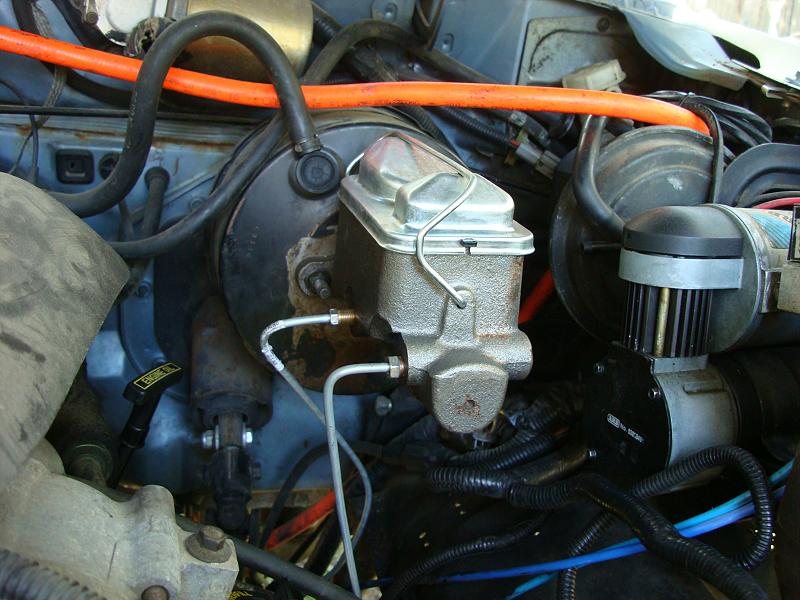
Comparing Master Cylinders
Some Ford Ranger owners have installed the 1985 Ford F-350 master cylinder (Dorman M39445) on their earlier Ranger’s. The stock Ranger master cylinder is on the left, and the F-350 master cylinder is on the right.
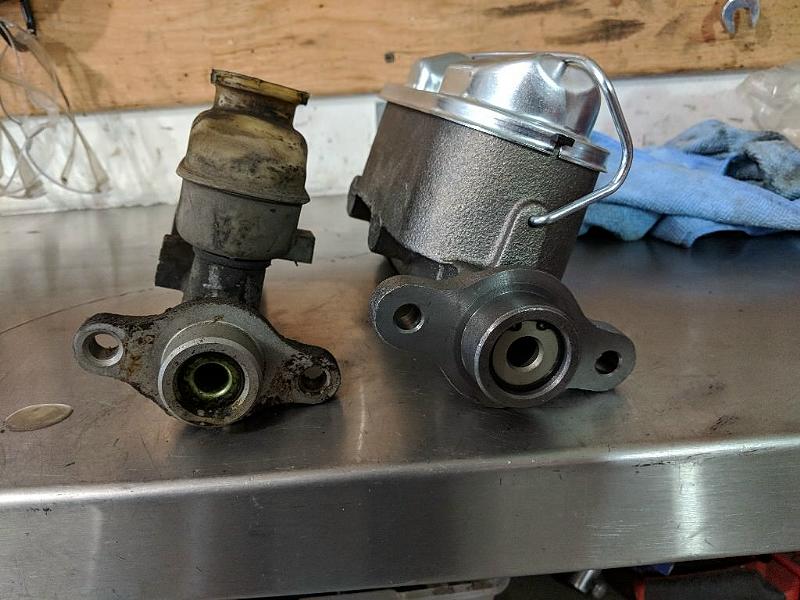
The stock master cylinder has a 7/8 inch piston, and the F-350 master cylinder has a 1-1/8 inch piston. The mounting bolts on the Ford Ranger’s booster are actually spaced 1/8 inch wider than the F-350, so you’ll have to use a carbide bit in an electric drill to widen the mounting hole a little on the F-350 master cylinder.
Connecting / Adapting The Brake Lines:
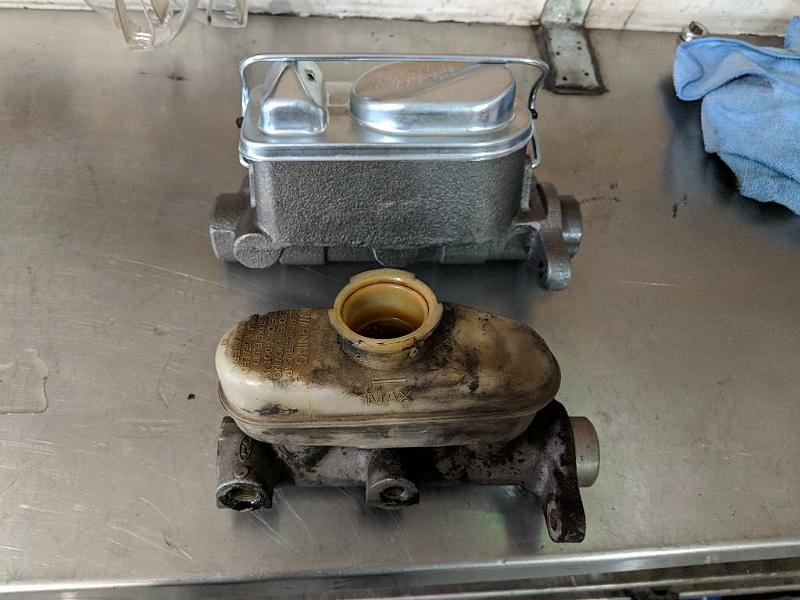
One of the important things to note is that the rear reservoir on the F-350 master cylinder goes to the rear brakes, and the front reservoir goes to the front brakes. It’s opposite on the Ranger. Make sure when you connect your brake lines to the new master cylinder that you’re connecting the correct line to the correct port.
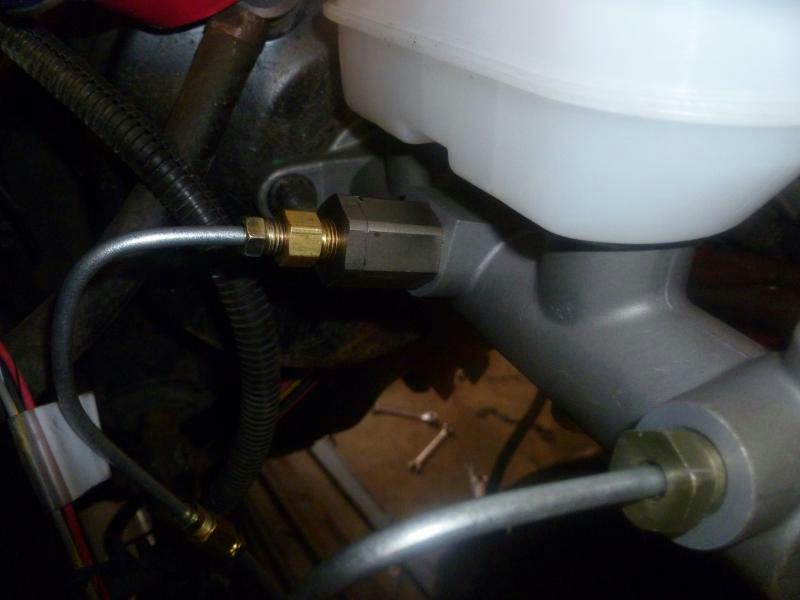
You’ll likely need an adapter so that your brake line fittings will connect to the F-350 master cylinder.
The 1985 Ford F-350 master cylinder is listed as having:
- Port 1 Thread Size (Forward) (In): 7/16-24 Inch
- Port 2 Thread Size (In): 3/8-24 Inch
A 1988 Ranger / 1996 Ranger (checked random year range span):
- Port 1 Thread Size (Forward) (In): 9/16-18 Inch
- Port 2 Thread Size (In): 7/16-24 Inch
The Ranger Port 2 needs to go to the F-350 Port 1 which should both be 7/16-24 inch
The Ranger Port 1 is 9/16-18 inch and has to go to the F-350 Port 2 which is 3/8-24 inch. Therefore, you need an adapter to take the 9/16-18 inch male thread and install it into a 3/8-24 inch female thread.
Dorman 490-543.1 (3/16 In. Female to 9/16-18 Male Inverted Flare Dual Brake Line Adapter) should do the job.
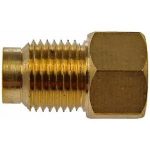
When installed, it would look similar to this:
It’s also important to note that all the master cylinder does is push fluid. The proportioning valve (on the frame) is what determines how much fluid goes where.
Also, if you do this swap and your brakes feel squishy, it’s likely because you have the wrong brake lines hooked to the wrong port. If you look at the F-350 master cylinder, you can see that the rear port is much larger than the front port.
Links:
Ford F-350 Master Cylinder Swap Discussion #1
Ford F-350 Master Cylinder Swap Discussion #2
Related Articles
About The Author

Jim Oaks is the founder of TheRangerStation.com, the longest-running Ford Ranger resource online since 1999. With over 25 years of hands-on experience building and modifying Ford Rangers — including magazine-featured builds like Project Transformer — Jim has become one of the most trusted authorities in the Ford Ranger off-road and enthusiast space.
Since launching TheRangerStation.com, Jim has documented thousands of real-world Ranger builds, technical repairs, drivetrain swaps, suspension modifications, and off-road adventures contributed by owners worldwide. TheRangerStation.com has been referenced in print, video and online by enthusiasts, mechanics, and off-road builders looking for practical, and experience-based information.