
How to Identify a Dana Spicer Axle: BOM Numbers, Model Tags, and Vehicle Applications
Identifying a Dana Spicer axle correctly is essential for repairs, upgrades, or replacement parts. Every Spicer axle carries a combination of Bill of Material (BOM) numbers, model numbers, and axle tags that tell you exactly what you have and what vehicle it came from. This guide explains where to find these identifiers, how to read them, and which resources to use for cross-referencing your Dana axles.
Where to Find Dana Spicer Axle Identification Numbers
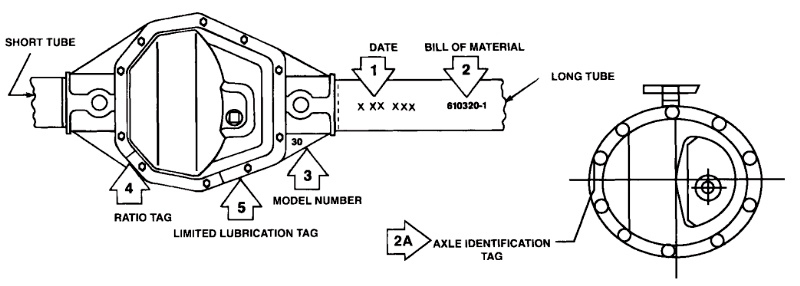
All Spicer Carrier Type axles are identified with a manufacturing date (1) and Bill of Material number (2) stamped on the right or left hand tube on driving axles. The Bill of Material number may also be found on the carrier in some models as shown in illustration (2A). For independent front suspension (IFS) axles, the B/M number may be located at one of three locations:
- A vertically positioned tag near the center of the right-hand side support arm
- Stamped into the left-hand side support arm (opposite end of the camber adjuster)
- Stamped into the “nose end” of the axle carrier
The location of the information will depend on the manufacturing date of the axle. The axle model number will be cast into one of the webs as shown (3), or it can be on the nose. Each axle also contains a gear ratio tag (4), and if equipped with a limited slip differential, it will have a tag specifying the type of limited slip lubricant to be used (5).
Refer to the appropriate model number section for parts identification and a breakdown of the Bill of Material. Please note that we no longer list BOM numbers here, as there are too many variations to include.
All Spicer Carrier Type axles are identified with a manufacturing date (1) and Bill of Material number (2) stamped on the right- or left-hand tube on driving axles. The Bill of Material number may also be found on the carrier in some models as shown in illustration (2A). For independent front suspension (IFS) axles, the B/M number may be located at one of three locations: 1). A vertically positioned tag near the center of the right-hand side support arm, 2) stamped into the left-hand side support arm (opposite end of the camber adjuster), or 3) stamped into the “nose end” of the axle carrier. The location of the information will depend on the manufacturing date of the axle.
The axle model number will be cast into one of the webs as shown (3), or it can be on the nose.
Each axle contains a gear ratio tag (4), and if the axle is equipped with a limited slip differential, it will have a tag specifying the type of limited slip lubricant to be used (5).
Refer to the appropriate model number section for parts identification and a breakdown of the Bill of Material.
Looking Up BOM (Bill of Material) Numbers
You can look them up in these documents:
1967-1978 Dana Axles – Look up BOM numbers under specific axles
1978-1998 Dana Axles – BOM numbers start on pdf page #9
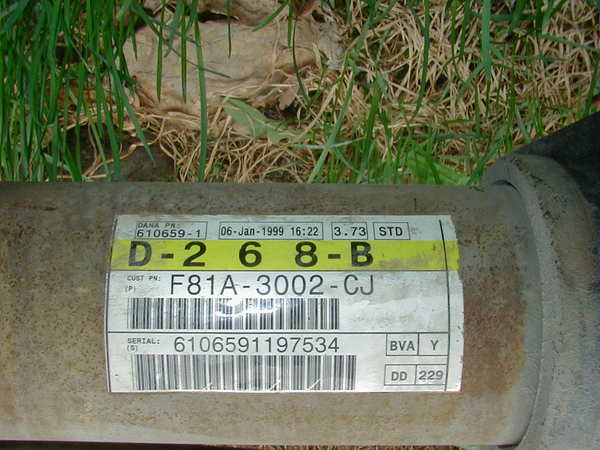
Looking at the axle sticker, we see on the top left Dana P/N 610659-1. If we go to 1978-1998 Dana Axles – BOM numbers, we see that this axle is from a Ford F250/350 SRW (Single Rear Wheel – Non-Dually) 4×4.
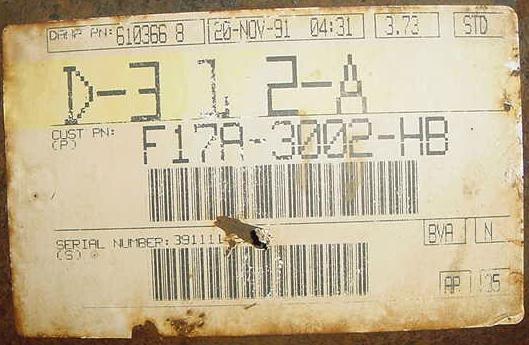
The number on the top left of this sticker in 610366-8. Using the same method to look up this number, we find that it is a Dana 35 from a Ford Explorer.
Axle Tags & Door Stickers
You can also identify axles by their axle tags and the sticker in the door jamb of the vehicle it came from. Check out: Ford 7.5 & 8.8 Inch Axle Tag & Door Codes
Resources
Ford Ranger / Bronco II / Explorer BOM Numbers
1967-1978 Dana Axles – Look up BOM numbers under specific axles
1978-1998 Dana Axles – BOM numbers start on pdf page #9
Last Updated:
About The Author
Jim Oaks is the founder of TheRangerStation.com, the longest-running Ford Ranger resource online since 1999. With over 25 years of hands-on experience building and modifying Ford Rangers — including magazine-featured builds like Project Transformer — Jim has become one of the most trusted authorities in the Ford Ranger off-road and enthusiast space.
Since launching TheRangerStation.com, Jim has documented thousands of real-world Ranger builds, technical repairs, drivetrain swaps, suspension modifications, and off-road adventures contributed by owners worldwide. TheRangerStation.com has been referenced in print, video and online by enthusiasts, mechanics, and off-road builders looking for practical, and experience-based information.